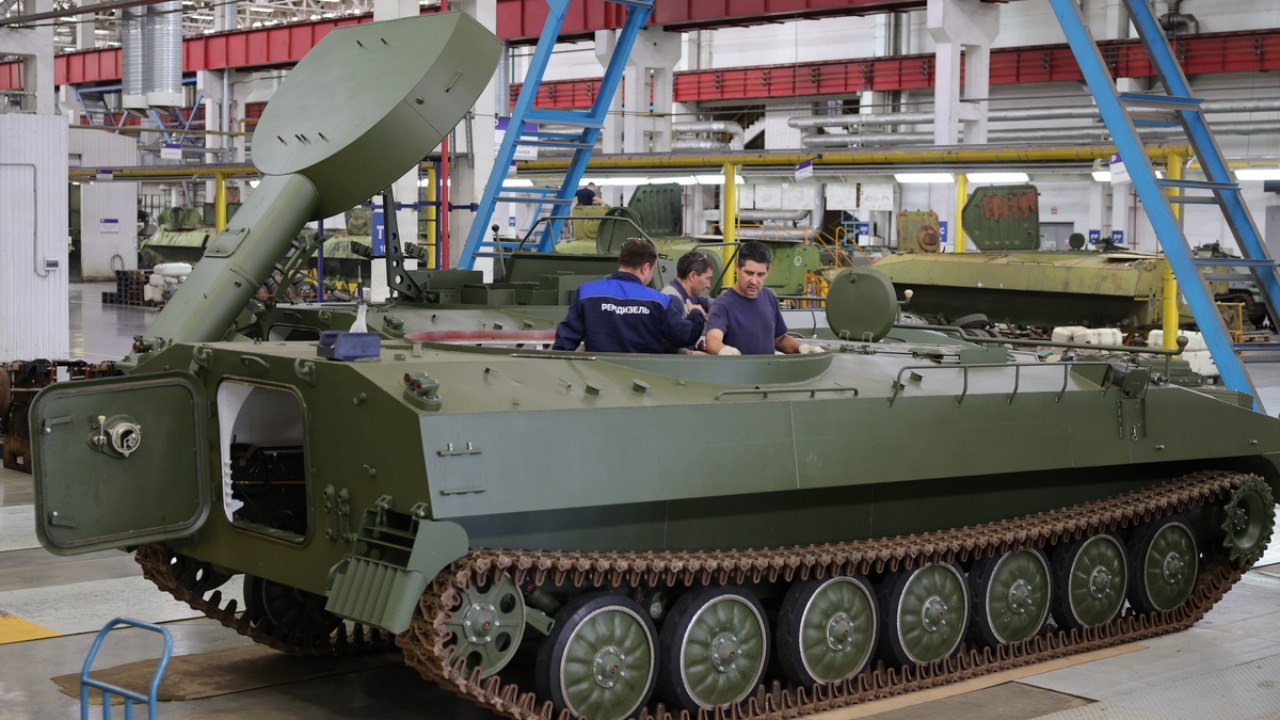

Russia has spent decades perfecting a class of armored vehicle built not to capture ground, but to erase it. Designed to blast paths through minefields, these machines carry enough explosives to pulverize buildings, shred fortifications, and turn a city block into rubble in a single, deafening salvo. On modern urban battlefields, they have become a brutal tool for clearing streets at the cost of everything that once stood there.
When I look at how these vehicles have been used from eastern Ukraine to earlier conflicts, I see more than a niche engineering solution. I see a doctrine that treats dense neighborhoods as disposable obstacles, one that fuses Soviet-era firepower with contemporary urban warfare and leaves civilians, infrastructure, and even friendly troops living in the shadow of weapons that can flatten entire streets in seconds.
Meet the UR-77, Russia’s “city block eraser”
The specific Russian vehicle that embodies this destructive concept is the UR-77 Meteorit, a tracked armored mine-clearing system that rides on a chassis derived from the 2S1 Gvozdika howitzer. Instead of a conventional gun, it carries two long rocket-propelled explosive line charges, each packed with enough high explosive to rip open a corridor through a dense minefield. In practice, that concentrated blast does not just neutralize buried mines, it can demolish nearby buildings, collapse walls, and strip the facades off entire rows of structures in a single detonation.
In urban fighting, the UR-77 has earned a reputation as a “city block eraser” because its line charges, when fired down a street or across a courtyard, can level most of what stands in their path. Russian units have used this capability not only to clear suspected mine belts, but also to obliterate defensive positions embedded in apartment blocks or industrial zones. The result is a weapon that blurs the line between engineering support and area bombardment, turning the task of mine-clearing into an act of wholesale urban destruction.
From minefields to main streets: how the UR-77 works
At its core, the UR-77 is an Armored Mine-Clearer, a vehicle built to survive on the front line while deploying explosive charges that would kill unprotected troops. The crew drives the vehicle into position, usually behind cover, then elevates a launcher that fires a rocket trailing a long hose packed with explosives. Once the hose lands across the target area, the crew detonates it, creating a massive linear blast that triggers or destroys mines along its length and carves a path wide enough for vehicles to pass.
On open ground, that blast is already extreme, but in a city it becomes catastrophic. When the line charge is fired down a narrow street, the shock wave reflects off walls, amplifying the overpressure and shredding nearby structures. Reports on Armored Mine Clearers Can Blast Entire Streets describe how these detonations have flattened entire city streets, a consequence of using a weapon designed for open minefields inside dense urban grids. The same engineering logic that makes the UR-77 efficient against mines makes it devastating against concrete, brick, and steel.
Rubishna and the urban battlefield
The Ukrainian city of Rubishna illustrates how this kind of vehicle reshapes urban combat. Since the early spring of 2022, Rubishna has been a key Ukrainian stronghold, holding out against Russian attackers who have thrown artillery, armor, and specialized engineering vehicles into the fight. In that environment, a system like the UR-77 is not just a support asset, it is a tool for smashing through hardened defensive belts that run through residential blocks and industrial compounds.
Footage and analysis of the fighting around Rubishna show how Russian forces have used heavy explosive systems to batter Ukrainian positions embedded in city blocks, reducing entire neighborhoods to rubble in order to dislodge defenders. One detailed look at the battle, often referred to as The Russian City Block Eraser, highlights how Apr offensives around this Ukrainian city turned once-livable streets into cratered wastelands. In that context, the UR-77’s ability to clear a swath through buildings and fortifications in a single blast becomes a grimly efficient way to advance, even as it obliterates the very terrain being fought over.
Why Russia built such extreme mine-clearing vehicles
To understand why Russia fields a vehicle that can flatten a city block, I have to go back to Soviet doctrine and its deep fear of minefields. Soviet planners expected NATO and other adversaries to seed vast belts of anti-tank and anti-personnel mines across likely avenues of advance. Their answer was to invest heavily in Armored Mine Clearers that could keep mechanized formations moving at speed, even through dense obstacles. The UR-77 is a direct descendant of that thinking, a system built to punch a hole through almost any barrier that might slow an armored thrust.
Over time, that doctrine has collided with the reality of modern urban warfare, where front lines run through cities rather than open plains. Instead of clearing mines in fields, the UR-77 now fires its charges into streets lined with apartment blocks, warehouses, and shops. The same explosive power that once carved safe lanes through mine belts now doubles as a crude but effective method of demolishing urban defenses. When reports note that Armored Mine Clearers Can Blast Entire Streets and that They have Done It Before, they are describing a predictable outcome of pairing Soviet-era engineering solutions with contemporary city fighting.
From engineering tool to terror weapon
On paper, the UR-77 is an engineering asset, a specialized vehicle meant to protect troops from mines. In practice, its use in cities turns it into something closer to a terror weapon. When a single detonation can strip the front off multiple buildings, collapse basements, and send shrapnel and debris flying hundreds of meters, civilians and soldiers alike experience it less as a technical tool and more as a blunt instrument of intimidation. The psychological effect of seeing an entire street vanish in a cloud of dust and flame is hard to overstate.
In battles like those around Rubishna, Ukrainian defenders have had to contend not only with artillery and airstrikes, but also with the knowledge that a UR-77 could be rolled up to the edge of their sector and used to erase their positions in one blast. That threat shapes how units dig in, where they choose to place strongpoints, and how quickly they must relocate after being spotted. It also raises the stakes for civilians who remain in contested areas, since any building that might conceal a firing position can be treated as expendable once an Armored Mine Clearer is brought forward.
The tactical logic behind leveling streets
From a purely tactical perspective, there is a grim logic to using a UR-77 in a city. Urban defenders rely on cover, concealment, and layered positions inside buildings to offset an attacker’s numerical or firepower advantage. By detonating a line charge down a street, Russian forces can strip away that cover in seconds, exposing trenches, firing points, and movement routes that would otherwise be hidden. The blast can also clear rubble and obstacles that might block armored vehicles, turning a cluttered street into a passable corridor.
However, that same blast destroys potential shelter for civilians and friendly troops, and it can create new hazards like unstable structures and unexploded ordnance. In Rubishna and similar cities, the use of such heavy explosive engineering systems has left behind blocks that are not just ruined, but structurally unsafe and littered with debris. The short-term gain of opening a path or collapsing a strongpoint comes at the cost of making the area nearly uninhabitable, a trade-off that reflects a willingness to sacrifice urban infrastructure for marginal tactical advantages.
Urban destruction as a feature, not a bug
When I look at how often Armored Mine Clearers have been used to flatten streets, it is hard to treat the resulting destruction as an accident. The ability to erase a city block is increasingly baked into Russian tactics, not just a side effect of mine-clearing. In sieges and assaults, these vehicles are brought forward as part of deliberate efforts to grind down defenses through overwhelming firepower, even when that means obliterating civilian neighborhoods that once housed the very population Russia claims to be protecting.
This pattern fits a broader approach to urban warfare that prioritizes attrition over precision. Instead of painstakingly isolating and clearing individual buildings, Russian units often rely on heavy explosives to reduce entire sectors, then move through the ruins. The UR-77 and similar systems are ideal tools for that method, since they can deliver a concentrated blast that does the work of multiple artillery strikes in a single shot. When sources describe how Armored Mine Clearers Can Blast Entire Streets and emphasize that They have Done It Before, they are capturing a recurring choice to treat urban destruction as an acceptable, even desirable, outcome.
What Rubishna reveals about future city fights
The battle for Rubishna offers a glimpse of how future urban conflicts might unfold when both sides field heavy engineering vehicles and large stocks of explosives. As Ukrainian forces dug into this key city and Russian units tried to dislodge them, the presence of systems like the UR-77 turned certain neighborhoods into kill zones where any movement risked drawing a catastrophic blast. That dynamic forced defenders to adapt, dispersing positions, using deeper cellars, and relying on mobility rather than static strongpoints that could be targeted for demolition.
For civilians, the implications are even more dire. When a single vehicle can level an entire city block, evacuation becomes not just a humanitarian priority but a matter of survival. Infrastructure that might have been damaged but repairable under conventional shelling is instead obliterated, leaving little to rebuild once the fighting stops. Rubishna’s experience, captured in detailed looks at The Russian City Block Eraser and the broader pattern of Armored Mine Clearers that Can Blast Entire Streets, suggests that any city caught between mechanized armies will face not just sporadic damage, but the risk of systematic erasure whenever these vehicles roll into view.
More from MorningOverview