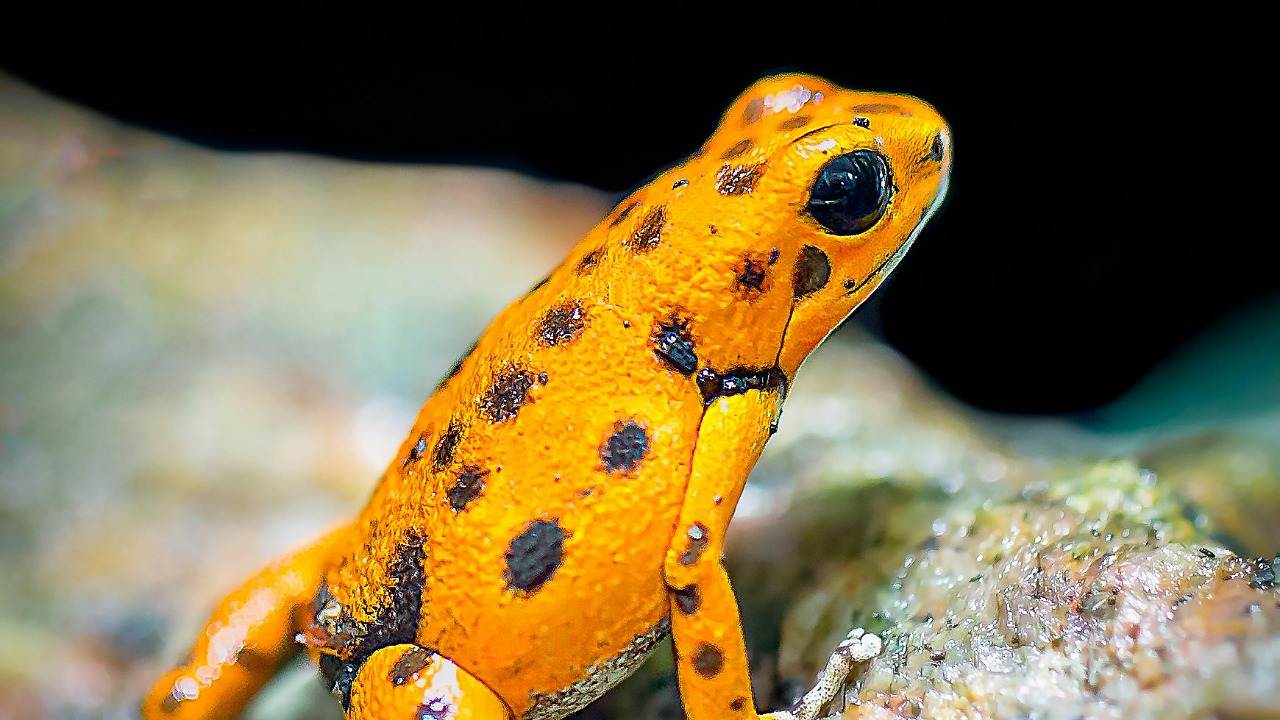

Most frogs defend themselves with toxins that sit passively in their skin, but only two species are known to go a step further and actively inject venom into anything that grabs them. These little amphibians turn their own skulls into weapons, blurring the line between familiar “poisonous frogs” and the much rarer category of truly venomous ones. I set out to trace how scientists uncovered these animals and what their discovery reveals about the way evolution keeps reinventing the tools of attack and defense.
Poisonous versus venomous: why the distinction matters
Before I get to the two headline frogs, I need to draw a sharp line between being poisonous and being venomous, because the difference is more than a semantic quirk. A poisonous animal is dangerous when another creature eats or touches it, while a venomous animal delivers its toxins directly through a bite, sting, or other specialized structure. Many brightly colored amphibians fall into the first camp, but until recently, frogs were not thought to belong in the second.
Researchers have long known that many species of frog are known to be poisonous, including the famous poison dart frogs that advertise their chemical defenses with neon skin. Those animals rely on predators learning, often the hard way, that eating them is a bad idea. Venom, by contrast, is an active weapon, injected through fangs, stingers, or spines, and it is the strategy used by rattlesnakes, cone snails, and some fish. The discovery that any frog could join that list forced biologists to rethink what amphibian bodies are capable of.
How scientists stumbled on venom in frogs
The realization that a frog could be venomous did not come from a dramatic jungle encounter but from close anatomical work on obscure tree frogs from Brazil. An international team examining preserved specimens noticed something odd along the edges of their skulls: rows of bony spines that actually pierced through the skin. Those spines sat next to large glands that produced potent toxins, a combination that looked less like passive armor and more like a delivery system.
When the team tested the skin secretions of these animals, they found that the chemicals behaved like venoms against would-be predators, not just irritants. The frogs did not simply ooze poison; they had the hardware to drive those toxins directly into another animal’s flesh. That combination of toxic secretion and penetrating spines is what elevated them from the crowded ranks of poisonous frogs into the far smaller club of venomous vertebrates.
The only two frogs confirmed to be venomous
Out of thousands of frog species cataloged worldwide, only two have been confirmed as venomous in this strict sense. Both live in Brazil and both are tree-dwelling specialists with skulls that look more like medieval weapons than the rounded heads most people picture when they think of frogs. Their names are a mouthful, but they now sit at the center of a quiet revolution in how herpetologists classify amphibian defenses.
One is Corythomantis greeningi and the other is Aparasphenodon brunoi, and together they are the only frogs known to be venomous, according to work highlighted when a Utah State University researcher described Corthythomantisgreeningi and Aparasphenodonbrunoi, both found in Brazil and equipped with unusual head spines. Their status is not a matter of hype but of anatomy and chemistry: each species combines toxic skin secretions with a built-in injection system that can puncture the skin of anything that bites or grabs them.
How venomous frogs weaponize their faces
What sets these frogs apart is not just that they are toxic, but how they use their own faces as weapons. Along the margins of their skulls, especially near the upper lip and snout, they carry bony spines that protrude through the skin. When a predator clamps down on the frog’s head, those spines act like tiny needles, concentrating the force of the bite into sharp points that can pierce the attacker’s gums or tongue.
Researchers have described how venomous frogs use toxic face spines as weapons, turning what would normally be a vulnerable body part into a booby trap. The spines sit adjacent to toxin-producing glands, so when they puncture a predator’s mouth, they can deliver a concentrated dose of venom directly into the tissue. It is a brutal but efficient design: the frog does not need to bite or sting, it simply has to survive the first chomp long enough for the attacker to regret its choice.
Two Brazilian specialists with skulls like armor
Both of these venomous frogs are Brazilian natives, and their shared geography hints at how similar ecological pressures can shape convergent solutions. They live in environments where predators are abundant and hiding places can be scarce, so a passive chemical coating may not be enough. Instead, evolution has equipped them with reinforced heads that double as shields and syringes.
Detailed anatomical work has shown that two Brazilian frogs have bony spines around the margin of their skull, and those spines actually penetrate the skin rather than sitting buried beneath it. That arrangement is unusual even among spiny-headed frogs and suggests that the structures evolved not just for protection but for active delivery of toxins. In effect, the skull becomes a kind of armored battering ram, ready to turn any close contact into a chemical confrontation.
Corythomantis greeningi: the “less toxic” frog with bigger weapons
Corythomantis greeningi is sometimes described as the less toxic of the two venomous frogs, but that label can be misleading. Its venom may be weaker molecule for molecule, yet the species compensates with sheer hardware. The spines along its head are larger, and the glands that feed them are more developed, which means it can potentially deliver a greater total dose in a single defensive encounter.
Reporting on these animals has emphasized that although Corythomantis greeningi has less toxic venom, it has larger head spines and larger skin glands that secrete more of that venom into any wound. For a predator, the distinction between “less toxic” and “more toxic” is academic if the total dose is high enough to cause severe pain, bleeding, or systemic effects. For humans who might handle these frogs without protection, the combination of big spines and abundant secretion is what makes the species medically significant.
Aparasphenodon brunoi: packing more toxin into a smaller frame
Aparasphenodon brunoi, by contrast, is often portrayed as the more chemically dangerous of the pair. Its venom has been measured as more potent, meaning that a smaller amount can cause serious effects. The frog itself is not large, but its compact body hides a sophisticated arsenal of glands and spines that can turn a predator’s bite into a high-stakes mistake.
Analyses of these animals have highlighted that both frogs possess bony spines around their skulls, but Aparasphenodon brunoi stands out for the strength of its toxins. For a small mammal or bird, a mouthful of this frog could translate into a rapid and overwhelming dose of venom. That potency is part of why scientists now treat these two species as a distinct category within amphibians, rather than simply folding them into the broader group of poisonous frogs.
How venomous frogs compare to familiar toxic amphibians
For most people, the phrase “dangerous frog” conjures images of bright yellow or blue poison dart frogs, or perhaps the hulking cane toad that has become a notorious invasive species. Those animals are indeed hazardous, but they do not inject their toxins. Instead, their skin is laced with chemicals that can sicken or kill anything that tries to eat them, a strategy that relies on predators making a fatal or near-fatal mistake once and then learning to avoid that color or shape.
Popular accounts of amphibian toxins often point to the Golden Poison Frog and the Cane Toad as classic examples of poisonous species, and for good reason. The Golden Poison Frog carries enough batrachotoxin in its skin to kill multiple humans, while the Cane Toad secretes bufotoxins that can stop a dog’s heart. Yet neither has the specialized spines or fangs that would qualify them as venomous. That distinction leaves Corythomantis greeningi and Aparasphenodon brunoi in a category of their own, even though their names are far less familiar.
Venom across the animal kingdom: where frogs fit in
To understand why these frogs are such outliers, it helps to zoom out to the broader landscape of venomous animals. Venom has evolved independently in snakes, spiders, scorpions, cone snails, some fish, and even a few mammals like the platypus. In each case, the toxins are produced in specialized glands and delivered through a physical structure that pierces skin, such as fangs, stingers, or spines. That combination of chemistry and hardware is what defines venom as a biological tool.
In reptiles, for example, venomous snakes are born with venom in special sacs that connect to hollow or grooved fangs, allowing them to inject toxins deep into prey or threats. Among arachnids, scorpions carry a stinger on the tail, and observers note that since everyone is pretty familiar with what a Scorpion looks like, the stinger on the tail is the key venom delivery system, often compared to a bee sting in terms of pain. Against that backdrop, frogs were long assumed to be limited to passive poisons. The Brazilian species break that rule by pairing amphibian skin toxins with a delivery system that behaves more like a snake’s fang or a scorpion’s barb.
Why venom in frogs is so rare
Given how effective venom can be, it is striking that only two frog species are known to use it. Part of the explanation lies in amphibian biology. Frogs already rely heavily on skin secretions for defense, and many also use camouflage, jumping ability, and nocturnal habits to avoid predators. For most lineages, those strategies may have been enough, reducing the evolutionary pressure to develop a more elaborate injection system.
Another factor is the engineering challenge of adding sharp, penetrating structures to a body built for leaping and absorbing impact. The bony spines in these Brazilian frogs are integrated into the skull, which is already a rigid structure, but they still represent a trade-off between protection and mobility. Studies that highlight the highlights of two Brazilian frogs with bony spines suggest that their lifestyle, clinging to rough surfaces and wedging into crevices, may have favored a reinforced head that could double as a weapon. In other habitats, that same adaptation might be more of a liability than an advantage.
What venomous frogs reveal about evolution’s creativity
For evolutionary biologists, the existence of venomous frogs is a reminder that nature rarely respects the neat categories humans prefer. Venom has evolved multiple times in vertebrates and invertebrates, and each time it has taken a slightly different form. In these frogs, the innovation lies not in inventing a new toxin from scratch, but in repurposing existing skin glands and skeletal structures into a more aggressive system.
Accounts that ask whether frogs can be venomous emphasize that the line between poison and venom can be crossed when an animal evolves a way to force its toxins into another body. Corythomantis greeningi and Aparasphenodon brunoi show that even a familiar group like frogs can surprise us when we look closely enough. Their skull spines and toxic secretions are not just curiosities; they are case studies in how incremental changes can add up to a fundamentally new kind of weapon.
Human risk and scientific opportunity
For people who live or work in the habitats of these frogs, the immediate question is how dangerous they are to humans. The answer is that they are not on the scale of the deadliest snakes or jellyfish, but they are not harmless either. A careless grab could drive multiple spines into the skin, delivering a concentrated dose of venom that causes intense pain, swelling, and potentially more serious systemic effects, especially if the person has underlying health issues or an allergic response.
At the same time, these frogs represent a scientific opportunity. Venoms have become rich sources of new drugs, from blood pressure medications derived from snake toxins to experimental painkillers based on cone snail peptides. The unique chemistry of amphibian venoms, combined with the unusual delivery system of head spines, could yield insights into nerve signaling, blood clotting, or immune responses that are not accessible through more familiar species. As researchers continue to probe how venomous frogs use toxic face spines, they are not just cataloging another oddity, they are expanding the toolkit for understanding and potentially treating human disease.
More from MorningOverview