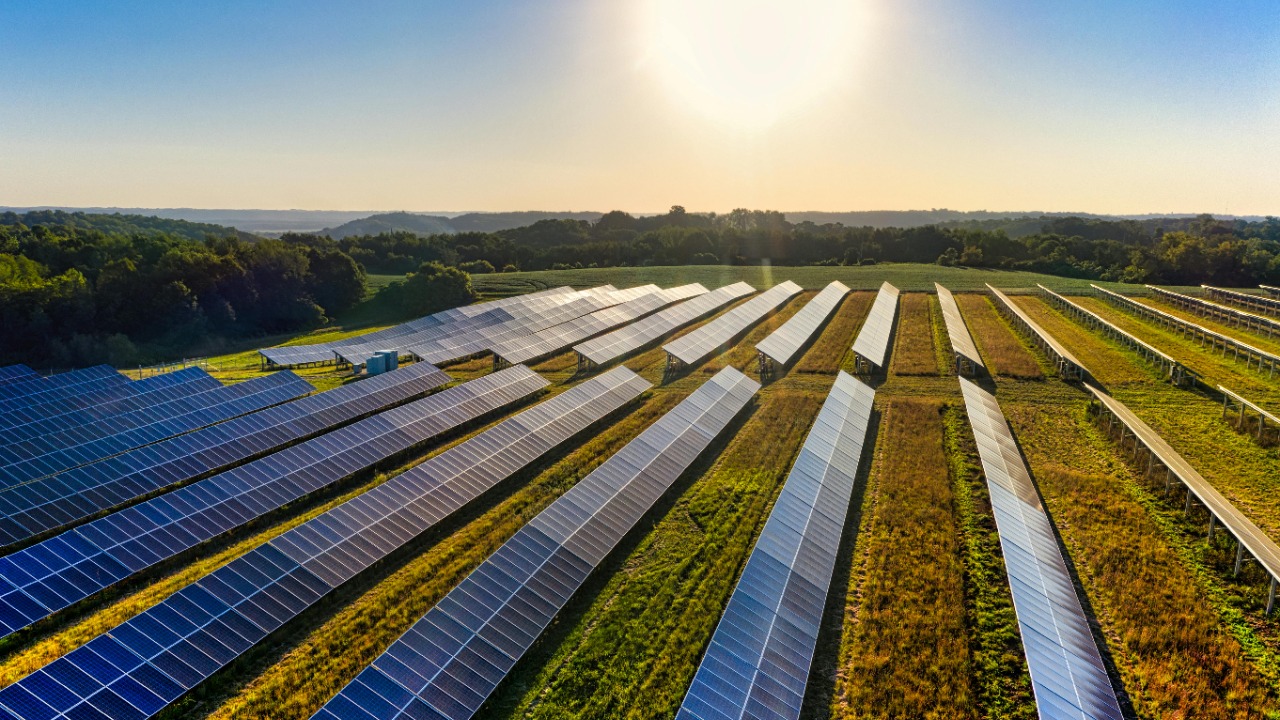

California’s clean energy buildout is no longer constrained mainly by sunshine or technology, but by the plumbing of the power system itself. The state is now attacking that bottleneck with a mix of streamlined permitting, new grid strategies, and creative land use that could determine whether its climate ambitions stay on paper or turn into steel in the ground.
From giant batteries in the desert to floating solar on reservoirs and panels on fallowed farmland, the next phase of growth will hinge on how quickly projects can connect to the grid and how efficiently that power can move. The choices California makes in the next few years will shape not just its own energy future, but the playbook other regions use to manage a high-renewables grid.
California’s towering clean energy target collides with grid reality
California has set itself a staggering goal: more than 400% growth in clean energy by 2045, a scale of expansion that would transform the state’s power system in a single generation. Governor Gavin Newsom has framed that target as essential to meeting climate mandates and keeping the lights on as electrification accelerates across transportation, buildings, and industry. The ambition is not abstract, it is already reshaping planning at utilities, regulators, and grid operators that must figure out how to absorb a tidal wave of new solar, wind, and storage.
Yet the same state that leads the country in installed solar capacity is now running into the limits of its own infrastructure. The grid that carried fossil power from a handful of big plants was never designed to handle thousands of distributed projects feeding electricity in all directions. That tension is visible across California, where developers face long waits to plug in, communities wrestle with land use tradeoffs, and policymakers scramble to keep the buildout aligned with climate timelines.
The interconnection logjam: California’s biggest clean energy bottleneck
The most acute choke point is no longer panels or batteries, but the simple act of connecting projects to the grid. In a widely shared explanation, an expert in an Oct video lays out why interconnection has become the biggest bottleneck for solar and storage, describing how overloaded queues and slow studies are sidelining otherwise viable projects. Developers can secure land, financing, and equipment, only to sit for years waiting for a utility or grid operator to finish impact analyses and assign upgrade costs.
That delay is not just a paperwork nuisance, it is a direct threat to California’s climate schedule and to the economics of clean energy. When interconnection drags on, tax credits can expire, supply contracts can unravel, and communities that expected local jobs and tax revenue are left in limbo. The same video underscores that agencies have tools to take control of the process and get the most out of their assets, but those tools need to be deployed at scale if the state is to keep pace with its own targets.
Small-scale solar feels the squeeze from four key bottlenecks
While mega-projects grab headlines, smaller utility and community solar developers are running into their own version of the grid bottleneck. One analysis likens the situation to a wine bottle, with a wide base of potential projects narrowing into a thin neck of actual interconnections, and identifies four main obstacles that slow or kill deals. According to that Mar report, developers face challenges that range from opaque utility processes to local permitting friction and limited capacity on distribution lines that were never meant to host significant generation.
To open this bottleneck, the same analysis argues that California must reform how it plans and pays for upgrades, and how it coordinates between state agencies, utilities, and local governments. The goal is not just to clear a path for a few flagship projects, but to create a repeatable framework so small-scale utility and community solar can open up throughout California. Without that, the state risks leaving cost-effective projects on the shelf, even as it chases its 2045 goals with more expensive or politically fraught infrastructure.
Fast-track permitting and the rise of giant solar-plus-storage
Recognizing that traditional permitting timelines were incompatible with its climate clock, California has begun to overhaul how large clean energy projects get approved. Under new fast-track rules, regulators have signed off on what is described as the World’s Largest Solar Battery Project Approved under Fast Track Rules Briefing, a massive solar-plus-storage complex that will be able to power 850,000 homes for four hours. The project’s scale is eye-catching, but the more important story is the process that got it over the line, which compressed what used to be a multi-year slog into a far shorter window.
That shift is rooted in a new framework that lets developers opt into a consolidated state review instead of navigating a patchwork of local approvals. Authorized under Authorized Assembly Bill 205, California’s Opt In Certification program creates a single, coordinated process for bringing large power projects online. By reducing duplicative reviews and clarifying timelines, the state is trying to ensure that interconnection studies and transmission planning can proceed in parallel with permitting, rather than in a slow, sequential chain.
AB 205 and the push to streamline land use and permits
The same law that underpins the Opt In Certification program is also reshaping how California handles land use for clean energy. Under Land use and local permitting rules, California recently issued “emergency regulations” under AB 205 that delegate blanket authority to the California Energy Commission for certain solar, wind, and battery backup projects. The idea is to avoid a scenario where dozens of local jurisdictions each apply different standards and timelines, creating a de facto cap on how fast projects can move.
That approach mirrors a broader national conversation about how to speed up energy infrastructure without sidelining environmental and community protections. One analysis of U.S. climate policy argues that, Finally, there is a clear need to streamline permit processes, and that Finally Expanding state primacy or implementing federal reforms to accelerate permitting timelines could unlock numerous projects. California’s AB 205 experiment is an early test of how far a state can go in centralizing authority while still respecting local input, and whether that balance can meaningfully shrink the interconnection queue.
Transmission as California’s next power play
Even if interconnection studies speed up, solar growth will stall if there is nowhere for the power to go. That is why transmission has become California’s next strategic frontier. At CAISO, the grid operator that manages most of the state’s high-voltage network, leaders say they are extraordinarily focused on making the best use of the existing grid as well as planning new lines. In a detailed discussion of California’s next power play, the operator explains that At CAISO, There is a lot of emphasis on ensuring transmission does not become the limiting factor.
That focus translates into a few concrete strategies. First, CAISO is trying to squeeze more capacity out of existing lines through advanced power flow controls and better coordination of maintenance outages. Second, it is aligning long-term transmission planning with the state’s clean energy procurement so that new solar and storage zones are not stranded. Finally, it is working with neighboring states to expand regional trading, which can help absorb California’s midday solar surplus and reduce curtailment. Each of these moves is about turning transmission from a passive conduit into an active enabler of the clean energy buildout.
Storage steps up: from record batteries to data center demand
As solar floods the grid during the day, batteries are becoming the critical tool for shifting that energy into the evening peak and smoothing out variability. California has already set a new benchmark, with a recent milestone described as California Battery Storage Hits Record, Securing Grid Reliability and Clean Power Briefing. That record reflects thousands of megawatts of grid-scale batteries that can respond in seconds, helping the state ride through heat waves, wildfires, and sudden plant outages without resorting to rolling blackouts.
The storage boom is not limited to utilities. Some industry leaders in the digital economy are also adding large-scale battery deployments for energy storage at their facilities. According to an analysis of renewable energy for data centers, Some operators are pairing on-site renewables with batteries to cut emissions and manage grid constraints. That trend matters for California because hyperscale data centers are among the fastest-growing loads on the system, and their willingness to invest in storage can either ease or exacerbate local bottlenecks depending on how projects are sited and interconnected.
Innovating around land: floating solar and fallowed fields
Grid constraints are not just about wires and substations, they are also about where projects can physically go. In a state where land is contested and water is scarce, developers are experimenting with new formats that solve multiple problems at once. One striking example is a project described as Floating Solar Array Latest Innovation in California’s Next Generation Clean Energy Frontier, By Oren Peleg, which installs panels on a reservoir to generate power while reducing evaporation. By using existing water infrastructure, the project sidesteps some of the land use conflicts that have dogged ground-mounted solar and helps solve a power bottleneck problem near the load it serves.
On dry land, policymakers are eyeing another underused asset: fallowed farmland. As drought and shifting economics push growers to take fields out of production, those acres become potential sites for solar that can plug into existing rural transmission. A detailed look at this trend describes how Fallow fields in California represent energy opportunities, with an analysis of a federal database suggesting significant potential for projects that respect habitat and community concerns. If paired with smart interconnection planning, these sites could relieve pressure on more sensitive landscapes while bringing new revenue to rural counties.
Rewriting old rules: the Williamson Act and solar on working lands
Unlocking that farmland potential, however, requires changing laws that were written for a different era. One of the most important is the Williamson Act, a 60-year-old statute that gives landowners tax breaks for keeping property in agricultural use. That framework has made it harder to convert even marginal or permanently fallowed land to solar, because doing so can trigger penalties or remove protections that farmers rely on. As climate and water realities shift, the question is whether the law can evolve without undermining its core purpose of preserving working landscapes.
One proposal to thread that needle comes from Assemblymember Buffy Wicks, a Democrat from Oakland, who has authored a bill to adjust how the Williamson Act treats solar on certain lands. The measure, described in coverage of how California may help solar bloom where water runs dry, is Authored by Assemblymember Buffy Wicks, a Democrat from Oakland, and explicitly tackles the Williamson Act, with supporters arguing it can open space for clean energy while critics warn of caveats and tradeoffs. How that debate plays out will shape whether solar on fallowed fields becomes a niche experiment or a mainstream tool for easing California’s grid constraints.
From bottleneck to blueprint
California’s effort to tackle its solar power bottleneck is messy, uneven, and still very much in progress, but it is already offering a glimpse of what a high-renewables grid transition looks like in practice. Interconnection reforms, fast-track permitting, and new land use strategies are not silver bullets on their own, yet together they begin to chip away at the structural barriers that have slowed the buildout. The state’s experience shows that climate ambition must be matched by institutional agility, from the legislature that passed Assembly Bill 205 to the regulators and grid operators now tasked with turning that law into functioning infrastructure.
For other regions watching from the sidelines, the lesson is that the hardest part of the energy transition may not be inventing new technologies, but rewiring the rules and networks that let those technologies scale. If California can turn its current constraints into a durable blueprint, the payoff will extend far beyond its borders, offering a roadmap for how to move from targets on paper to clean power flowing through the wires.
More from MorningOverview