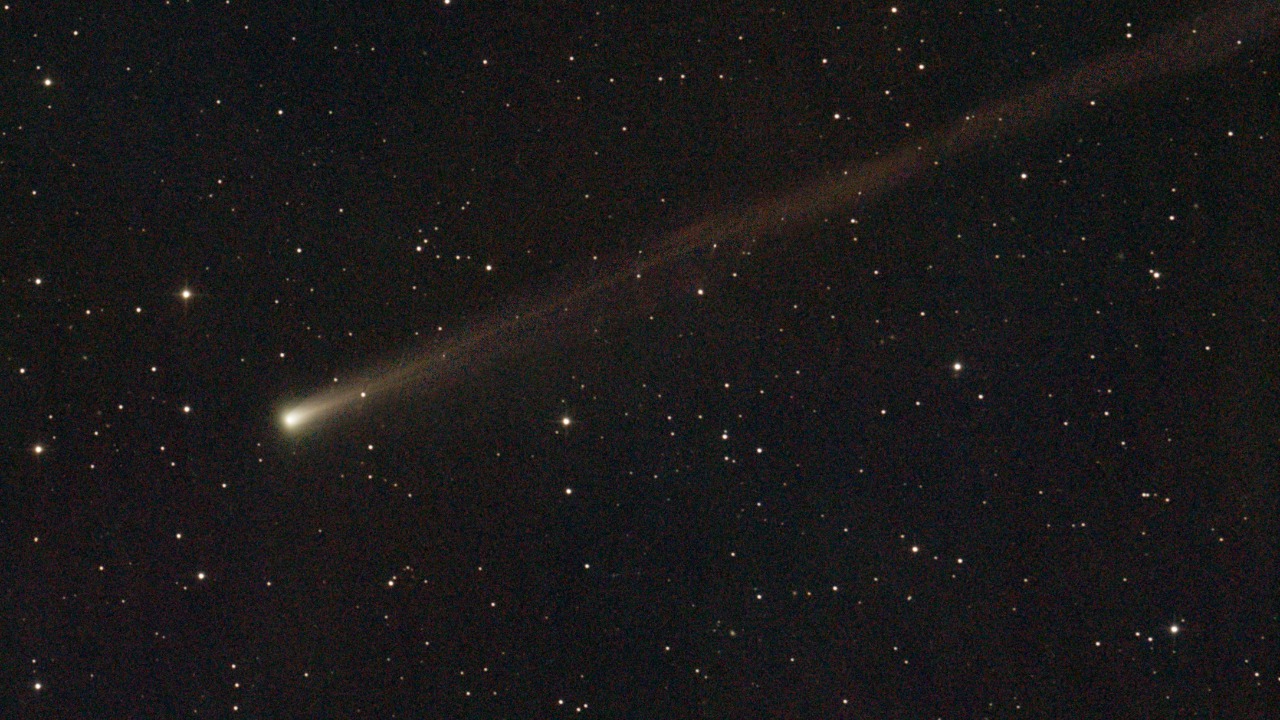

A small, icy traveler from deep space has just threaded its way through the inner Solar System, offering a fleeting but profound reminder that our planetary neighborhood is not isolated. As astronomers track this interstellar comet on its way past the Sun and back into the dark, they are seizing a rare chance to compare it with earlier visitors from other stars and to probe how typical, or unusual, our own system might be.
I see this moment as part of a rapidly unfolding story: in less than a decade, humanity has gone from never having seen an interstellar object up close to cataloging a growing family of them, each with its own quirks and clues. The latest passage, involving Comet 3I/ATLAS, is not just a spectacle in the sky but a data-rich experiment in how planetary systems form, evolve, and exchange material across the galaxy.
What makes Comet 3I/ATLAS so extraordinary
The object now slipping through our skies, Comet 3I/ATLAS, is only the third known body on a clearly interstellar path, and it is unmistakably a comet. Its orbit is hyperbolic, meaning it is not gravitationally bound to the Sun and will never return once it departs, a signature that it originated around another star before being nudged into interstellar space and eventually into our own system. As it swept through its closest approach to the Sun, Comet 3I/ATLAS developed the classic features of a cometary visitor, with a brightened nucleus and a tail sculpted by solar radiation, confirming that this is an active, volatile-rich body rather than a bare rock.
That close pass, when Comet 3I/ATLAS reached its minimum distance from the Sun, has been a focal point for observatories because it concentrates the most intense heating and outgassing into a relatively short window. Tracking the trajectory of this comet as it approached and then passed the Sun has allowed researchers to refine its orbit and to measure how jets of gas and dust subtly alter its motion. The geometry of that path, which carries Comet 3I/ATLAS in and then back out past the orbit of the Earth, is central to confirming its interstellar status and has been mapped in detail as the comet reaches closest point to the Sun.
The short, strange history of interstellar visitors
To understand why 3I/ATLAS matters, I have to place it in the short but dramatic history of interstellar objects. The first known example, 1I/2017 U1, better known as Oumuamua, was discovered by the Pan-STARRS survey as it swept across the sky at high speed, already on its way out of the Solar System. Its light curve, measured through careful photometry over several nights in late Oct, revealed a highly elongated shape and a tumbling rotation that did not match any familiar comet or asteroid, and its lack of a visible tail only deepened the mystery. Those early observations, rooted in the systematic sky coverage of Pan-STARRS and the follow-up photometry, are still the foundation for every debate about what Oumuamua really was.
One provocative line of research has even suggested that Oumuamua might have been a kind of solar sail hybrid, with its non-gravitational acceleration explained by radiation pressure acting on an unusually thin object. That idea, while controversial, underscores how little data astronomers had to work with and how much they had to infer from a brief observational window. The technical analysis of Oumuamua’s trajectory, brightness variations, and the capabilities of the Pan-STARRS survey, along with the detailed photometry conducted over several days in Oct, is laid out in a study that asks whether Oumuamua could be a solar sail, highlighting just how radical some interpretations became in the absence of a visible coma or tail.
From Oumuamua to Borisov: the first confirmed interstellar comet
The second interstellar visitor, comet 2I/Borisov, changed the conversation by looking far more like a traditional comet, even as it came from outside the Solar System. It was discovered by Crimean amateur astronomer Gennadiy Borisov, whose patient sky patrols with custom-built telescopes picked out a faint, moving smudge that soon proved to be on a hyperbolic path. Once its orbit was calculated, astronomers could say with confidence that this object, later named 2I/Borisov, had not formed in our planetary neighborhood but had arrived from interstellar space, making it the first confirmed interstellar comet and a crucial counterpoint to the enigmatic Oumuamua.
What set Borisov apart was not just its origin but its unmistakably cometary behavior, with a persistent coma and tail that made it easier to study with a wide range of instruments. Detailed follow-up observations showed that 2I/Borisov was shedding gas and dust in a way that resembled long-period comets from the outer reaches of our own system, suggesting that the processes that build icy bodies around other stars may be broadly similar. The official characterization of 2I/Borisov as the first confirmed interstellar comet, discovered by the Crimean observer Gennadiy Borisov and tracked as it sped through the inner Solar System, is summarized in an In Depth profile that has become a touchstone for this new class of objects.
How 3I/ATLAS fits into the growing interstellar family
Comet 3I/ATLAS now joins Oumuamua and Borisov as the third member of this small but revealing family, and in some ways it bridges the gap between them. Like 2I/Borisov, 3I/ATLAS is clearly a comet, with a very active appearance and a tail that leaves no doubt about its volatile content. At the same time, its trajectory and brightness evolution offer a fresh test of how interstellar comets respond to the Sun’s heat and radiation, and whether their activity patterns match those of comets that formed in the Kuiper Belt or Oort Cloud. By comparing the behavior of 3I/ATLAS with that of Borisov, astronomers can start to ask whether these visitors are typical products of other planetary systems or rare outliers.
In the small catalog of interstellar objects, the contrast is already striking. Oumuamua, with its odd shape and lack of a visible coma, stands apart from the other two, while 2I/Borisov and 3I/ATLAS look more like the comets we know, even if their orbits mark them as outsiders. Researchers studying this trio have emphasized that the other two interstellar objects, 2I/Borisov and 3I/ATLAS, are clearly comets, with active comae and tails that make them easier to characterize in terms of composition and dust production. That distinction, and the way They behave under solar heating, is central to ongoing work that treats 3I/ATLAS as the third interstellar object and a crucial data point in this emerging field.
What Borisov’s dust reveals about alien comets
To appreciate what 3I/ATLAS might teach us, I look closely at what we have already learned from 2I/Borisov’s dust. Polarimetric studies, which measure how light is polarized as it scatters off tiny particles, have shown that Borisov’s coma behaves differently from that of many well-studied Solar System comets. Unlike Hale-Bopp and other famous comets, which often display complex and varying polarization patterns across their comae, 2I/Borisov exhibits a polarimetrically homogeneous coma, suggesting a more uniform distribution of dust properties. That uniformity hints at a relatively pristine object that has not been heavily processed by repeated close passes to its parent star.
Those measurements matter because polarization encodes information about the size, shape, and composition of dust grains, which in turn reflect the conditions in the protoplanetary disk where the comet formed. If Borisov’s dust is more uniform than that of Hale-Bopp and similar comets, it may indicate that the region of its birth was less disturbed or that the comet has preserved its original structure more faithfully. The detailed analysis that notes how, unlike Hale-Bopp and many other comets, Borisov shows a polarimetrically homogeneous coma, uses that behavior to extract information about the physical characteristics of cometary dust and to argue that 2I/Borisov is a valuable probe of its natal environment, as outlined in a study of unusual polarimetric properties.
Why 3I/ATLAS is a rare scientific opportunity
With that context, Comet 3I/ATLAS becomes more than a curiosity, it is a rare laboratory for testing whether the traits seen in Borisov are common among interstellar comets or a one-off. Because 3I/ATLAS is active and develops a clear coma and tail, astronomers can apply the same toolkit of spectroscopy, imaging, and polarimetry that they used on 2I/Borisov, looking for similarities and differences in dust and gas. If its coma turns out to be homogeneous in polarization, that would strengthen the case that many interstellar comets are relatively unprocessed, pristine bodies. If instead it shows the kind of complex structure seen in Hale-Bopp, that would point to a broader diversity in how comets form and evolve around other stars.
The timing of 3I/ATLAS’s passage also matters, because it arrives after years of investment in survey telescopes and rapid-response follow-up networks that did not exist when Oumuamua appeared. Observatories can now pivot quickly to capture spectra, high-resolution images, and time-series data as the comet brightens and fades, building a far richer dataset than was possible for the first interstellar visitor. The fact that this object is the third interstellar body ever found, and that it is set to pass through our Solar System in a way that allows extended monitoring, has been highlighted in coverage of how NASA discovers the 3rd interstellar object and prepares to watch it zip past.
How astronomers know these comets came from another star
One of the most common questions I hear about interstellar comets is how astronomers can be so sure they are not just extreme members of our own comet population. The answer lies in orbital mechanics. Objects bound to the Sun follow elliptical orbits with eccentricities less than 1, while interstellar visitors trace hyperbolic paths with eccentricities greater than 1, indicating that their total energy relative to the Sun is positive. When observers calculate the orbit of an object like 2I/Borisov or 3I/ATLAS and find a strongly hyperbolic trajectory, they can say with confidence that it did not originate in the Oort Cloud or Kuiper Belt but instead entered the Solar System from interstellar space.
In practice, that conclusion is strengthened by the object’s speed and direction as it approaches the inner Solar System. Both Borisov and 3I/ATLAS arrived with velocities and incoming vectors that do not match any plausible scenario of ejection from our own distant reservoirs of comets, and their paths through the planetary region are consistent with a single flyby rather than a bound orbit. The case of 2I/Borisov is particularly clear, with its hyperbolic orbit used to confirm that it came from outside the Solar System, and that same logic now underpins the classification of 3I/ATLAS as an interstellar comet. Reports that describe how the second interstellar object was 2I/Borisov, discovered by Gennadiy Borisov and identified as interstellar when its origin was confirmed by its hyperbolic orbit, provide a template for how astronomers now treat each new candidate.
What these visitors tell us about planetary systems across the galaxy
As I weigh the significance of Comet 3I/ATLAS, I keep coming back to what these visitors collectively say about the broader galaxy. Every interstellar comet is a fragment of another planetary system, ejected during the chaotic early stages of planet formation or through later gravitational encounters, and then left to wander the space between stars for millions or billions of years. When such an object passes through our Solar System, it carries with it a record of the chemistry, temperature, and dynamics of its birthplace, encoded in its ices, dust, and internal structure. By comparing the compositions and behaviors of Oumuamua, 2I/Borisov, and 3I/ATLAS, astronomers are effectively sampling multiple planetary nurseries without ever leaving home.
The early results hint at both common ground and diversity. Borisov’s broadly comet-like activity suggests that icy bodies around other stars can resemble those in our own system, while Oumuamua’s odd shape and lack of a visible coma point to more exotic possibilities, such as fragments of disrupted planetesimals or even thin, sheet-like structures. As data on 3I/ATLAS accumulates, researchers will be looking for patterns that might reveal whether most planetary systems produce large numbers of comet-like bodies that are eventually ejected, or whether our current sample is biased by the kinds of objects our surveys are best at detecting. In that sense, every new interstellar comet is not just a passing spectacle but a datapoint in a much larger effort to map how common Solar System–like architectures really are.
The next generation of interstellar discoveries
Comet 3I/ATLAS is also a preview of what the next decade of sky surveys is likely to bring. Facilities designed to scan the sky repeatedly and deeply, such as the Vera C. Rubin Observatory’s Legacy Survey of Space and Time, are expected to uncover many more fast-moving, faint objects on unusual trajectories. With each new detection, astronomers will be better positioned to trigger rapid follow-up observations, capturing spectra and high-resolution images before the object fades from view. The experience gained from Oumuamua, Borisov, and now 3I/ATLAS is already shaping how these surveys prioritize targets and how they coordinate with ground-based and space-based telescopes to maximize the scientific return.
For me, the most striking aspect of this progression is how quickly interstellar objects have gone from theoretical curiosities to practical observing targets. A decade ago, the idea of routinely studying material from other planetary systems without sending spacecraft beyond the heliosphere would have sounded speculative. Today, with three such objects already logged and more almost certainly on the way, the field is shifting toward statistical questions about their frequency, origins, and diversity. As Comet 3I/ATLAS recedes into the dark, it leaves behind not just a trail of dust but a roadmap for how we will study the next wave of visitors from other stars, each one a brief but revealing messenger from a distant sun.
More from MorningOverview