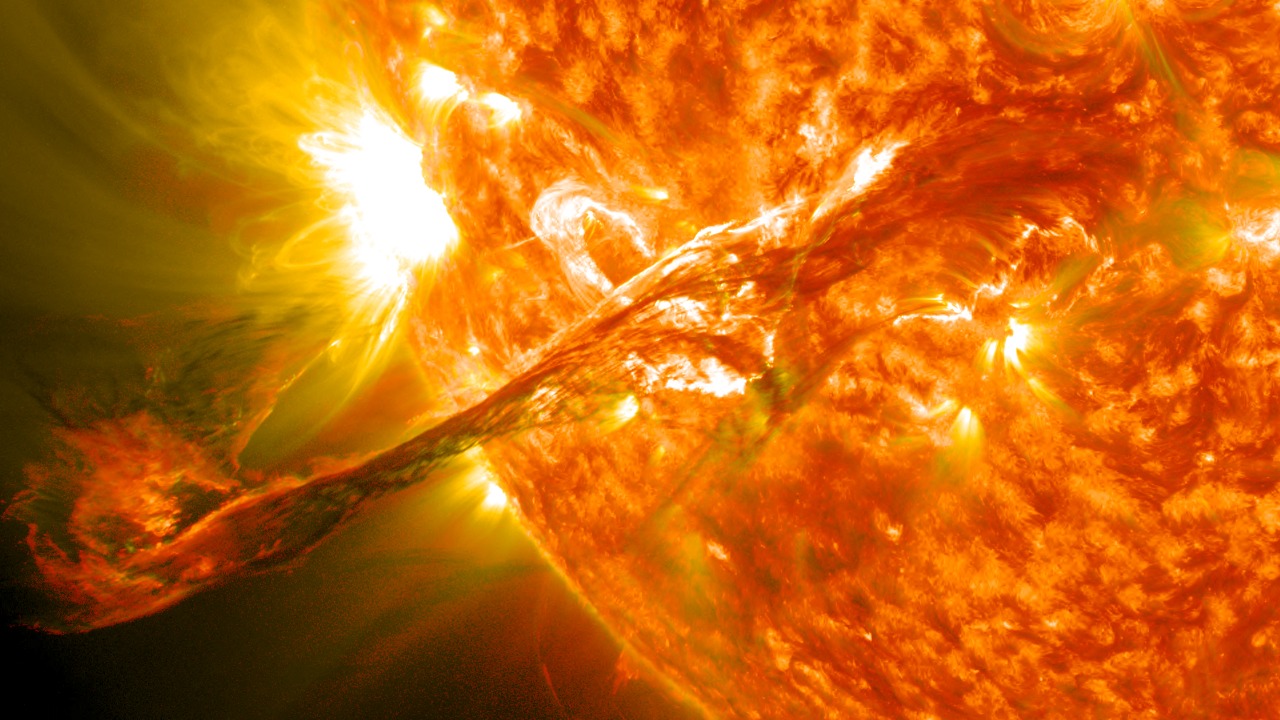

The Sun has recently produced two colossal X-class solar flares that disrupted radio signals across large swaths of the globe, just as Americans are still parsing memories of nationwide cell outages that hit earlier in the year. The timing has revived a familiar question in the public mind: when phones go dark, is it our star or our infrastructure that is really to blame?
I see a widening gap between what space weather experts are actually warning about and what many people assume every time a network map turns red. The latest flares are a reminder that the Sun can indeed rattle modern technology, but the evidence so far points to a more complicated, and often more terrestrial, story behind recent U.S. cellular disruptions.
Two colossal X-flares and a restless solar cycle
The recent twin outbursts from the Sun were not routine hiccups but X-class events, the most intense category of solar flares that our instruments track. In less than half a day, the star at the center of the solar system hurled two such eruptions that were powerful enough to trigger radio blackouts across the Americas, the Pacific and parts of eastern Australia, a pattern consistent with reports that the Sun unleashed 2 colossal X-class solar flares in under 12 hours that knocked out radio signals in those regions, including across the Americas and parts of eastern Australia, as described in Nov. These flares were strong enough to saturate high frequency radio bands that pilots, mariners and emergency services rely on, a reminder that space weather is not an abstract curiosity but a practical operational concern.
Solar physicists classify flares by their X-ray brightness, and X-class sits at the top of that scale, with the number that follows indicating relative strength, a convention that is spelled out in detail in a recent analysis that notes that X-class denotes the most intense flares and that the number provides more information about its strength, as explained in Dec. The fact that the Sun is now firing off multiple X-class events in quick succession fits the broader pattern of Solar Cycle 25 ramping toward its peak, a phase when the odds of disruptive flares and associated coronal mass ejections rise sharply.
How solar flares actually disrupt communications
When the Sun erupts, the first thing to hit Earth is not a cloud of particles but a burst of electromagnetic radiation that races outward at the speed of light. That flash slams into the upper atmosphere and supercharges the ionized layers that radio waves use as a reflective ceiling, a process that can cause high frequency signals to fade or vanish entirely, a chain of events that helps explain why the radio waves that interact with electrons in the ionized layers lose energy due to more frequent collisions, which can lead to radio blackouts according to NOAA’s Space Weather Prediction Center, as described in Gargantuan sunspot 15-Earths wide erupts with another colossal X- …. Pilots flying long-haul routes over the ocean, where ground-based radar and cell towers are scarce, are often the first to notice when their high frequency channels go quiet.
The more delayed threat comes from fast-moving particles and plasma that can arrive hours later and buffet the planet’s magnetic field. When those particles and plasma slam into Earth’s magnetic shield, they can temporarily disrupt the power grid and interfere with satellite systems that underpin GPS and other radio and GPS communications, a risk that forecasters have been flagging as severe solar storms become more likely, as outlined in a detailed explainer that notes that when fast-moving particles and plasma slam into Earth’s magnetic field, they can temporarily disrupt the power grid and other radio and GPS communications, as described in When. This is the realm of geomagnetic storms and auroras, spectacular to watch but potentially punishing for the infrastructure that keeps modern life humming.
What NOAA’s forecasters are actually seeing
Behind the scenes, a network of satellites and ground-based sensors feeds data into models run by the Space Weather Prediction Center, the U.S. government’s front line for tracking solar tantrums. The agency’s forecasters issue alerts and watches when they expect coronal mass ejections, or CMEs, to reach Earth, and in early November they were still anticipating the arrival of a more Earth-directed CME from early 5 November while keeping a watch in effect, a status that was shared in a space weather update that noted that they were still anticipating the arrival the more Earth-directed CME from early 5 November and that the Watch remains in effect, as detailed in November and the Watch. Those alerts are designed to give power grid operators, satellite controllers and aviation authorities a few precious hours to prepare.
For anyone trying to understand whether a glitchy phone is part of a bigger solar story, the most reliable starting point is the official dashboard that tracks current solar flares, geomagnetic indices and radio blackout maps in near real time. That information is publicly available through the Space Weather Prediction Center’s main portal, which aggregates data on flares, CMEs and geomagnetic conditions affecting Earth, as presented on the agency’s primary Space Weather Prediction Center site. Checking those charts before blaming the cosmos can quickly reveal whether a flare is actually in progress or whether the problem is more likely rooted in terrestrial networks.
February’s twin X-flares and the AT&T outage
The public confusion around solar flares and cell service did not start with the latest X-class events. Earlier this year, Two X-class solar flares arrived at Earth over the course of a single night and morning, a one-two punch that coincided with massive AT&T service problems across the United States, a timing that led many users to suspect that the Sun was to blame, a narrative that was examined in a report noting that Two X-class solar flares arrived at Earth last night and early this morning and that the radiation bursts coincided with massive AT&T service outages, as described in Two. The overlap in timing was striking enough that social media quickly filled with charts of solar activity alongside screenshots of outage maps.
Yet experts who dug into the data found little evidence that those flares had the right characteristics to knock out a terrestrial cellular network on that scale. The radiation bursts were real, and they did interact with Earth’s upper atmosphere, but the pattern of disruption did not match the localized, carrier-specific failures that AT&T customers experienced, a conclusion that space weather specialists emphasized when they assessed the event. The best available evidence pointed instead to a problem within the company’s own systems, even as the coincidence with solar activity kept the cosmic explanation alive in the public imagination.
NASA’s view of February’s “twin” events
Part of what made the February episode so compelling visually was the imagery captured by NASA’s Solar Dynamics Observatory, which watched the Sun crackle with activity as the flares erupted. One of those events was classified as an X1.8-class solar flare that erupted on Feb. 21, a detail that was highlighted in coverage noting that NASA’s Solar Dynamics Observatory captured an Image of an X1.8-class solar flare on Feb. 21, 2024, as described in NASA. The spacecraft’s high resolution views of the solar disk, rendered in extreme ultraviolet light, showed bright active regions that underscored just how dynamic the star had become.
Those same observations helped scientists characterize the flares as strong but not unprecedented, and crucially, to assess their likely impact on Earth’s environment. While the phrase “twin solar flares” made for dramatic headlines, the underlying physics suggested that their main effect would be on high frequency radio and the ionosphere, not on the ground-based infrastructure that routes smartphone traffic. That distinction matters, because it shows how even spectacular solar events do not automatically translate into the kind of cell outages that dominated U.S. headlines in February.
Why NOAA said cell networks were “unlikely” to be hit
In the wake of those February flares and the AT&T outage, forecasters at the Space Weather Prediction Center took the unusual step of addressing the cell phone question head on. Their assessment was blunt: while solar flares can affect high frequency radio communications, they are unlikely to be the cause of widely reported cellular network outages, a conclusion that was spelled out in a bulletin titled Two Major Solar Flares; Effects on Cellular Networks Unlikely, which stated that while solar flares can affect high frequency radio communications, they are unlikely to be the cause of widely reported cellular network outages, as detailed in Two Major Solar Flares. In other words, the physics of how flares interact with the atmosphere does not line up neatly with the way 4G and 5G networks are built.
Cellular systems rely on dense webs of ground-based towers, fiber backbones and localized switching equipment, which are far less exposed to the immediate effects of solar radiation than satellites or high frequency radio links. When a carrier like AT&T experiences a nationwide disruption that affects only its own customers, the pattern itself is a clue that the root cause is likely internal rather than solar. NOAA’s message was not that the Sun is harmless, but that people should be cautious about drawing straight lines between every flare and every outage without evidence.
How solar storms could still threaten modern networks
None of this means that space weather is irrelevant to the future of mobile connectivity. As the Sun moves deeper into an active phase, the risk of severe geomagnetic storms that can induce currents in long transmission lines and damage transformers grows, a scenario that could indirectly take out cell towers by cutting their power supply. The same storms can disturb the orbits of satellites that provide timing signals and backhaul links, which in turn support everything from GPS navigation in ride-hailing apps to synchronization in 5G base stations, a vulnerability that is part of the broader concern about how solar storms can disrupt power grids and other radio and GPS communications when fast-moving particles and plasma collide with Earth’s magnetic field, as outlined in Earth. In a worst case, a major geomagnetic event could degrade multiple layers of the infrastructure stack at once.
That is why grid operators and satellite companies pay close attention to alerts from the Space Weather Prediction Center and similar agencies abroad. When a CME is on the way, they can reconfigure power flows, put satellites into safer modes and adjust flight paths to reduce exposure. For mobile users on the ground, the most visible sign of such a storm might be unusually vivid auroras or a temporary loss of GPS accuracy rather than a sudden collapse of cell service, but the underlying risk to the systems that keep phones connected is real enough to warrant serious planning.
The long arc of U.S. cellular infrastructure
To understand why most recent outages have been traced to terrestrial causes, it helps to remember how U.S. mobile networks evolved. Companies that operate these systems have spent decades competing for spectrum and building out towers, and as far back as the early 2000s, Companies like Verizon Wireless, the biggest U.S. mobile phone company, were described as hungry for more airwaves to offer additional advanced services like high-speed wireless Internet, a dynamic that was highlighted in a report noting that Companies like Verizon Wireless, the biggest U.S. mobile phone company, are hungry for more airwaves to offer additional advanced services like high-speed wireless Internet, as described in Companies. That hunger drove a patchwork of technologies and frequency bands that still shapes how resilient, or fragile, different parts of the network can be.
Modern 5G deployments add another layer of complexity, with millimeter-wave cells in dense urban cores, mid-band spectrum for broader coverage and legacy 3G and 4G systems still carrying a significant share of traffic. Each of those layers has its own failure modes, from software bugs in core routing equipment to misconfigurations in cloud-based control planes. When something goes wrong, the resulting outage can look dramatic on a map even if the Sun is quiet, which is why engineers tend to look first at logs and configuration changes before they check solar indices.
Why the “Sun vs. cell towers” narrative keeps returning
Despite the technical nuances, the idea that a stormy Sun might be behind a sudden loss of bars on a smartphone has a powerful narrative pull. It offers a simple, almost mythic explanation for a frustrating modern experience, and it connects personal inconvenience to grand cosmic forces. The fact that the Sun has indeed unleashed 2 colossal X-class solar flares in less than 12 hours that knocked out radio signals across the Americas and the Pacific, as documented in coverage of those events in Sun unleashes 2 colossal X-class solar flares, knocking out …, only reinforces the sense that our devices are at the mercy of space weather.
Yet when I look at the pattern of evidence from February’s AT&T outage and the more recent X-class flares, a different picture emerges. Solar activity is undeniably ramping up, and it is already causing measurable disruptions to radio communications and posing challenges for power and satellite operators. At the same time, the most visible cell outages in the United States this year have been traced to issues within carriers’ own networks rather than to the Sun. The real story is not a simple clash between flares and phones, but a more intricate interplay between a restless star, a vulnerable but adaptable infrastructure and a public that is still learning how to read the signals coming from both.
More from MorningOverview