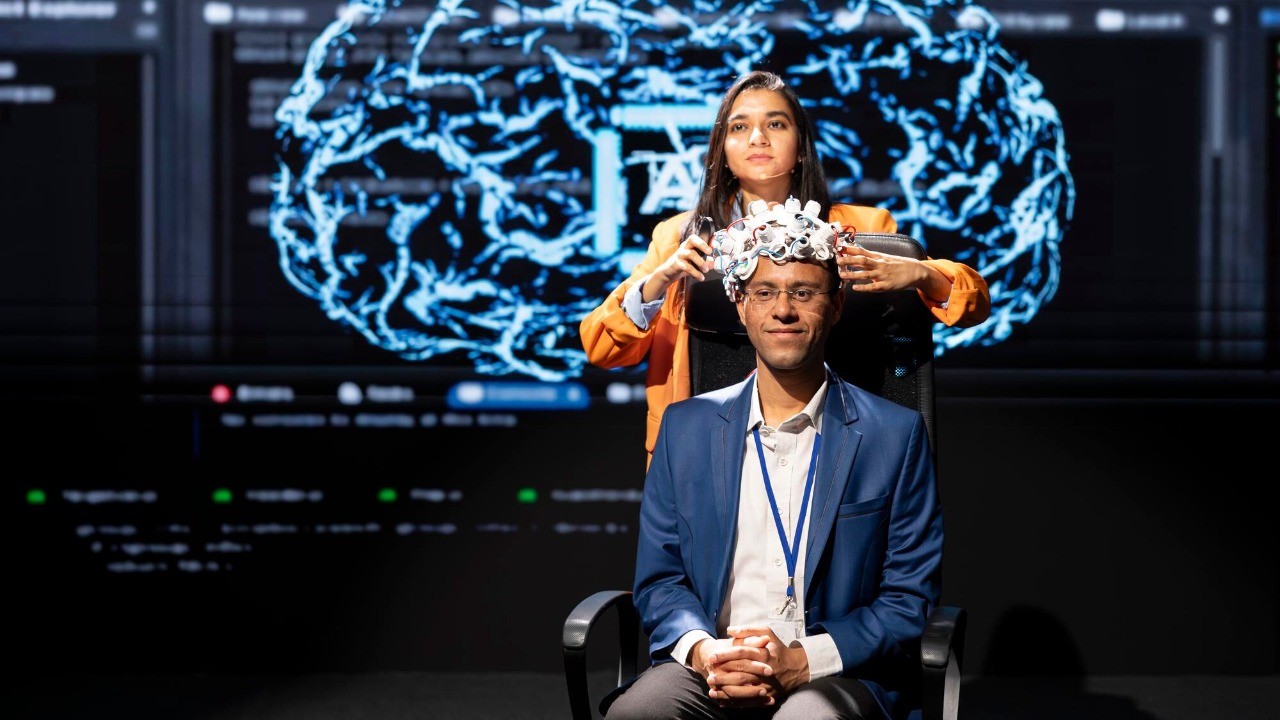

Artificial intelligence can already beat grandmasters at Go, draft legal briefs, and generate photorealistic images in seconds, yet it still struggles with the kind of flexible, context-rich learning most children pull off before middle school. The gap is not about raw processing power, it is about how the human brain organizes mistakes, uncertainty, and prior knowledge into something machines still cannot quite match. When I look at the latest research, what stands out is that our minds are not just faster or more intuitive, they are wired with structural advantages that let us outlearn even the most advanced models.
Those advantages show up in the way we block out distractions, reinterpret errors, and repurpose old skills for new problems, often without realizing it. While AI systems can be scaled with more data and bigger chips, the brain’s edge comes from how it limits itself, how it forgets, and how it refuses to treat every new task as a blank slate. That is why, despite the hype, the smartest way to use AI is still to let it amplify human learning rather than replace it.
The hidden power of “cognitive blocks”
One of the most counterintuitive findings in recent work on human learning is that the brain’s constraints are not bugs, they are features. Instead of trying to process every possible pattern, our neural circuits carve the world into manageable chunks, using what researchers describe as cognitive blocks that bundle related ideas, actions, and expectations together. These blocks act like mental building bricks, letting us reuse the same structure to navigate a subway map, learn a new software interface, or pick up the rules of a board game without starting from zero each time.
What gives the brain an edge over current AI is how flexibly it can recombine those blocks when the environment changes. Instead of relearning everything from scratch when a rule shifts, the mind can swap out one block, keep the rest, and rapidly adapt to a new task that shares only a family resemblance with the old one. In the research on these Cognitive structures, that ability to build new tasks from old parts is exactly what current machine-learning systems lack, even when they are trained on enormous datasets.
Why errors teach humans more than machines
Where AI often treats errors as noise to be minimized, the human brain treats them as information. When a prediction fails, our neural circuits do not just adjust a single weight, they reorganize expectations about cause and effect, context, and even our own competence. Work on human and AI learning has highlighted how, according to According to Frank, who has studied this paradox in humans, errors cue the brain to update information in a way that is tightly linked to motivation and attention, not just statistics.
That difference matters when tasks get messy, ambiguous, or emotionally charged. A large language model can be trained to reduce its average error rate across billions of examples, but it does not experience the sting of being wrong in front of a teacher or the relief of finally understanding a stubborn algebra concept. In the work that Frank and others describe, that emotional and cognitive coupling means a single mistake can reshape how a person approaches an entire category of problems, something current AI architectures still struggle to replicate without extensive retraining.
Creativity, not computation, is the real bottleneck
When people compare AI to the brain, they often focus on speed and scale, but the more important comparison is creativity. While AI excels in data processing and statistics, it lacks the ability to create truly innovative and creative solutions that break out of its training distribution. Human learners, by contrast, routinely combine ideas from different domains, like a musician who borrows from physics to design a new instrument or a software engineer who uses game design principles to rethink a hospital triage system.
Researchers who study the impact of automation on cognition have pointed out that While AI can remix patterns in powerful ways, its processes are only recursive, looping through what it has already seen rather than inventing genuinely new conceptual spaces. The human brain, by contrast, can treat a constraint as a prompt for originality, turning a lack of data or a surprising failure into a reason to search for a new rule, metaphor, or strategy. That is why, even as generative models flood the internet with plausible text and images, the most valuable work still comes from people who can ask better questions, not just generate more answers.
How the brain generalizes from tiny data
One of the clearest demonstrations of the brain’s learning advantage is how quickly it can generalize from very little information. A child can see a single 2024 Toyota Corolla and then recognize a 2018 model from a different angle, in different lighting, and still know it is a car, not a truck or a bus. Most AI systems need thousands of labeled images to reach similar reliability, and even then they can be fooled by small changes that would never confuse a human driver.
This efficiency comes from the way our cognitive blocks compress experience into abstract rules. Instead of memorizing every pixel, the brain learns concepts like “wheels,” “doors,” and “moves on roads,” then uses those to interpret new examples. In the work on Artificial intelligence and human learning, this kind of compositional generalization is exactly what researchers are trying to engineer into models, but it still comes naturally to people who have never heard the term “machine learning” in their lives.
Why forgetting is a feature, not a flaw
AI systems are often praised for their perfect recall, but the brain’s selective forgetting is part of what makes it so adaptable. Instead of storing every detail, our memory systems prioritize what is useful, emotionally salient, or repeatedly reinforced, letting irrelevant noise fade into the background. That pruning keeps cognitive blocks lean and flexible, so they can be reused in new contexts without being weighed down by outdated specifics.
In practice, this means a nurse who learned to chart patients in an older version of Epic can pick up a new interface quickly, because the underlying block of “record vital signs, medications, and notes” stays intact while the superficial details change. AI models, by contrast, often suffer from catastrophic forgetting when they are fine-tuned on new tasks, losing performance on old ones unless engineers carefully manage the training process. The human brain’s ability to forget strategically is one of the quiet reasons it continues to outlearn machines in dynamic, real-world environments.
Emotion, motivation, and the drive to understand
Another structural advantage the brain holds over AI is that it does not just process information, it cares about it. Curiosity, fear, pride, and frustration all shape how we allocate attention and effort, which in turn shapes what we learn and how deeply we encode it. A teenager who wants to beat friends in Valorant will absorb complex maps, weapon stats, and team strategies far faster than a model trained on the same data without any intrinsic stake in the outcome.
Researchers who compare human and machine learning have emphasized that error-driven updates in people are tightly coupled to these motivational systems. When Frank describes how errors cue the brain to update information, that process is not just a mathematical adjustment, it is a psychological event that can either energize or shut down further learning. Current AI architectures have no equivalent of a bored student or a suddenly inspired one, which is why they can grind through data tirelessly but still miss the deeper patterns that emerge when a person is driven to truly understand.
Brains learn in context, AI learns in isolation
Human learning is almost never a solo act. From the moment we start imitating caregivers, our brains are tuned to pick up cues from other people, environments, and social norms. That context shapes not only what we learn, but how we interpret it, whether it is a coding bootcamp in San Francisco, a language exchange on Duolingo, or a mechanic in Detroit teaching an apprentice how to diagnose a misfiring engine by sound alone.
By contrast, most AI systems are trained in isolation, on static datasets that strip away the messy social and physical context in which knowledge is actually used. Even when models are fine-tuned with human feedback, the interaction is narrow compared with the rich, multi-sensory, and socially embedded learning that defines human development. That is one reason why, despite impressive benchmarks, AI still struggles with tasks that require reading a room, understanding unspoken norms, or adapting instructions to the emotional state of the person on the other side of the conversation.
When AI helps the brain learn faster
None of this means AI has no place in the future of learning. In fact, the most promising work treats machines as amplifiers of human cognition rather than replacements. Educators and technologists are already experimenting with systems that analyze where a student gets stuck in algebra, then offer targeted hints instead of generic explanations, or language apps that adjust difficulty in real time based on how quickly a learner responds.
Some researchers and practitioners frame the question directly: Can machines outlearn the mind that built them, or is the real opportunity in letting the human and the algorithm work together? The most compelling vision is not a classroom run by chatbots, but a partnership where AI handles pattern spotting and personalized pacing while the teacher focuses on motivation, context, and the kind of conceptual leaps that still belong uniquely to human minds.
Guardrails against mental “dulling”
There is a real risk, however, that leaning too heavily on AI tools could erode some of the very strengths that give the brain its edge. If students outsource every draft to a text generator or rely on navigation apps for every trip, they may exercise fewer of the cognitive blocks that support spatial reasoning, memory, and original writing. Researchers who worry about whether AI is dulling our minds argue that, without deliberate guardrails, we could end up with people who are fluent in prompting systems but less practiced at thinking through problems themselves.
That concern is sharpened by the fact that, while AI excels in data processing and statistics, its processes are only recursive, as highlighted in work that notes how Every automated shortcut risks narrowing the range of mental moves we practice. The challenge for educators, parents, and policymakers is to design learning environments where AI augments, rather than replaces, the struggle that makes understanding stick. That might mean requiring students to sketch a concept map before asking a chatbot for help, or having drivers navigate familiar routes without GPS once in a while to keep their internal maps alive.
How to train your brain like a high-performance learner
If the brain’s structural advantages are real, the practical question is how to use them. The research on cognitive blocks and error-driven learning suggests a few concrete habits that can help anyone learn more like a high-performance system. First, breaking complex skills into reusable chunks, whether you are learning Python, jazz piano, or advanced Excel modeling, mirrors the way the brain naturally organizes information. Instead of treating each new project as unique, you deliberately look for the blocks you can carry over, which makes transfer to new tasks faster and more reliable.
Second, leaning into mistakes rather than avoiding them taps the same mechanisms that Sep research on human learning highlights. That can be as simple as keeping a “bug log” when you code, writing down not just what went wrong but what pattern it reveals about your thinking, or reviewing missed questions on a practice exam before celebrating the ones you got right. Over time, those habits train your brain to treat errors as valuable signals, not personal failures, which is exactly the mindset that lets humans keep outlearning the machines built to imitate them.
More from MorningOverview