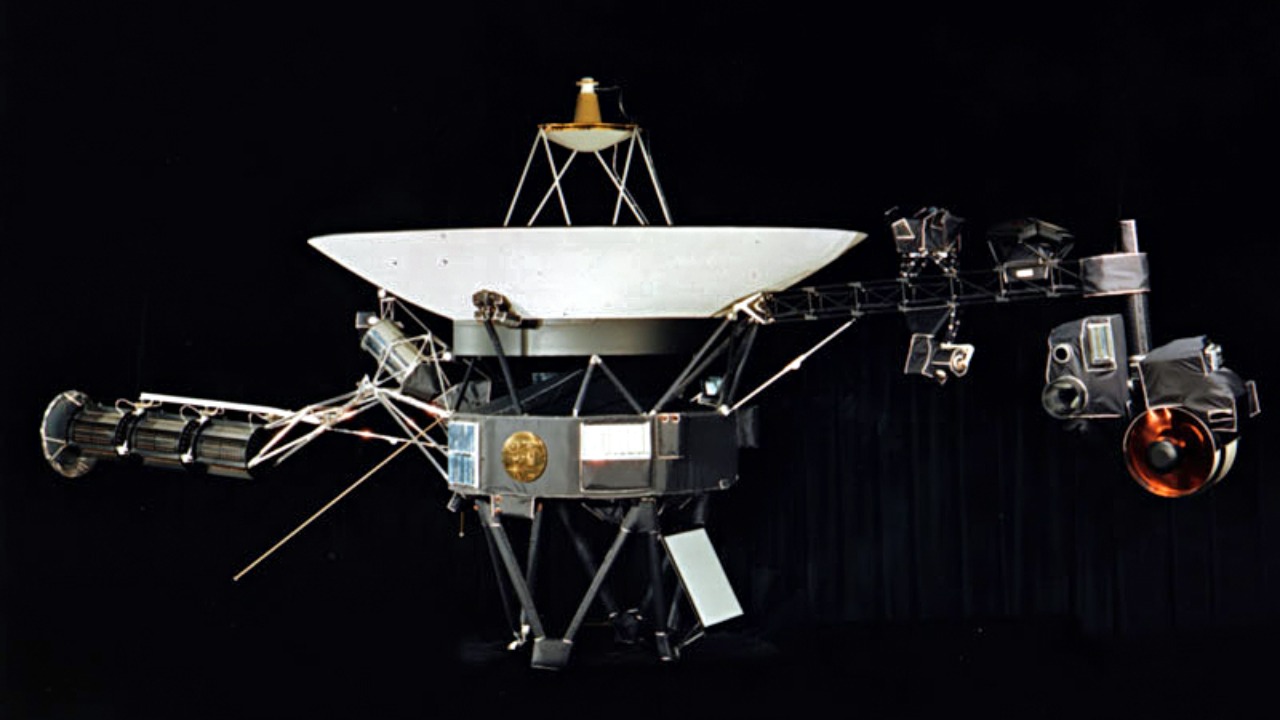

At the ragged frontier where the Sun’s influence gives way to interstellar space, Voyager 1 has stumbled into something that sounds more like science fiction than plasma physics: a blisteringly hot boundary region with temperatures reported around 54,000 degrees Fahrenheit. The discovery reframes the edge of the solar system not as a quiet fade-out, but as a turbulent, superheated interface where our star’s outflow slams into the thin gas between the stars.
What Voyager 1 is sensing out there is not a solid barrier or a literal wall of flames, but a complex sheath of charged particles and compressed gas that behaves like a fiery rampart around the Sun’s domain. I see this as one of those rare moments when a decades‑old spacecraft forces scientists, and the rest of us, to redraw the mental map of where “home” ends and the galaxy begins.
Voyager 1’s long journey to the solar system’s edge
To understand why this latest finding matters, it helps to remember just how far Voyager 1 has traveled. Launched in 1977 as part of a twin mission, the spacecraft used gravity assists at Jupiter and Saturn to gain the speed it needed to climb out of the planetary neighborhood and head toward the outer reaches of the Sun’s influence, a region that mission scientists describe in detail on the official Voyager 1 mission page. Over the decades, its trajectory has carried it beyond the orbits of Uranus and Neptune, then past the Kuiper Belt, into a realm where the Sun is no longer a bright disk but a particularly luminous star among many.
Voyager 1 is now widely recognized as the most distant human‑made object, a status documented in technical and historical overviews such as the Voyager 1 entry that tracks its milestones and current distance from Earth. From that vantage point, the spacecraft has already crossed the heliopause into what scientists call interstellar space, yet it continues to sample the charged particles and magnetic fields that define the Sun’s outer cocoon. It is in this liminal zone, where the solar wind collides with the interstellar medium, that the newly reported “wall” of extreme temperature appears.
What a 54,000°F “wall” really means in space physics
When reports describe Voyager 1 encountering a 54,000 degree Fahrenheit barrier, the phrase conjures an image of a glowing curtain of fire, but the physics is more subtle and more interesting. What the spacecraft is detecting is a region where the temperature of the plasma, the ionized gas that carries the solar wind, spikes dramatically as the Sun’s outflow is compressed and slowed by the surrounding interstellar material, a scenario laid out in coverage of the 54,000°F boundary. In this context, “temperature” refers to the average kinetic energy of individual particles, not the kind of heat you would feel on your skin.
Scientists analyzing Voyager data describe this boundary layer as a sheath where particle energies correspond to tens of thousands of degrees, a range that independent explainers translate into roughly 30,000 to 50,000 kelvin, or up to about 54,000 degrees Fahrenheit, at the edge of the Sun’s domain. One detailed breakdown of the measurements notes that the spacecraft’s instruments infer a 30,000–50,000 kelvin wall in the transition region, which matches the dramatic temperature figure now circulating. In practical terms, that means individual ions are moving at enormous speeds, even though the gas itself is so tenuous that a human body placed there would not “burn” in any familiar sense.
How Voyager 1 detected the superheated boundary
Voyager 1 does not carry a thermometer in the everyday sense, so the claim of a 54,000°F region rests on how its instruments read the behavior of charged particles and magnetic fields. The spacecraft’s plasma wave system and related detectors measure fluctuations in electron density and the energy of incoming particles, which researchers then translate into an effective temperature for the surrounding plasma. Reports describing the recent analysis explain that as Voyager 1 moved farther from the Sun, it recorded a sharp change in particle energies that signaled entry into a much hotter, more compressed layer, a pattern highlighted in coverage of the spacecraft hitting the 54,000°F region.
Because the plasma is so diffuse, these measurements rely on counting very small numbers of particles and tracking how their energies shift over time, which is why scientists cross‑check the data against models of the heliosphere and the interstellar medium. Visual explainers, including a widely shared Voyager 1 boundary animation, walk through how the spacecraft’s instruments convert those subtle signals into a map of the temperature and density structure around the heliopause. The emerging picture is that Voyager 1 has moved through a region where the solar wind is squeezed and heated as it piles up against the interstellar gas, creating the “wall” signature in the data.
The heliosphere, heliopause, and where this “wall” fits in
To place this hot boundary in context, it helps to picture the heliosphere as a vast bubble carved out of the galaxy by the solar wind, with the Sun at its center and the planets orbiting well inside. The outermost region where the solar wind slows and interacts with the interstellar medium is known as the heliopause, and Voyager 1’s crossing of that frontier is a key milestone in its mission history, as chronicled in both official mission timelines and broader overviews like the report on the fiery solar system edge. The newly reported temperature spike appears to sit in the complex transition zone around this boundary, where the Sun’s influence is fading but not yet gone.
In that region, the solar wind slows from supersonic to subsonic speeds, magnetic fields drape and twist, and interstellar particles begin to leak into the heliosphere, creating a layered structure rather than a clean, sharp edge. Analyses that focus on the temperature data suggest that the 30,000–50,000 kelvin “wall” corresponds to a sheath where the solar wind is compressed and heated just before it fully yields to the interstellar flow, a scenario that aligns with the visual breakdown of Voyager’s path through the heliosphere. In that sense, the wall is not a separate object, but a particularly energetic slice of the Sun’s outer bubble.
Why a 30,000–50,000 kelvin plasma layer matters
From a scientific perspective, the discovery of a plasma layer at 30,000 to 50,000 kelvin at the edge of the heliosphere is a crucial test of how well models capture the interaction between stellar winds and the interstellar medium. The temperature range reported in detailed explainers of the heliospheric wall matches long‑standing predictions that the solar wind should heat up as it is compressed, but the exact values and thickness of the layer help refine those models. For astrophysicists, that means better constraints on how similar bubbles around other stars might behave, which in turn affects how we think about cosmic rays, stellar environments, and even the shielding of planetary systems.
There is also a practical dimension to mapping this hot boundary, because the heliosphere acts as a kind of radiation shield that modulates the flux of high‑energy particles entering the inner solar system. By measuring how the temperature and density change across the boundary, Voyager 1 provides direct evidence of how effective that shield is, and how it might vary over the Sun’s activity cycle. Reports that frame the 54,000°F region as a “wall of fire” at the solar system’s edge, such as the coverage of the extreme temperature, are tapping into this deeper story about how our star shapes the radiation environment that future interstellar probes, and any hypothetical crewed missions, will have to navigate.
Separating science from viral “wall of fire” hype
The phrase “wall of fire” has spread quickly across social media and video platforms, and while it captures the drama of the discovery, it also risks misleading people about what Voyager 1 has actually found. In reality, the spacecraft is moving through an incredibly thin plasma where the density is far lower than the best vacuum we can create in a laboratory, even though the particle energies correspond to tens of thousands of degrees. Some of the most widely shared clips, including a popular short video about the “wall of fire”, lean heavily on the fiery imagery without always emphasizing that this is a diffuse, invisible gas rather than a literal curtain of flames.
That tension between accurate physics and viral storytelling is also evident in discussion threads and fan communities that have amplified the news, such as posts in a large space‑focused Facebook group where users trade interpretations of what Voyager 1 is seeing. I find that the most responsible coverage strikes a balance, using the “wall” metaphor to hook attention while quickly grounding it in the language of plasma temperatures, particle densities, and heliospheric structure. The underlying data, as summarized in more technical explainers, support the existence of a hot boundary layer, but they do not point to a solid barrier or a region that would look fiery to the naked eye.
Voyager 1’s aging hardware and the challenge of reading its data
Interpreting these boundary measurements is made more challenging by the fact that Voyager 1 is operating far beyond its original design lifetime, with instruments and power systems that have been running for nearly half a century. The spacecraft’s radioisotope thermoelectric generators are slowly losing output, forcing engineers to shut down nonessential systems to keep the key science instruments alive, a reality that mission histories like the Voyager 1 overview describe in detail. That means every new dataset from the edge of the heliosphere is both precious and constrained, shaped by the limitations of aging detectors and the need to prioritize certain measurements over others.
Despite those constraints, the mission team continues to extract meaningful information from the spacecraft’s plasma and magnetic field instruments, cross‑checking the readings against models and previous crossings of heliospheric boundaries. Public‑facing explainers, including a widely viewed video walkthrough of Voyager’s current status, emphasize how engineers have had to improvise new operating modes to keep the data flowing. In that context, the identification of a 54,000°F boundary layer is not just a scientific result, but also a testament to the ingenuity required to interpret faint signals from a probe that is now so far away that its radio messages take many hours to reach Earth.
How this discovery reshapes our mental map of “the solar system”
For most of us, the phrase “edge of the solar system” still evokes the orbit of Pluto or perhaps the distant Kuiper Belt, but Voyager 1’s latest findings underscore how much larger and more complex the Sun’s true domain really is. The detection of a superheated plasma layer at the heliopause suggests that the boundary between solar space and interstellar space is not a simple line, but a structured region with distinct physical properties, including the 30,000–50,000 kelvin temperatures highlighted in detailed analyses of the outer heliosphere. That realization forces a shift in how I think about “inside” and “outside” the solar system, replacing a tidy border with a dynamic, layered frontier.
It also reframes the narrative of Voyager 1 itself. The spacecraft is not simply drifting into a featureless interstellar void, but is instead threading its way through a complex interface region where the Sun’s influence is still being negotiated with the surrounding galaxy. Some of the more accessible explainers, such as the animated breakdown of the heliopause, make clear that this hot boundary is part of a broader story about how stars carve out cavities in the interstellar medium. In that sense, the 54,000°F “wall” is both a local curiosity and a window into a universal process that shapes the environments of stars across the Milky Way.
What comes next for Voyager 1 and interstellar exploration
Looking ahead, Voyager 1 will continue to move deeper into interstellar space, but its ability to map the structure of the heliosphere’s outer layers is limited by its dwindling power and aging instruments. Mission planners expect that, over the coming years, more systems will have to be turned off, gradually reducing the stream of data that has made discoveries like the 54,000°F boundary possible, a reality that is implicit in long‑form discussions of the mission’s extended phase. That makes each new analysis of its measurements, including the identification of the hot plasma layer, feel like a final set of postcards from the edge of the Sun’s domain.
At the same time, the insights Voyager 1 is providing are already shaping plans for future interstellar probes that could carry more advanced instruments specifically designed to study the heliopause and beyond. Commentaries that frame the recent findings as a fiery frontier at the solar system’s edge hint at a broader shift in how space agencies and researchers think about the next generation of deep‑space missions. I see the reported 54,000°F wall not as the end of the story, but as a starting point for a new era of exploration that treats the boundary between solar and interstellar space as a rich scientific target in its own right.
More from MorningOverview