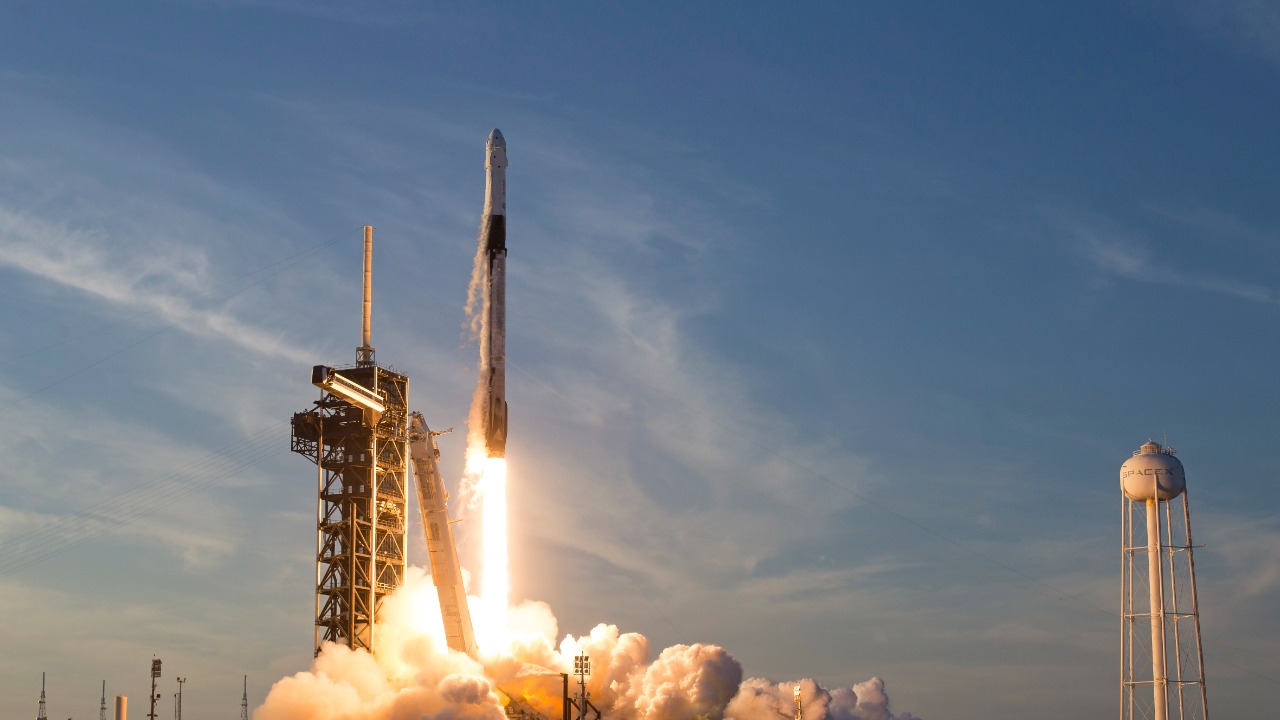

China’s rocket industry is racing to master rapid reuse, not just to match SpaceX’s Falcon 9, but to potentially vault past it in cost, cadence, and strategic reach. A wave of state-backed and private launch companies is converging on similar vertical-landing architectures while experimenting with new engines, offshore pads, and aggressive reflight targets that could reset the economics of getting to orbit.
If these efforts converge, the next generation of Chinese boosters could undercut Falcon 9 on price, saturate low Earth orbit with domestic constellations, and give Beijing a powerful lever in both commercial and military space. I see a clear pattern in the reporting: China is not copying SpaceX one rocket at a time, it is building a whole ecosystem designed to compress a decade of American learning into just a few years.
Falcon 9 set the benchmark China now wants to beat
Any claim that China might leap ahead starts with acknowledging how thoroughly Falcon 9 has defined the modern launch market. SpaceX turned reusable first stages from a risky experiment into a routine service, landing boosters on droneships, flying them again and again, and driving down per‑kilogram prices to the point where legacy expendable rockets look uneconomical. That performance is the yardstick Chinese planners and entrepreneurs are using as they sketch their own reusable fleets.
Chinese officials and engineers are not shy about the reference point. Reporting shows that national space planners have been studying reusable rockets similar to SpaceX, focusing on vertical landings, grid fins, and propulsive returns that echo Falcon 9’s profile. The goal is not mere imitation. By starting from a proven architecture, Chinese teams can skip years of trial and error, then layer on their own optimizations in engines, structures, and operations that might let them surpass Falcon 9’s performance envelope and turnaround times.
A crowded Chinese field targeting rapid reuse
What stands out in the Chinese push is how many players are converging on reuse at once. Instead of a single national champion, there is a mix of big state contractors and nimble startups, all chasing the same prize of low‑cost, high‑cadence orbital access. That competition creates pressure to move faster, test more often, and take calculated risks that a purely state‑run program might avoid.
On the state side, large groups such as CASC are developing reusable variants of their workhorse launchers, while private firms like LandSpace and Space Pioneer are preparing commercial reusable rockets of their own. Community comparisons, including a detailed thread posted on Nov 14, 2025 that notes how As Chinese reusable rockets from CASC, LandSpace, and Space Pioneer are ready to launch commercially, underscore how quickly this ecosystem is maturing. When multiple companies are racing to prove the same capability, the odds rise that at least one will find a way to out‑perform Falcon 9 on some key metric.
Engine breakthroughs and static‑fire milestones
Reusable rockets live or die on their engines, and Chinese firms are pouring effort into high‑thrust, restartable powerplants that can survive repeated flights. Instead of treating static fires as mere checkboxes, they are using them as public proof points that their designs are ready to move from test stands to launch pads. Each successful firing shortens the gap between concept and operational reuse.
One of the clearest examples comes from Beijing’s private sector. Reporting from Oct 21, 2025 describes how China’s private space industry is looking to emulate SpaceX’s success by flying reusable rockets to orbit, with a Beijing‑based company acing a major engine test that cleared the way for a near‑term launch. The report notes that China is explicitly targeting the kind of rapid reuse that made Falcon 9 one of the most flown orbital rockets of all time last year, and it frames the static fire as a pivotal step toward that goal. When engines are designed from the outset for multiple cycles, rather than stretched from expendable heritage, they can eventually support more aggressive reflight schedules than Falcon 9 has yet demonstrated.
Tianlong‑3 and the offshore test that hints at higher cadence
Among the new vehicles, Tianlong‑3 has emerged as a bellwether for how far Chinese private launchers are willing to push. The rocket is designed for vertical landing and reuse, but what really signals ambition is how its developers are testing it: not just on inland pads, but from offshore platforms that could one day support high‑frequency launches without congesting coastal spaceports. That approach mirrors, and could eventually refine, the sea‑based operations SpaceX uses for Falcon 9.
In reporting dated Sep 16, 2025, engineers described how On Monday the company fired nine Tianhuo‑12 engines together for 35 seconds from an offshore platform in Shandong province, a full‑duration static fire that validated the clustered propulsion system under realistic conditions. The test, which involved the Tianhuo engines operating in concert, is tied to plans for a large constellation that could deploy more than 13,000 satellites. If Tianlong‑3 can routinely launch from sea platforms and recover its first stage for reuse, it could support a launch cadence that rivals or even exceeds Falcon 9’s busiest years, especially if multiple platforms operate in parallel.
Deep Blue Aerospace and the vertical‑landing learning curve
Engine tests are only half the story. To truly rival Falcon 9, Chinese rockets must master the choreography of boostback, reentry, and precision landing that SpaceX refined over hundreds of flights. Here, smaller companies are playing an outsized role, using subscale demonstrators and incremental hops to build the software and control heritage that larger orbital vehicles will later inherit.
One of those firms is Jiangsu Deep Blue Aerospace Technology Company. On Sep 15, 2024, The CEO of the privately‑owned Jiangsu Deep Blue Aerospace Technology Company went on the record saying that the firm planned to carry out a key test of reusable rocket technology later that month. The company has been working on vertical takeoff and vertical landing prototypes that echo Falcon 9’s recovery profile, but with the benefit of modern sensors and flight computers that did not exist when SpaceX began its own Grasshopper tests. If Deep Blue and its peers can compress that learning curve, they may reach reliable landings with fewer flights, freeing them to focus sooner on turnaround speed and cost per reflight.
Space Epoch and the race to reliable recovery
Another crucial piece of the puzzle is proving that a booster can not only land, but do so in a way that is repeatable and economical. That is where companies like Space Epoch come in, using dedicated test vehicles to validate guidance, navigation, and control systems that will later migrate to operational rockets. Each successful recovery test reduces the technical risk of betting entire commercial constellations on reusable hardware.
Earlier this year, Space Epoch conducted a flight recovery test that it described as a major breakthrough in the development of liquid reusable rocket technology. Reporting from May 28, 2025 notes that the success of this flight recovery test was framed as a key step toward the company’s broader ambitions, even though no dates have been revealed for an orbital launch. By proving that a liquid‑fueled stage can survive ascent, controlled descent, and landing, Space Epoch is building the operational confidence that investors and government customers will demand before shifting large payloads from expendable rockets to reusable ones.
Strategic rivalry: China, SpaceX, and the Jeff Bezos factor
Reusable rockets are not just an engineering contest, they are a strategic race for market share and geopolitical influence. SpaceX’s Falcon 9 currently dominates commercial launches, but China’s leadership sees an opportunity to challenge that dominance by offering competitive prices and guaranteed access for domestic and aligned customers. At the same time, the rivalry is not only with SpaceX, but also with other American players that aspire to the same market.
One report from Sep 11, 2024 captures this dynamic by noting that China is targeting SpaceX’s reusable rocket lead and seeking to replace Jeff Bezos as Elon Musk’s top space rival. The piece highlights how His bigger New Glenn rocket, designed to deliver satellites to orbit and fly a minimum of 25 times, is expected to debut as part of that competition. By positioning its own reusable fleet against both Falcon 9 and New Glenn, China is signaling that it intends to be a permanent fixture in the global launch market, not a niche provider. If Chinese rockets can match or beat the reflight targets that New Glenn is designed for, they could undercut both American rivals on price and availability.
Policy backing and the industrial machine behind reuse
Technical milestones only matter if they are backed by sustained policy support and industrial capacity, and here China has a structural advantage. Central planners can align funding, regulation, and state‑owned supply chains to accelerate promising designs, while private firms tap into a deep pool of aerospace talent and manufacturing infrastructure. That coordination can shorten development cycles and smooth the path from prototype to mass production.
Evidence of this alignment appears in multiple reports that describe how China is systematically studying reusable rockets similar to SpaceX and integrating those lessons into national plans. When a Beijing‑based company aces an engine test, or when a firm like Jiangsu Deep Blue Aerospace Technology Company announces a new landing trial, they are not operating in a vacuum. They are part of a broader strategy that includes constellation planning, ground infrastructure, and regulatory frameworks designed to make reuse the default, not the exception. That kind of whole‑of‑industry push could allow Chinese rockets to scale up faster than Falcon 9 did in its early years.
How China could leapfrog Falcon 9 in the next phase
Putting these threads together, I see several ways Chinese reusable rockets could move beyond simply matching Falcon 9 to surpassing it in key areas. First, by starting later, Chinese designers can incorporate a decade of global experience into their first‑generation reusable vehicles, avoiding some of the compromises baked into Falcon 9’s original design. Second, the use of offshore platforms, as seen in the Tianlong‑3 test from Shandong, opens the door to higher launch cadence with fewer range conflicts, something SpaceX is only now scaling up with its own sea‑based infrastructure.
Third, the sheer number of actors, from CASC and LandSpace to Space Pioneer, Jiangsu Deep Blue Aerospace Technology Company, and Space Epoch, creates a diversified innovation pipeline. When China’s private space industry is looking to emulate SpaceX’s success while state giants pursue their own reusable variants, the result is a portfolio of designs that can be optimized for different payload classes and orbits. If even a few of these vehicles achieve reliable reuse with turnaround times shorter than Falcon 9’s typical refurbishment cycles, China will not just have caught up. It will have built a launch ecosystem capable of outpacing the benchmark that once seemed unassailable.
More from MorningOverview