
Mars orbiters have given astronomers an unexpected new vantage point on 3I/ATLAS, sharply tightening estimates of the interstellar visitor’s trajectory through the inner solar system. By combining those off‑Earth images with ground‑based tracking, researchers say they have cut the uncertainty in the object’s path by roughly an order of magnitude, turning a once‑fuzzy arc into a far more precise route through our planetary neighborhood.
That refined track is not just a technical win for orbital mechanics. It is also a test case for how the solar system can use its own planets and spacecraft as a distributed sensor network, one that could eventually help determine whether a future interstellar object or long‑period comet poses any realistic risk to Earth.
Why 3I/ATLAS matters in the interstellar story
Interstellar objects are rare enough that each one effectively becomes a once‑in‑a‑generation laboratory for studying material from beyond the solar system. 3I/ATLAS, an object with a comet‑like appearance that passed through the inner solar system on a hyperbolic trajectory, offered astronomers another chance to probe how such visitors move, fragment, and interact with sunlight and the solar wind as they speed back into deep space. Its orbit is not bound to the Sun, which means its path encodes information about where it came from and how it was nudged on its way here.
Because 3I/ATLAS was discovered after its closest approach and was already fading, the window to collect high‑quality data was narrow, and early orbital solutions carried large uncertainties. Researchers tracking the object’s motion, as described in mission notes on its interstellar trajectory, focused on pinning down its incoming and outgoing velocity vectors as precisely as possible, since even small errors in those numbers can translate into huge differences when projected back to its origin in the Milky Way.
How Mars became an off‑Earth observatory
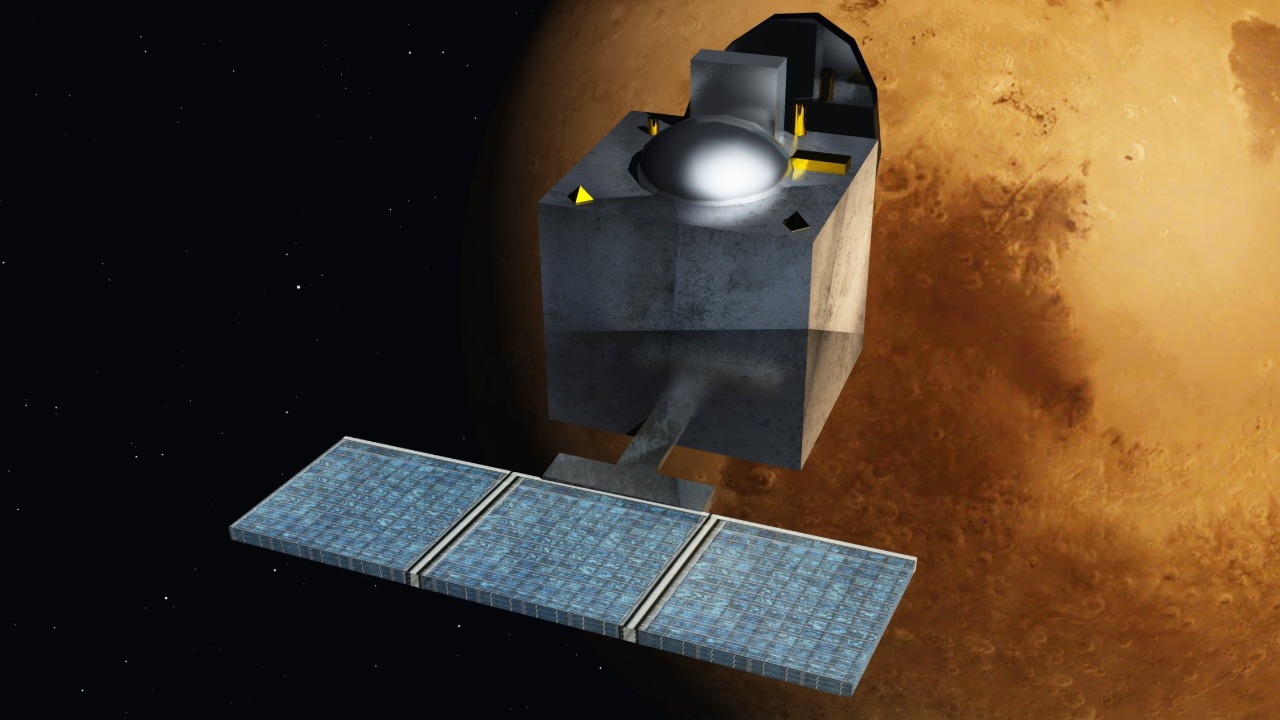
What changed the game for 3I/ATLAS was the realization that Mars‑orbiting spacecraft could watch the object from a completely different angle than telescopes on or near Earth. The ExoMars Trace Gas Orbiter (TGO), circling Mars, was in a position to capture images of the faint visitor against a different star background, effectively turning the Red Planet into a second observing platform. That geometry allowed scientists to triangulate the object’s position in three dimensions instead of relying on a single line of sight.
Analyses of those observations explain how the TGO team used a series of long‑exposure images to extract the moving point of light corresponding to 3I/ATLAS and then folded those measurements into existing orbital solutions. Reporting on the campaign notes that the Mars‑based data, when combined with Earth‑based tracking, significantly tightened the object’s calculated path, a result highlighted in technical summaries of how TGO refined its route.
Ten‑fold improvement in the orbit: what that really means
A ten‑fold improvement in an orbit solution does not mean astronomers were wildly off at the start; it means the “error bars” around the predicted path shrank dramatically. For 3I/ATLAS, early estimates of where it had been and where it was going formed a broad corridor through space, wide enough that reconstructing its birthplace or predicting its exact future position was difficult. After the Mars orbiter data were added, that corridor narrowed to a much slimmer tube, giving scientists far more confidence in both backward and forward projections of its motion.
Researchers involved in the analysis describe how this improvement came from reducing uncertainties in key parameters like the object’s inclination, eccentricity, and asymptotic velocity, which together define its hyperbolic trajectory. Coverage of the results emphasizes that the Mars‑based images cut the positional uncertainty by roughly an order of magnitude, a leap in precision that surprised some in the community and is detailed in reports on how a Mars orbiter narrowed the path.
Reconstructing the journey through the inner solar system
With a sharper orbit in hand, astronomers can replay 3I/ATLAS’s passage through the inner solar system almost frame by frame. The refined trajectory clarifies how close the object came to Mars and Earth, how its speed changed as it fell into and then climbed out of the Sun’s gravitational well, and how its tail and coma evolved as it was heated. That reconstruction is essential for interpreting brightness measurements and any signs of fragmentation or outgassing that might have altered its motion.
Detailed reconstructions presented by mission scientists show the object’s path as a sweeping hyperbola that threads between the orbits of the inner planets before heading back into interstellar space. Visualizations of that journey, based on the updated orbital elements, are highlighted in explainers that walk through how astronomers pinpointed its path, underscoring how the Mars vantage point turned a rough sketch into a more faithful replay of its solar system flyby.
What the Mars data reveal about 3I/ATLAS itself
Trajectory is only part of the story; the Mars‑based observations also help constrain what kind of object 3I/ATLAS is. By comparing its brightness from different viewing angles and distances, astronomers can infer its size, reflectivity, and activity level, even when the object is too faint for detailed spectroscopy. If its motion deviates from a purely gravitational path, that can signal jets of gas and dust pushing it slightly off course, a hallmark of comet‑like behavior.
Mission write‑ups note that the refined orbit, combined with photometric data, supports the interpretation of 3I/ATLAS as a small, active body that behaved broadly like a comet, though with some uncertainties that remain because of its faintness and late discovery. Technical background on the object’s physical characteristics, including its apparent magnitude and inferred nucleus size, is summarized in agency material that outlines what is known about 3I/ATLAS, while the Mars‑assisted tracking adds confidence that any subtle non‑gravitational forces are properly accounted for in its orbit.
Planetary defense lessons from an interstellar visitor
Although 3I/ATLAS itself is not a threat to Earth, the techniques used to track it have clear implications for planetary defense. If a future interstellar object or long‑period comet were on a trajectory that raised concern, having a second or third vantage point from other planets or spacecraft could dramatically speed up efforts to determine whether it would actually hit Earth or pass safely by. The 3I/ATLAS campaign effectively served as a rehearsal for that kind of multi‑platform tracking.
Analyses of the Mars‑assisted orbit solution argue that the ten‑fold reduction in uncertainty illustrates how quickly risk assessments could improve if planetary missions are prepared to pivot and observe a newly discovered object. Commentaries on the work point out that the same approach could be applied using spacecraft around Mars, Jupiter, or even smaller bodies, a point underscored in coverage of how Mars‑based images could aid future Earth protection.
Inside the ExoMars Trace Gas Orbiter’s role
The ExoMars Trace Gas Orbiter was not designed to chase interstellar objects; its primary mission is to study the Martian atmosphere and search for trace gases like methane. Yet its sensitive camera systems and stable orbit made it an opportunistic asset for tracking a faint, fast‑moving point of light like 3I/ATLAS. Mission teams had to adjust observation schedules and exposure settings to capture the object without saturating the detector with background stars or Martian glare.
Project summaries describe how the TGO team coordinated with ground‑based observers to time their imaging runs, then processed the data to isolate the moving target from noise. Those efforts are detailed in technical briefings that explain how TGO helped pinpoint the path, turning a spacecraft built for atmospheric science into a key contributor to interstellar object tracking.
Debates and open questions about interstellar visitors
Every interstellar object discovered so far has sparked debate about its origin and composition, and 3I/ATLAS is no exception. Some researchers argue that such bodies are likely fragments from distant planetary systems, ejected during the chaotic early stages of planet formation, while others suggest more exotic possibilities. The improved orbit from Mars does not settle those debates, but it does provide a firmer foundation for any models that try to trace the object back to a particular region of the galaxy.
Astrophysicist Avi Loeb, for example, has used earlier interstellar visitors as case studies in how to interpret unusual trajectories and brightness profiles, and he has fielded questions about what 3I/ATLAS might tell us about the broader population of such objects. In a public Q&A, he discusses how better orbital data can sharpen tests of competing hypotheses about interstellar debris, a perspective captured in a transcript of his discussion that situates 3I/ATLAS within the emerging field of interstellar object studies.
Public fascination and the view from Mars enthusiasts
Beyond the technical community, 3I/ATLAS has drawn attention from space enthusiasts who are captivated by the idea of material from another star system briefly visiting our own. The fact that Mars, a world already central to human exploration plans, played a role in tracking the object only adds to that appeal. For many, the story illustrates how the solar system is becoming a more interconnected observational platform as more spacecraft take up residence around other planets.
That fascination shows up in online discussions where Mars fans share mission images, animations, and news about the object’s flyby, including threads that highlight how Mars helped track the visitor using its orbiters. Short explainer videos and social clips have also circulated, breaking down the basics of interstellar trajectories and the role of the ExoMars Trace Gas Orbiter, such as a brief video overview that walks viewers through the geometry of the Mars‑assisted observations.
How media and explainers are shaping the narrative
As with earlier interstellar objects, much of the public’s understanding of 3I/ATLAS comes through a mix of news coverage, agency explainers, and commentary pieces that translate technical orbital mechanics into accessible language. Some stories focus on the novelty of using Mars as a second observatory, while others emphasize the planetary defense angle or the broader implications for interstellar science. Together, they frame the Mars‑assisted tracking as a milestone in how quickly and precisely we can respond to unexpected visitors from deep space.
Feature pieces have walked readers through the sequence of discovery, follow‑up observations, and the eventual incorporation of Mars orbiter data, highlighting how each step sharpened the picture of 3I/ATLAS’s journey. One such explainer traces how the object’s story became clearer as more data flowed in, describing how its journey grew more defined thanks to the Mars observations, while another synthesis underscores how astronomers used Mars‑based data to lock in its path.
More from MorningOverview