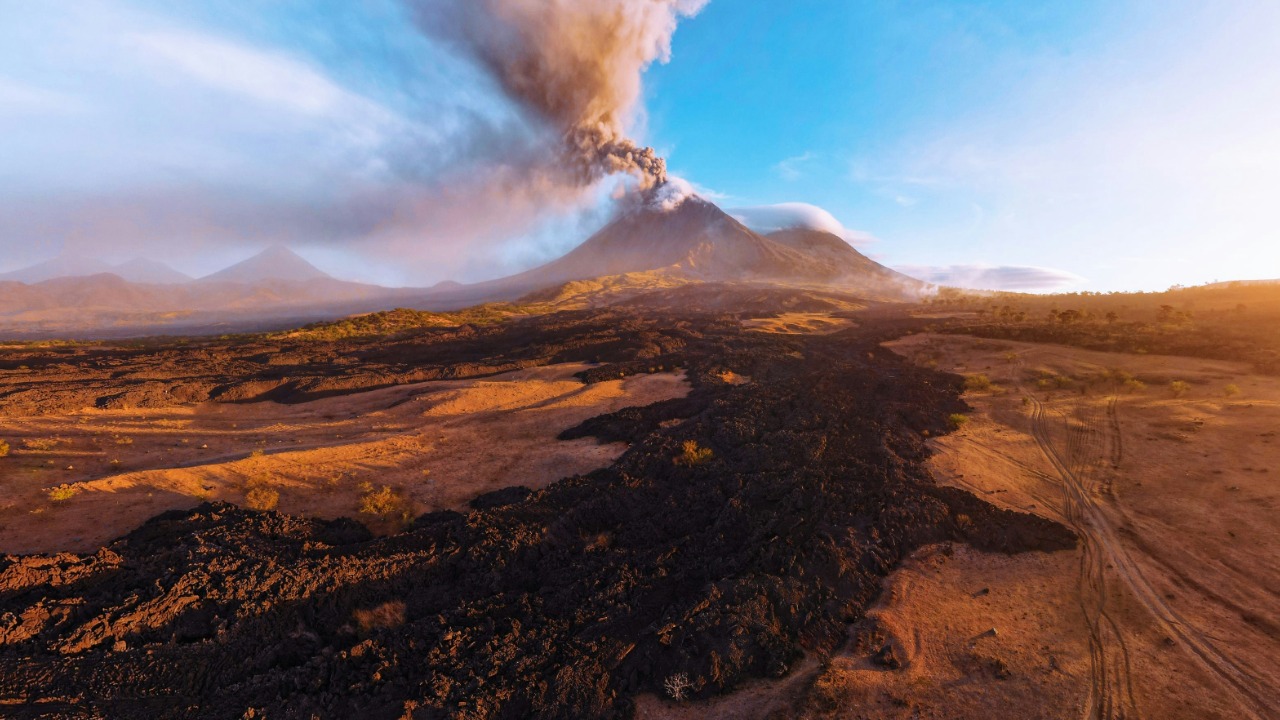

The sudden awakening of a volcano that had been quiet for roughly 12,000 years has transformed a remote corner of Ethiopia into a global focal point, as a towering ash plume shot into the sky like an explosive “ash bomb” and spread across international air routes. After millennia of geological silence, the eruption has forced scientists, governments, and nearby communities to confront how little we truly know about long-dormant volcanic systems. I want to unpack what happened, why this particular blast matters far beyond its crater, and how it fits into a broader pattern of risk in a warming, more densely populated world.
The sleeping giant that finally woke up
When a volcano that has not erupted since the last Ice Age suddenly roars back to life, the first question is simple: what changed? In this case, the Ethiopian volcano had been classified as dormant for about 12,000 years, a span that predates written history and most of the civilizations that now depend on the air routes and trade corridors passing nearby. That long quiet period meant many hazard maps treated the mountain as a background feature rather than an active threat, so the abrupt transition from geological calm to explosive activity has come as a shock to residents and observers alike, who watched a dense ash column rise with almost no public warning.
Eyewitness accounts describe the initial blast as a sudden, concussive event that felt like a bomb going off, with a dark plume punching into the sky and ash beginning to fall on surrounding settlements within minutes. Reporting on the first phase of activity notes that the volcano erupted for the first time in roughly 12,000 years and that the eruption unfolded “like a sudden bomb,” language that captures both the speed and violence of the event and is reflected in early coverage of the 12,000-year eruption. For people living on the flanks of the volcano, the shift from a familiar, seemingly inert mountain to an active source of ash and gas has been as psychological as it is physical, upending assumptions about what counts as “safe” terrain.
Where the eruption is unfolding and who is in harm’s way
Location determines everything in a volcanic crisis, from who breathes the ash to which economies absorb the shock. The volcano at the center of this event sits in Ethiopia, within the tectonically active region that stretches along the East African Rift, where the African continent is slowly splitting apart. That setting has long been known for geothermal activity and smaller eruptions, but this particular peak had not been part of the usual watch list, which is why its reawakening has drawn such intense scrutiny from regional authorities and international scientists trying to map out the new risk footprint.
Local reports describe ash falling on nearby communities and drifting across parts of Ethiopia’s highlands, with residents facing reduced visibility, respiratory irritation, and concerns about contamination of water sources and crops. Coverage of the event emphasizes that the volcano had been dormant for about 12,000 years before it exploded and that its ash is now spreading well beyond the immediate crater, a pattern highlighted in detailed accounts of the Ethiopian ash plume. For people living downwind, the eruption is not an abstract geological curiosity but a direct threat to health, agriculture, and mobility, especially in rural areas where medical care and air filtration are limited.
How the ash bomb unfolded in real time
The sequence of events, as best as scientists and journalists can reconstruct it, began with a sharp uptick in seismic activity beneath the volcano, followed by a rapid escalation into an explosive eruption that lofted ash high into the atmosphere. Residents reported a loud, booming sound and a sudden darkening of the sky as the plume rose, suggesting a powerful release of gas and fragmented rock rather than a slow, effusive lava flow. That kind of explosive onset is typical of volcanoes where magma has been trapped and pressurized over long periods, then suddenly finds a pathway to the surface.
As the eruption progressed, satellite imagery and pilot reports indicated that the ash column reached cruising altitudes used by commercial jets, forcing aviation authorities to reroute flights and issue warnings to airlines operating in and out of East Africa. One account describes the volcano erupting for the first time in almost 12,000 years and notes that the ash cloud quickly became a concern for air traffic, underscoring how even a remote mountain can disrupt global systems when it injects material into key flight corridors, a point reinforced in coverage of the near-12,000-year event. The speed with which the ash spread, and the need for immediate rerouting, highlight how little lead time modern infrastructure sometimes has when nature moves on its own schedule.
What scientists know, and do not know, about a 12,000-year pause
From a scientific perspective, a volcano that has been quiet for roughly 12,000 years sits in a gray zone between “extinct” and “active,” and this eruption is forcing a rethinking of how those labels are applied. Many hazard assessments rely on the historical record of eruptions, which in most regions only stretches back a few centuries at best, so a volcano that last erupted in the late Pleistocene can easily slip through the cracks of modern risk planning. The Ethiopian blast is a stark reminder that geological timescales do not align neatly with human memory, and that a lack of recent activity does not guarantee future safety.
Researchers who study long-dormant systems have pointed out that magma can continue to evolve beneath a volcano even during long surface lulls, changing its chemistry and gas content in ways that make any eventual eruption more explosive. Early scientific commentary on this event has framed it as a textbook case of a volcano reawakening after roughly 12,000 years of quiescence, with experts stressing that such long pauses are not unusual in Earth’s history and that they complicate efforts to forecast behavior, a theme echoed in analysis of a 12,000-year dormant volcano. The key unknown now is whether this eruption marks a brief, isolated outburst or the start of a new, longer-lived phase of activity, a question that will only be answered through sustained monitoring.
Global skies, grounded planes, and fragile supply chains
Volcanic ash is more than a local nuisance; it is a direct hazard to jet engines, which can ingest the fine particles, melt them in the combustion chamber, and then have them resolidify on turbine blades. That is why aviation authorities treat ash clouds with such caution, even when the volcano itself is far from major cities. In the Ethiopian case, the ash plume’s height and spread intersected with busy air routes linking Africa, the Middle East, and Europe, prompting rerouting and, in some cases, delays and cancellations as airlines sought to avoid the densest parts of the cloud.
Reports on the eruption note that the ash is spreading across wide areas and that its trajectory has raised concerns about impacts on international flights and even on weather patterns, given that high-altitude particles can influence solar radiation and cloud formation. One detailed account of the ash dispersal describes how the material from the Ethiopian volcano is spreading worldwide and highlights the potential for disruptions to aviation and climate, underscoring the vulnerability of global systems to a single geological event, as seen in coverage of the far-reaching ash cloud. For supply chains that rely on just-in-time deliveries and tightly scheduled air cargo, even short-lived closures of key routes can ripple outward into delayed shipments, higher costs, and logistical headaches that far outlast the eruption itself.
Life on the ground: evacuations, health risks, and daily disruption
While satellite images and flight maps capture the big-picture impact, the most immediate consequences are unfolding in villages and towns within reach of the ash fall. Residents near the volcano have faced a cascade of challenges, from breathing difficulties and eye irritation to the contamination of open water sources and the smothering of crops under a layer of fine gray dust. Local authorities have had to weigh evacuation orders against the realities of moving people who may have limited transportation options and deep ties to their land, all while trying to interpret evolving scientific advice about where the ash will fall next.
Eyewitness reporting from the region describes people watching in disbelief as a mountain they had long considered a fixed part of the landscape suddenly began to belch ash and gas, forcing them to shelter indoors or flee to safer ground. One account of the eruption emphasizes that it is the first in about 12,000 years and details how residents have been coping with ash fall, reduced visibility, and the fear of further explosions, capturing the human dimension of the crisis in coverage of the first-in-12,000-years blast. For families whose livelihoods depend on agriculture and livestock, the long-term worry is not just the immediate health risk but the possibility of failed harvests, contaminated grazing land, and a slow, grinding economic shock that could linger long after the ash stops falling.
Social media’s eruption: viral videos and real-time panic
In the age of smartphones, a volcanic eruption is not just a geological event; it is also a media spectacle that unfolds in real time across platforms. Within hours of the Ethiopian volcano’s awakening, videos began circulating on social networks showing towering ash columns, lightning flickering within the plume, and residents reacting with a mix of awe and fear. Those clips have helped convey the scale of the eruption to a global audience, but they have also amplified rumors and unverified claims, forcing both scientists and local officials to play catch-up in correcting misinformation.
One widely shared video, posted with the claim that a 12,000-year-old “sleeping giant” had just erupted, shows a massive ash column rising above the landscape and has been framed as confirmation that a long-quiet volcano has suddenly come back to life, a narrative that has spread rapidly through coverage of the “sleeping giant” eruption. I see a double-edged dynamic here: on one hand, viral footage can spur faster responses by drawing attention to unfolding hazards; on the other, it can distort perceptions of risk if dramatic images are shared without context, or if older clips are misrepresented as current. The challenge for authorities is to harness that attention while grounding it in verified information about ash fall zones, evacuation routes, and health precautions.
How international media framed a once-in-millennia blast
Beyond social media, traditional outlets have seized on the drama of a volcano erupting for the first time in roughly 12,000 years, often emphasizing the sheer length of the dormancy and the suddenness of the blast. That framing is understandable, since it captures the sense of a “sleeping” Earth suddenly stirring, but it can also risk oversimplifying the science by implying that such events are freak anomalies rather than part of a broader pattern of long-term geological cycles. Coverage has tended to focus on the explosive onset, the height of the ash plume, and the disruption to flights, with less attention to the quieter, slower-moving impacts on agriculture, water, and local economies.
Some reports have highlighted the volcano’s long dormancy and the shock of its reawakening, describing it as a long-dormant system that has erupted for the first time in about 12,000 years and emphasizing the dramatic visuals of ash clouds and glowing vents, as seen in accounts of the long-dormant volcano. Others have focused more on the regional context, noting that the eruption is part of a wider pattern of tectonic activity in East Africa and that it raises questions about how many other seemingly quiet volcanoes might still be capable of sudden, explosive behavior. As I read across these narratives, the throughline is clear: the event has captured global attention not only because of its spectacle, but because it challenges comfortable assumptions about which parts of the planet are “safe” from major eruptions.
Regional context: Ethiopia, East Africa, and a restless rift
To understand why this eruption matters beyond its immediate ash cloud, it helps to situate it within the broader tectonic story of East Africa. The region sits atop the East African Rift, where the African Plate is slowly splitting into separate pieces, creating a zone of thinning crust, volcanic activity, and geothermal potential. Ethiopia, in particular, has several volcanic fields and rift valleys that have produced eruptions in recent centuries, but not all of them are closely monitored, especially those that have been quiet for thousands of years and are far from major population centers.
Regional reporting has underscored that the Ethiopian eruption is part of a wider pattern of geological unrest, with experts pointing to the rift’s long history of volcanic activity and the need for better monitoring of seemingly dormant peaks. One analysis from the region notes that the volcano had been dormant for roughly 12,000 years before this eruption and places it within a broader discussion of East African tectonics and risk, highlighting how the event has prompted renewed scrutiny of other quiet volcanoes in the area, as reflected in coverage of the East African eruption. For policymakers in Ethiopia and neighboring countries, the lesson is that long-term geological processes are not abstract background forces; they are active drivers of risk that intersect with development plans, infrastructure investments, and disaster preparedness strategies.
Why this eruption resonates far beyond Ethiopia
Even if the immediate physical impacts of the eruption remain largely regional, the symbolism of a 12,000-year dormant volcano suddenly erupting has global resonance. It serves as a vivid reminder that Earth’s systems operate on timescales that dwarf human planning horizons, and that infrastructure built on assumptions of stability can be upended by events that fall outside the narrow window of recorded history. For climate and disaster planners, the Ethiopian blast is a case study in “low frequency, high impact” risk, the kind of scenario that is easy to discount until it happens, and then impossible to ignore.
International coverage has drawn parallels between this eruption and other recent volcanic events that disrupted air travel and regional economies, noting that a volcano erupting for the first time in roughly 12,000 years can still have immediate consequences for modern systems, from aviation to agriculture. One report on the global reaction highlights how the story of a long-dormant volcano suddenly awakening has captured public imagination and scientific interest alike, framing it as a wake-up call about the need to better understand and monitor such systems, a theme echoed in coverage of the first-time-in-12,000-years eruption. For me, the enduring takeaway is that the line between “dormant” and “dangerous” is far thinner than many of us would like to believe, and that living on a dynamic planet means accepting that some of the most consequential events will arrive without the comfort of a long historical playbook.
What comes next for monitoring, research, and preparedness
In the wake of the eruption, scientists are racing to install more instruments around the volcano, from seismometers and GPS stations to gas sensors that can track changes in magma movement and pressure. Those data will be crucial for understanding whether the current activity is winding down or whether the volcano is entering a new phase that could include additional explosive events or lava flows. For researchers, the eruption is also a rare opportunity to study how a long-dormant system behaves when it reawakens, potentially refining models that could be applied to other volcanoes with similarly sparse historical records.
At the same time, disaster planners and local authorities are reassessing evacuation routes, communication strategies, and public education campaigns to ensure that communities around the volcano are better prepared for whatever comes next. Some analyses of the event have stressed that the eruption of a volcano dormant for roughly 12,000 years should prompt a broader review of how such systems are classified and monitored worldwide, arguing that the Ethiopian case illustrates the need for more proactive risk assessments, a point underscored in reporting on the sudden ash bomb. The broader challenge, as I see it, is to translate the shock of this once-in-millennia event into sustained investment in monitoring and preparedness, so that the next time a “sleeping giant” stirs, the world is not caught quite so off guard.
More from MorningOverview