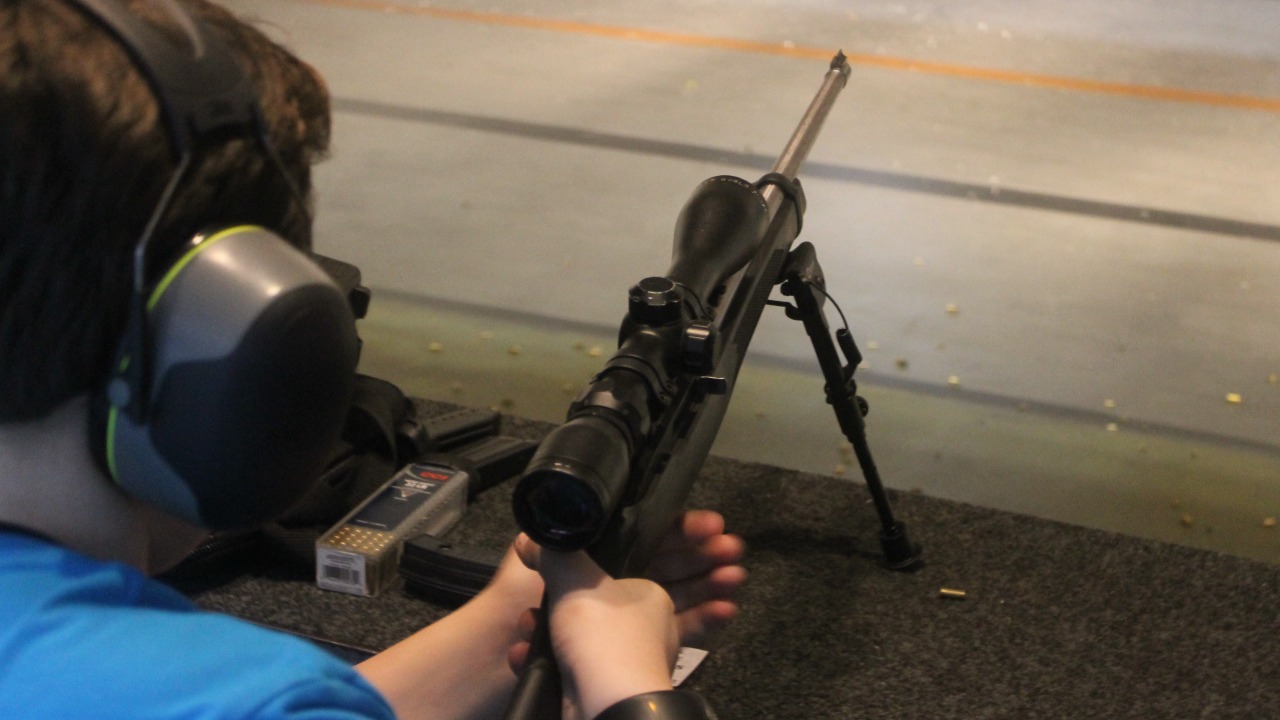

Extreme rifle accuracy is never just about the shooter, it is always a partnership between disciplined technique and a cartridge that stays predictable from muzzle to target. From tiny rimfires to heavyweight magnums, certain calibers have earned reputations for tight groups, stable ballistics and reliable performance that match the high-reach and premium-action trends seen in modern military and backcountry rifles. I will walk through nine such calibers, showing how each one delivers the kind of precision that serious hunters, competitors and tactical users now expect.
1. .22 Long Rifle
.22 Long Rifle is the classic starting point for precision, and its reputation for extreme accuracy at short range is well earned. The cartridge’s low recoil and modest report let shooters focus on fundamentals like trigger control and follow-through, which is why so many competitive smallbore and rimfire leagues rely on it for tight scoring rings. When I look at how modern long-range systems are built for reach, such as the high-caliber platforms described in coverage of the Haskins rifle’s extreme reach, the same principle appears at a different scale: consistent ballistics and repeatable performance are non-negotiable, whether the target is 50 yards away or far beyond typical engagement distances.
That parallel matters for stakeholders like training units and youth programs, because .22 Long Rifle offers a low-cost way to build the same accuracy habits demanded by high-end systems. Law enforcement agencies and military marksmanship teams often use rimfire trainers that mimic centerfire rifles, letting shooters practice on steel or paper without burning through expensive match ammo. For hunters, a well-zeroed .22 Long Rifle becomes a precision tool for small game, where a fraction of an inch can mean a clean headshot instead of a wounded animal. In that sense, the cartridge anchors the accuracy ladder, preparing shooters to step into more powerful calibers while already expecting sub-MOA performance from themselves and their gear.
2. 6mm PPC
6mm PPC has long been a benchmark in benchrest circles, where tiny groups and unforgiving scoring rings expose any weakness in a cartridge’s design. Built around the efficient PPC case, it delivers superb consistency that competitive shooters have exploited for decades in 100 and 200 yard matches. That focus on precision dovetails with the way modern hunting rifles are engineered, particularly premium titanium-action builds like the Tundra Ti X, which are designed to wring every bit of accuracy from high-performance cartridges. When a rifle action is rigid, lightweight and carefully bedded, a cartridge like 6mm PPC can show just how small factory or handloaded groups can become.
For stakeholders in the competitive shooting world, 6mm PPC remains a reference point whenever new 6 mm cartridges are proposed. Discussions comparing 223, 6 mm and 6.5 options often circle back to the PPC lineage, because its case geometry and powder capacity have already proven what is possible in terms of accuracy. Rifle builders and custom barrel makers pay close attention to how 6mm PPC chambers are cut, since tiny variations in throat length or neck diameter can open up groups that used to be single ragged holes. Even hunters who never touch a benchrest match benefit indirectly, because many of the design lessons that keep 6mm PPC at the top of scoreboards filter into modern 6 mm hunting rounds that promise flatter trajectories and tighter impacts on game.
3. .223 Remington
.223 Remington is often associated with high-volume shooting, but it also ranks among the most accurate factory-loaded cartridges available. A detailed rundown of top precision loads lists .223 Remington alongside 6.5 Creedmoor and .308 Winchester as one of the top 5 most accurate factory cartridges, which underscores how far the round has come from its early military roots. In practical terms, that means a quality .223 rifle with match ammunition can hold tight groups at typical varmint and mid-range distances, giving shooters a forgiving learning curve without punishing recoil.
Community advice for new precision shooters often reflects this balance of accuracy and shootability. In one widely referenced discussion, experienced users recommend, “Get the” 223 and pair it with a 77 grain “SMK” bullet, noting that at 300 yards it will perform well even though wind affects it more than larger calibers. That kind of guidance shows why .223 Remington is a staple for varmint hunters, law enforcement marksmen and entry-level PRS competitors. Ammunition is widely available, barrel life is generous, and the cartridge’s mild recoil lets shooters spot their own hits and misses, which accelerates learning. For agencies and clubs managing training budgets, the ability to run thousands of accurate .223 rounds through AR-15 or bolt-action platforms without excessive wear is a major operational advantage.
4. 6.5 Creedmoor
6.5 Creedmoor has become almost synonymous with modern long-range accuracy, and that reputation is grounded in its design brief. Technical breakdowns of the cartridge emphasize that the 6.5 Creedmoor was created to deliver superior accuracy, low recoil and strong performance at extended ranges, with the 6.5 mm bullet diameter giving it an efficient balance of sectional density and ballistic coefficient. One detailed comparison of rifle cartridges notes that Creedmoor was engineered specifically to excel where older designs start to struggle, especially beyond 600 yards where wind drift and drop become harder to manage.
Further analysis of 6.5 mm options reinforces that point, describing the 6.5mm Creedmoor as “a beast” designed to compete directly with the 308 Win cartridge and observing that “Many” hunters now view Creedmoor as an all-around choice. For stakeholders like backcountry hunters and precision match organizers, that combination of manageable recoil and high hit probability has real consequences. Hunters can carry lighter rifles without sacrificing accuracy, and match directors can set challenging steel targets at distance knowing that a large share of competitors will be running cartridges capable of consistent impacts. The popularity of 6.5 Creedmoor has also pushed manufacturers to refine factory ammunition, so off-the-shelf loads now routinely deliver sub-MOA performance that used to require careful handloading.
5. .308 Winchester
.308 Winchester has been a cornerstone of accurate shooting for decades, and it still anchors many discussions about what a “do everything” precision cartridge should look like. Guides to hunting calibers point out that 308 Winchester and .270 Winchester are popular choices for deer hunting because they balance power, accuracy and recoil in a way that works for a wide range of shooters. That same balance is reflected in precision circles, where .308 Winchester appears alongside 6.5 Creedmoor and .223 Remington in lists of the most accurate factory-loaded cartridges, confirming that its long service life has not dulled its competitive edge.
Technical comparisons between 243 and 308 further clarify .308’s role. One detailed analysis notes that 243 shoots lighter bullets at higher speeds for flatter trajectories, “Whereas” the .308 is built for heavier bullets that hold energy and resist wind better at distance. That tradeoff is crucial for stakeholders like military and police marksmen, who often prioritize barrier penetration and retained energy over minimal drop. In the commercial market, .308’s influence is even broader, since “Calibers developed from the .308 include the .243 Winchester, 7mm-08 Remington, .260 Remington, and the .358 Federal,” showing how its case has become a template for accurate, efficient cartridges. For rifle makers, that ecosystem means a single bolt face and magazine pattern can support multiple precision offerings, simplifying logistics while giving shooters a wide menu of accurate options.
6. .243 Winchester
.243 Winchester is widely regarded as one of the flattest-shooting mainstream hunting cartridges, and that trait directly supports precision in the field. A detailed comparison of 243 vs 308 explains that 243 shoots lighter bullets at higher speeds, which makes it “great for flatter trajectories” and reduces the amount of holdover a shooter must estimate at typical deer or varmint distances. When a bullet’s path is flatter, small range estimation errors translate into smaller vertical misses, which is a practical form of accuracy that matters when shots are taken from improvised rests or in shifting light.
The cartridge’s lineage also ties it to proven precision platforms. Technical notes on .308-based designs highlight that “Calibers developed from the .308 include the .243 Winchester, 7mm-08 Remington, .260 Remington, and the .358 Federal,” meaning .243 benefits from the same robust case head and feeding characteristics that make .308 reliable. For stakeholders like youth hunters and recoil-sensitive shooters, .243 Winchester offers a compelling mix of mild kick, high hit probability and lethal performance on medium game. Rifle manufacturers often chamber lightweight mountain rifles in .243 because its recoil is manageable even in sub-7-pound setups, which helps shooters maintain proper form and avoid flinching. That, in turn, translates into more consistent real-world accuracy than a harder-kicking cartridge that looks better on paper but is harder to shoot well.
7. 7mm-08 Remington
7mm-08 Remington blends the efficient 7 mm bullet diameter with the proven .308 Winchester case, creating a cartridge that is both accurate and versatile. Technical overviews of .308-based families explicitly list 7mm-08 Remington among the “Calibers” derived from the 308 parent, alongside 243, 260 and 358, which underscores how much confidence designers place in this case architecture. By necking the case down to accept 7 mm bullets, 7mm-08 gains access to high ballistic coefficient projectiles that track well in the wind while still keeping recoil manageable for most shooters.
For big-game hunters, that combination translates into a cartridge that can deliver precise hits on deer, antelope and even elk-sized animals without the punishment of larger magnums. The 7 mm bullet’s sectional density helps it penetrate reliably, while the efficient powder column of the 308-based case keeps velocities in a sweet spot for controlled expansion. Stakeholders like rifle manufacturers and ammunition companies benefit from this balance, because 7mm-08 can be offered in compact, lightweight rifles that still promise ethical performance at typical hunting distances. In the broader accuracy conversation, 7mm-08 often appears as a practical alternative to 6.5 Creedmoor or .308 Winchester, giving shooters another path to tight groups and predictable ballistics without stepping into niche or hard-to-find cartridges.
8. .300 Winchester Magnum
.300 Winchester Magnum has long been associated with long-range hunting and tactical roles where accuracy at extended distances is non-negotiable. Its ability to launch heavy .30 caliber bullets at high velocities gives it a trajectory and wind profile that appeals to shooters who need reliable hits beyond typical .308 Winchester ranges. Modern rifle designs aimed at backcountry hunters, such as the lightweight, titanium-action builds showcased in the Tundra Ti X, often include .300 Winchester Magnum among their chamberings, signaling that manufacturers expect this cartridge to be used in demanding, accuracy-critical environments.
For stakeholders like Western big-game hunters and long-range enthusiasts, .300 Winchester Magnum’s precision potential comes with tradeoffs in recoil and barrel life, but many accept those costs for the added reach. The cartridge’s popularity has driven ammunition makers to produce high-quality factory loads with match-grade bullets, which reduces the barrier to entry for shooters who do not handload. Guides and outfitters often recommend .300 Winchester Magnum to clients who may face cross-canyon shots on elk or sheep, where a flatter trajectory and higher retained energy can expand the ethical window for a clean kill. In the context of extreme accuracy, .300 Winchester Magnum represents the point where traditional hunting cartridges begin to overlap with specialized long-range and tactical roles, bridging the gap between field practicality and precision shooting demands.
9. .338 Lapua Magnum
.338 Lapua Magnum is the archetypal extreme long-range cartridge, designed from the outset to give snipers and precision shooters a tool for engagements far beyond conventional distances. Its large case capacity and heavy, high-BC bullets allow it to maintain supersonic flight well past the ranges where smaller calibers start to lose stability, which is why it is so closely associated with “extreme long-range sniping.” The same focus on reach and terminal performance that defines modern high-caliber rifles for rangers and specialized units, as seen in reporting on the Haskins rifle’s extreme reach, also underpins the role of .338 Lapua Magnum in military and law-enforcement arsenals.
For stakeholders such as defense planners and specialized police units, .338 Lapua Magnum offers a way to engage threats or critical targets at distances where smaller calibers may lack both accuracy and energy. The cartridge’s adoption has spurred a wave of purpose-built rifles with heavy barrels, advanced muzzle brakes and precision chassis systems, all optimized to exploit its ballistic potential. Civilian long-range competitors and enthusiasts have followed suit, using .338 Lapua Magnum to push the limits of steel target distances and to explore the outer edges of practical marksmanship. While the recoil, cost and rifle weight put it beyond what most hunters or casual shooters need, its role at the top of the accuracy ladder helps drive innovation in optics, rangefinding and ballistic software that eventually benefits every other caliber on this list.
Supporting sources: 223 vs 6mm vs 6.5, 6.5mm Ammo Breakdown: Best 6.5 Calibers for Accuracy & ….
More from MorningOverview