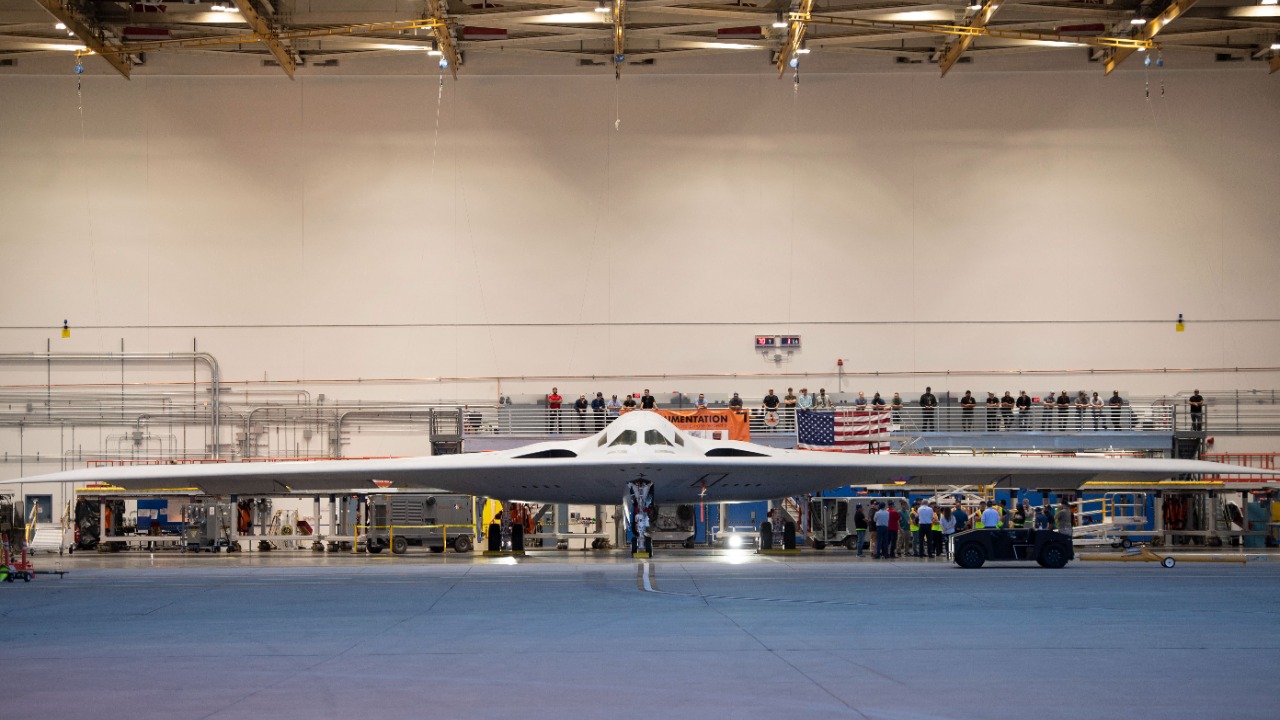

The contest between America’s B-21 Raider and China’s H-20 is not a duel between equals so much as a race between a flying reality and an ambitious sketch. The B-21 is already flying, funded, and being woven into U.S. war plans, while the H-20 remains a largely opaque program that Chinese officials talk about more than they show. When I compare what is publicly known about both projects, the B-21 consistently comes out ahead in stealth, flexibility, and the ability to survive inside the dense air defenses that will define any future conflict in the Western Pacific.
Two bombers, two very different stages of reality
The most basic reason the B-21 currently outclasses the H-20 is that one exists as an operational program and the other still lives mostly in renderings and speculation. The U.S. Air Force has already rolled out the B-21, flown test sorties, and begun integrating it into a long-term force structure that will eventually include at least 100 aircraft. By contrast, Chinese officials and state-linked commentators have discussed the H-20 for years, but they have not publicly confirmed a first flight, production numbers, or even a clear in-service timeline, which leaves the aircraft more concept than capability.
That asymmetry matters because it shapes how each bomber fits into real-world planning. U.S. commanders can already factor the B-21 into strike packages, logistics, and basing decisions, while the H-20 still has to prove it can move from design boards to hardened shelters and flight lines. Analysts who have compared the two programs note that the B-21’s progress, from rollout to flight testing, gives Washington a tangible edge in long-range stealth strike, while the H-20’s performance, payload, and even exact mission profile remain unverified based on available sources.
Stealth design and survivability inside modern air defenses
Stealth is the core currency of any next-generation bomber, and here the B-21 appears to be optimized for survival against the most advanced integrated air defense systems. Its flying-wing shape, blended inlets, and tightly managed panel lines are all aimed at shrinking its radar cross-section across multiple frequency bands, especially the higher frequencies used by modern fire-control radars. U.S. officials have repeatedly framed the B-21 as a platform designed from the outset to penetrate the dense sensor networks and long-range surface-to-air missiles that ring China’s coastline and key inland bases.
Chinese commentators have suggested that the H-20 will also adopt a flying-wing layout and low-observable coatings, but the degree of refinement is still unknown. Some Chinese military writers have even argued that their air defenses will be able to detect and target the B-21, a claim that underscores how seriously Beijing takes the aircraft’s threat profile even as it highlights the uncertainty around the H-20’s own radar signature. One detailed assessment of Chinese air defense doctrine notes that planners in Beijing are already gaming out how to track and engage the Raider, which is why they publicly insist that new sensors and missiles can shoot it out of the sky, even though no such engagement has occurred.
Range, payload, and the geography of the Western Pacific
Long-range bombers live or die by how far they can fly and what they can carry, especially in a theater as vast as the Western Pacific. The B-21 is being built to strike from the continental United States or distant bases and still reach targets deep inside China, then return or recover at dispersed locations. While exact figures remain classified, U.S. planners describe the Raider as having intercontinental reach with both conventional and nuclear payloads, which allows it to hit hardened command centers, air bases, and naval facilities without relying on vulnerable forward airfields.
Chinese sources and outside analysts often describe the H-20 as a prospective “regional” or “theater” bomber, intended to hold at risk targets across the so-called second island chain, including Guam and other U.S. facilities. Some open-source estimates suggest that the H-20 could carry a substantial payload of cruise missiles or gravity bombs, but these projections are based on models and artist impressions rather than flight-tested data. Comparative assessments that stack the two designs side by side consistently point out that the B-21 is already being integrated into a global strike concept, while the H-20’s actual range and loadout remain unverified based on available sources.
Production tempo and the race to field combat-ready squadrons
Even the most advanced bomber is only as useful as the fleet that can be generated, maintained, and deployed. The B-21 program has moved from concept to test aircraft and into early production, with the U.S. Air Force already planning for multiple squadrons and long-term sustainment. That industrial momentum matters, because it means the Raider is not just a prototype but the foundation of a future bomber force that will eventually replace aging B-1B and B-2 fleets while complementing the B-52J.
In Washington, defense analysts have urged policymakers to accelerate that production curve to stay ahead of China’s military buildup. One detailed policy argument has called for speeding up procurement of the Raider so that more stealth bombers are available to deter or, if necessary, blunt a Chinese move against Taiwan or U.S. allies, stressing that a larger B-21 fleet would complicate Beijing’s targeting calculus and reduce the strain on existing aircraft. That push to speed up B-21 production underscores how central the bomber has become to U.S. strategy, while there is no comparable public evidence that the H-20 has even entered serial production.
AI, crew concepts, and the B-21’s digital edge
Where the B-21 most clearly pulls ahead conceptually is in its integration of advanced computing and potential artificial intelligence support. U.S. officials and industry leaders have described the Raider as a “digital native” aircraft, built around open-architecture software and designed to evolve rapidly through code updates rather than slow hardware overhauls. That approach is not just about maintenance; it is about enabling the bomber to process sensor data, manage electronic warfare suites, and coordinate with other platforms in real time.
One of the most striking indicators of that digital ambition is the B-21’s planned ability to operate with a single pilot, a concept that only makes sense if the aircraft can offload routine tasks to highly automated systems. Reporting on the program has highlighted how this single-pilot option hints at sophisticated onboard AI that can help manage navigation, threat detection, and weapons employment, effectively turning the Raider into a crewed platform with some of the autonomy of an unmanned system. Analysts who have examined this feature argue that the bomber’s single-pilot operations point to a broader shift in how the U.S. intends to fight, with the B-21 acting as a smart node in a larger combat cloud, while there is no comparable public detail about AI integration in the H-20.
How Beijing views the B-21 threat
China’s own rhetoric about the B-21 is revealing, because it shows a mix of anxiety and bravado that rarely appears around other U.S. platforms. Chinese military commentators and state-linked outlets have described the Raider as a serious challenge to their air defenses, particularly because it can launch precision strikes from outside the range of many legacy systems and then slip through gaps in radar coverage. That concern is amplified by the bomber’s ability to carry both nuclear and conventional weapons, which forces Chinese planners to treat every detected bomber track as a potential strategic threat.
At the same time, some Chinese analysts publicly insist that new long-range radar systems and hypersonic interceptors will be able to counter the Raider, a claim that serves both domestic reassurance and deterrence messaging. Independent assessments of Chinese commentary note that Beijing is “freaked out” by the B-21’s potential to operate almost uncontested in the early hours of a conflict, especially if it is paired with stand-off weapons and electronic attack assets. One detailed review of Chinese reactions describes the Raider as looking “unstoppable” in Chinese discussions of future war, a characterization that reflects how seriously Beijing takes the bomber’s arrival even as it races to field its own H-20, which remains unverified based on available sources.
U.S. strategy: integrating the B-21 into a China-focused force
For Washington, the B-21 is not a vanity project but a central pillar of a broader strategy to deter China across the Indo-Pacific. U.S. Air Force leaders have repeatedly tied the Raider to operational concepts that emphasize long-range precision strike, distributed basing, and the ability to operate inside contested environments. The bomber is expected to work alongside stealth fighters, drones, submarines, and cyber capabilities to create multiple dilemmas for Chinese commanders, forcing them to defend a wide array of targets simultaneously.
Reporting on U.S. planning makes clear that the B-21 is being fielded with China specifically in mind, from its range and payload to its communications and networking architecture. Senior officials have described how the Raider will be able to share data with other platforms, receive targeting information from offboard sensors, and adapt its mission profile in flight, all of which are tailored to the complex, heavily defended battlespace around China’s eastern seaboard. One detailed overview of the program notes that the bomber is already being woven into exercises and war games focused on the Western Pacific, underscoring that it is a core element of how the U.S. Air Force intends to counter China rather than a generic global asset.
What we actually know about the H-20
While the B-21’s contours are increasingly clear, the H-20 remains a study in strategic ambiguity. Chinese officials have acknowledged the program and hinted at its role, but they have not released hard data on its performance, stealth characteristics, or production status. Most of what is discussed in open sources comes from satellite imagery of Chinese aviation facilities, state media animations, and occasional comments by retired officers, all of which leave significant gaps in understanding.
Some analysts argue that this opacity is deliberate, allowing Beijing to reap some deterrent value from the idea of a long-range stealth bomber without revealing its vulnerabilities or true capabilities. Others caution that the lack of concrete information makes it difficult to assess whether the H-20 will match, exceed, or fall short of the B-21 in key areas like radar cross-section, electronic warfare resilience, and mission flexibility. A number of video analyses and expert panels have tried to piece together the H-20’s likely profile from these fragments, but they consistently conclude that many of the most important details remain unverified based on available sources.
Public perception, propaganda, and the bomber narrative
Beyond hard capabilities, the B-21 and H-20 are also competing in the realm of perception, where images, animations, and commentary shape how domestic and foreign audiences view each aircraft. In the United States, the Raider has been showcased in carefully choreographed rollouts and official videos that emphasize its sleek design and advanced technology, reinforcing the message that Washington retains a qualitative edge in stealth aviation. These presentations are aimed not only at taxpayers and lawmakers but also at potential adversaries, signaling that the U.S. is investing heavily in platforms designed to operate inside the most dangerous airspace on earth.
China, for its part, has used state media segments and animated clips to hint at the H-20’s future role, often depicting it flying over the Pacific and launching missiles at distant targets. These portrayals serve a dual purpose: they bolster national pride at home and suggest to foreign audiences that Beijing is closing the gap in long-range strike. Independent commentators who have reviewed these videos and public statements note that they often blur the line between aspiration and reality, presenting a bomber that has yet to be seen in operational form as if it were already patrolling the skies. Several widely viewed breakdowns of these materials stress that many of the claims about the H-20’s performance and readiness remain unverified based on available sources, even as they shape the broader narrative.
How experts and wargames frame the matchup
When I look at how military analysts and wargame designers frame a potential conflict involving both bombers, a consistent pattern emerges: the B-21 is treated as a known quantity that must be accounted for, while the H-20 is often modeled as a future variable with wide error bars. In many scenarios, the Raider appears early in a conflict, striking key nodes in China’s air defense network, command-and-control hubs, and logistics infrastructure, thereby opening corridors for other U.S. and allied forces. Its stealth, range, and payload make it a first-night-of-war asset, designed to punch holes in the most heavily defended areas.
The H-20, by contrast, is usually cast as a platform that could threaten U.S. bases and carrier groups if and when it becomes operational, but whose exact impact is hard to quantify. Some simulations assume a capable stealth bomber that can launch long-range cruise missiles at Guam or even Hawaii, while others model a more limited aircraft with regional reach and less refined low-observable features. Video-based wargame discussions and expert roundtables frequently highlight this uncertainty, noting that while the B-21’s role is already being integrated into U.S. doctrine, the H-20’s eventual place in Chinese strategy is still unverified based on available sources.
More from MorningOverview