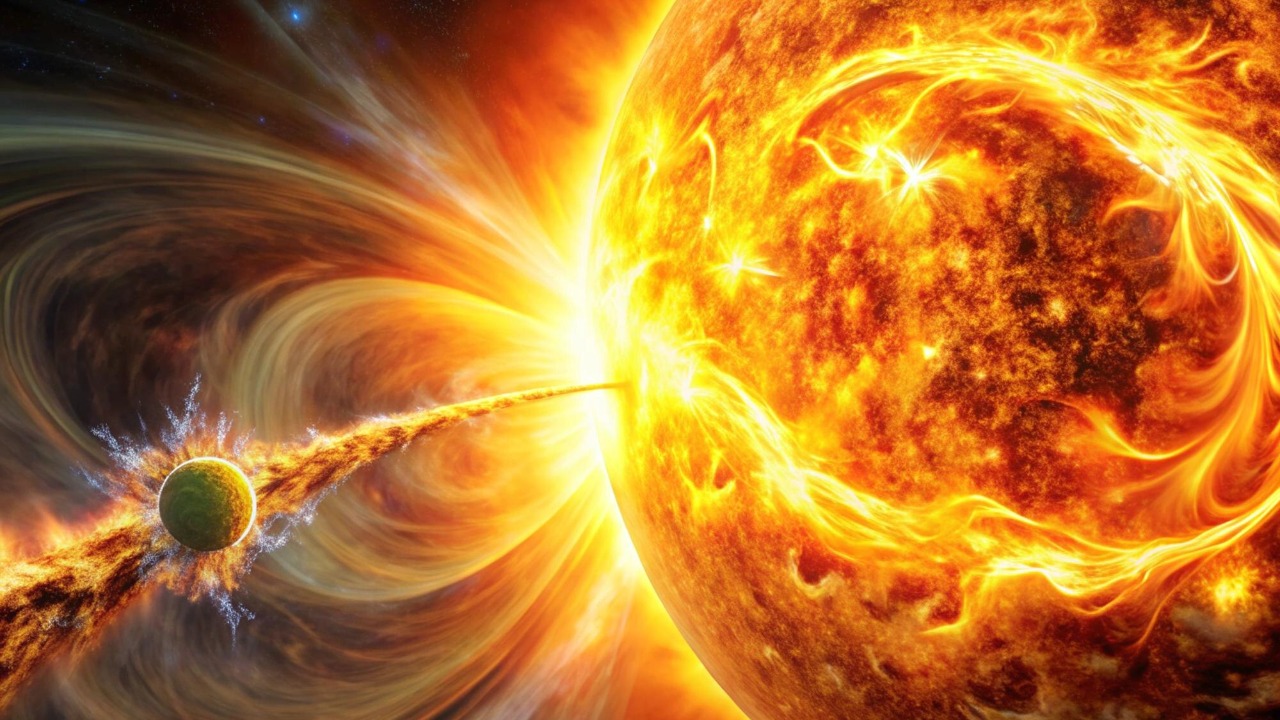

Solar scientists are warning that the current surge in solar activity is not just a spectacle in the sky but a genuine test of how resilient our wired world really is. As the Sun approaches the peak of its 11‑year cycle, forecasts of powerful flares and geomagnetic storms have sharpened concerns that a single extreme event could trigger cascading power failures and communications outages on a global scale. The risk is not hypothetical anymore, it is being modeled, monitored and, in some corners of the scientific community, treated as a looming stress test for modern civilization.
At the center of the alarm is a simple mismatch: the Sun is entering a volatile phase just as societies have become more dependent than ever on vulnerable technologies, from GPS timing signals to high‑voltage transformers. The same bursts of energy that paint auroras across the night sky can, in the wrong configuration, overload power grids, blind satellites and scramble radio networks that keep aircraft, ships and emergency services connected.
Solar cycle 25 is heating up faster than expected
Solar activity naturally waxes and wanes, but the current cycle has intensified more quickly than many forecasters anticipated, raising the odds of disruptive storms in the near term. I see that concern reflected in recent coverage that describes space weather centers moving into a higher state of readiness as sunspot counts climb and eruptions become more frequent. In one widely shared segment, experts walk through how a surge of energetic particles from the Sun could, under the right conditions, set off a chain of failures that ripple through power grids and communications networks, underscoring why they are now on what they describe as high alert for a potential global blackout scenario, a warning echoed in a detailed explainer on the coming solar storm.
That heightened vigilance is not just about one flare or one storm, it is about the cumulative pattern of increasingly energetic outbursts as the solar maximum approaches. Space weather forecasters have been tracking clusters of complex sunspots that can spawn multiple eruptions in quick succession, a pattern that increases the chance that at least one will be aimed squarely at Earth. The more often the Sun fires off these bursts, the more likely it becomes that a fast, magnetically intense coronal mass ejection will intersect our planet’s magnetic field in a way that drives strong currents into the ground and into the infrastructure built on top of it.
Why scientists fear a true global blackout scenario
When researchers talk about a global blackout, they are not imagining a single light switch being flipped off everywhere at once, they are describing a cascading failure that starts in a handful of stressed systems and spreads. Recent modeling work has tried to quantify that risk by simulating how an extreme geomagnetic storm would interact with real‑world power grids and communications networks. One widely discussed study used a detailed digital twin of modern infrastructure to show how a severe event could overload transformers, disrupt long‑distance transmission lines and knock out key substations, a scenario that a recent report described as a scary simulation of how unprepared many regions remain.
Those simulations matter because they expose weak points that are not obvious in day‑to‑day operations. High‑voltage transformers, for example, are built to handle predictable loads, not the slow, relentless currents that a geomagnetic storm can induce over hundreds of kilometers of transmission line. If enough of those components fail at once, grid operators could be forced into rolling blackouts or even large‑scale shutdowns to prevent permanent damage, while satellite operators and aviation authorities scramble to cope with lost signals and degraded navigation. The models do not guarantee that such a chain reaction will happen, but they make clear that the combination of aging infrastructure and rising solar activity is a risk that can no longer be dismissed as a remote possibility.
Recent flares and radio blackouts show the stakes
The warnings are not based solely on theoretical models, they are being reinforced by real events that have already pushed parts of the system to their limits. Earlier this year, a powerful solar flare triggered what space weather monitors classified as the strongest event of the year, and the impact was immediate for anyone relying on high‑frequency radio. Reports from aviation and maritime operators described sudden loss of contact over wide swaths of the globe as the burst of radiation ionized the upper atmosphere and effectively jammed certain frequencies, an episode detailed in coverage of how 2025’s strongest solar flare produced a global radio blackout.
Those radio disruptions are a preview of what a more extreme event could do to a much broader set of systems. High‑frequency radio is still a backbone for long‑range aviation, especially on polar routes, and for ships far from shore, so even a temporary blackout forces rerouting and contingency procedures. At the same time, satellites that provide GPS, communications and Earth observation can be bombarded by energetic particles that degrade their electronics or force operators to put them into safe mode. Each of these impacts is manageable in isolation, but when they occur together, and when they coincide with stress on ground‑based power infrastructure, the margin for error narrows quickly.
NASA and space forecasters sharpen their warnings
Space agencies and forecasting centers have responded to this uptick in activity by issuing more explicit alerts about what a major solar storm could do. NASA scientists have publicly warned that a particularly intense coronal mass ejection could generate geomagnetic disturbances strong enough to trigger widespread power outages, disrupt satellite operations and interfere with communications. In one recent briefing, they described how a fast‑moving cloud of charged particles could compress Earth’s magnetic field and drive currents into long conductors, a scenario that prompted headlines about a massive solar storm capable of causing blackouts.
Operational forecasters have echoed that message, emphasizing that their job is no longer just to track auroras but to provide actionable lead time for grid operators, airlines and satellite companies. In a widely viewed broadcast, space weather experts walked through how they monitor the Sun in real time, using a fleet of spacecraft to detect eruptions and estimate their speed and direction, and how they translate that into warnings that can give critical infrastructure operators hours to prepare. That segment, which highlighted the potential for severe storms to hit Earth and trigger power and communications disruptions, was featured prominently in a space forecasters report that brought the issue into mainstream morning news.
Public anxiety and viral posts amplify the alarm
As official warnings have grown more pointed, public anxiety has followed, often amplified by social media posts that blur the line between sober risk assessment and apocalyptic speculation. One widely shared message described a “wave of intense solar storms” trending globally and framed scientists’ concerns in stark terms, suggesting that a catastrophic event could be imminent and that societies are dangerously unprepared. That post, which circulated on a popular social platform and drew thousands of reactions, captured how a wave of intense solar storms has become a kind of shorthand for broader fears about technological fragility.
I see that viral framing as a double‑edged sword. On one hand, it pushes a niche scientific topic into public view and can spur people to ask smart questions about how dependent they are on vulnerable systems. On the other, it can exaggerate timelines and probabilities, making it sound as if a civilization‑ending storm is guaranteed in the next news cycle. That distortion can crowd out more practical conversations about what can actually be done to harden infrastructure, improve forecasting and build redundancy into critical services, which is where the most constructive work is happening.
How an extreme storm could unravel modern infrastructure
To understand why experts worry about a worst‑case solar storm, it helps to trace how the damage would propagate through the systems we rely on every day. When a powerful coronal mass ejection slams into Earth’s magnetic field, it can induce strong currents in long conductors such as power lines, pipelines and undersea cables. Those geomagnetically induced currents can saturate transformers, cause voltage instability and, in extreme cases, permanently damage equipment that is expensive and slow to replace. Analysts who have studied this chain reaction describe how a truly extreme event could take out multiple high‑voltage transformers at once, a scenario explored in depth by researchers who warn that an extreme solar storm could wreak havoc on the modern world’s interconnected infrastructure.
The vulnerabilities do not stop at the grid. Telecommunications networks depend on precisely timed signals, often derived from GPS satellites, to synchronize data flows across continents, so disruptions in space can quickly cascade into dropped calls, slowed internet traffic and degraded financial transactions. Aviation and maritime operations rely on both satellite navigation and radio communications that can be compromised by solar activity, forcing rerouting and delays. Even undersea cables, which carry the bulk of international data, can be affected by geomagnetically induced currents in their long conductive paths, although the exact risk profile is still being studied. The picture that emerges from these analyses is not one of instant collapse but of a complex system pushed into a state where small failures can compound into much larger outages.
Inside the new generation of solar storm simulations
To move beyond broad warnings, scientists and engineers have been building increasingly sophisticated simulations that couple solar physics with models of terrestrial infrastructure. These tools start with observations of the Sun, track how eruptions propagate through space and then estimate how the resulting geomagnetic disturbances would interact with specific grids, pipelines and communication networks. In one recent project, researchers fed realistic storm parameters into a high‑resolution model of power and telecom systems to see how outages might spread, a process that was documented in a detailed simulation video that walked viewers through each stage of the hypothetical event.
What stands out in these simulations is not just the scale of potential damage but the importance of timing and coordination. If grid operators receive accurate forecasts with enough lead time, they can reconfigure networks, reduce loads and temporarily take vulnerable equipment offline to ride out the storm. Satellite operators can switch to safe modes, airlines can adjust routes and emergency services can prepare backup communication plans. The same models that reveal frightening vulnerabilities also point to specific interventions that can dramatically reduce the risk of a prolonged, multi‑region blackout, provided that the warnings are heeded and the necessary investments are made ahead of time.
Balancing real risk with scientific skepticism
Not every expert agrees that a civilization‑scale catastrophe is likely, and that tension is important to keep in view. Some researchers argue that while extreme solar storms are inevitable over long timescales, the probability of one striking Earth in a way that causes global infrastructure collapse in any given decade is relatively low. They caution against sensationalism and emphasize that many past flares and storms, including some very strong ones, have produced limited damage thanks to existing protections and the inherent resilience of certain systems. That more measured perspective was laid out in a recent analysis that asked whether people should really worry about solar flares and concluded that the risk is real but often overstated, a point made explicitly in a scientific review of solar flare hazards.
I find that skepticism useful as a counterweight to the most dramatic scenarios, but it does not erase the need for preparation. Even if the odds of a truly catastrophic event are modest, the consequences would be so severe that they justify serious planning, much as societies invest in earthquake‑resistant buildings in regions that may go decades between major quakes. The challenge is to translate that nuanced risk assessment into policy and investment decisions without either downplaying the threat or inflating it into a source of paralyzing fear.
How governments and operators are responding so far
Governments and infrastructure operators have begun to treat space weather as a strategic risk, but the pace and scope of their responses vary widely. Some national grid operators have installed monitoring equipment that can detect geomagnetically induced currents in real time and have developed playbooks for reducing loads or reconfiguring networks when strong storms are forecast. Satellite companies have refined their procedures for putting spacecraft into safe modes and for recovering quickly once conditions improve. In a recent news segment, officials described how they are integrating space weather alerts into broader emergency management frameworks, a shift captured in a video report that highlighted both progress and remaining gaps.
Despite those steps, many experts argue that preparation still lags behind the risk, especially in regions with aging infrastructure or limited resources. Hardening transformers, upgrading grid controls and building redundant communication pathways all require significant investment and long lead times. There is also a coordination problem, since a severe solar storm does not respect national borders and can affect multiple continents at once, making it harder to rely on mutual aid. The emerging consensus among researchers and some policymakers is that space weather needs to be treated less as a niche scientific curiosity and more as a core resilience issue, on par with cyber threats and extreme terrestrial weather.
What a realistic “worst case” might look like
When I piece together the latest forecasts, simulations and real‑world incidents, a realistic worst‑case scenario looks less like a single instant of global darkness and more like a rolling crisis that unfolds over days or weeks. A powerful coronal mass ejection could arrive with only a day or so of warning, triggering geomagnetic disturbances that cause regional blackouts, satellite anomalies and widespread radio interference. In the first hours, grid operators might struggle to stabilize voltage, some transformers could fail and certain regions could lose power for extended periods, while airlines reroute flights and ships adjust routes to cope with navigation and communication problems. That kind of event, while disruptive, is within the range of what current models and historical analogues suggest is plausible, and it aligns with the kind of high‑alert posture that forecasters have been describing.
In the days that follow, the severity of the crisis would depend heavily on how quickly damaged equipment can be repaired or replaced and how well backup systems perform. Regions with robust grid interconnections, modern transformers and clear emergency protocols might restore power relatively quickly, while areas with older infrastructure or limited spare capacity could face longer outages. Communications would likely be patchy, with some satellite services degraded and some terrestrial networks overloaded. It would be a stressful, messy test of resilience, but not necessarily a permanent step back into a pre‑electric age. The real lesson from such a scenario is that the line between manageable disruption and systemic crisis is thinner than many people assume, and that the time to thicken that line is before the next major storm arrives.
More from MorningOverview