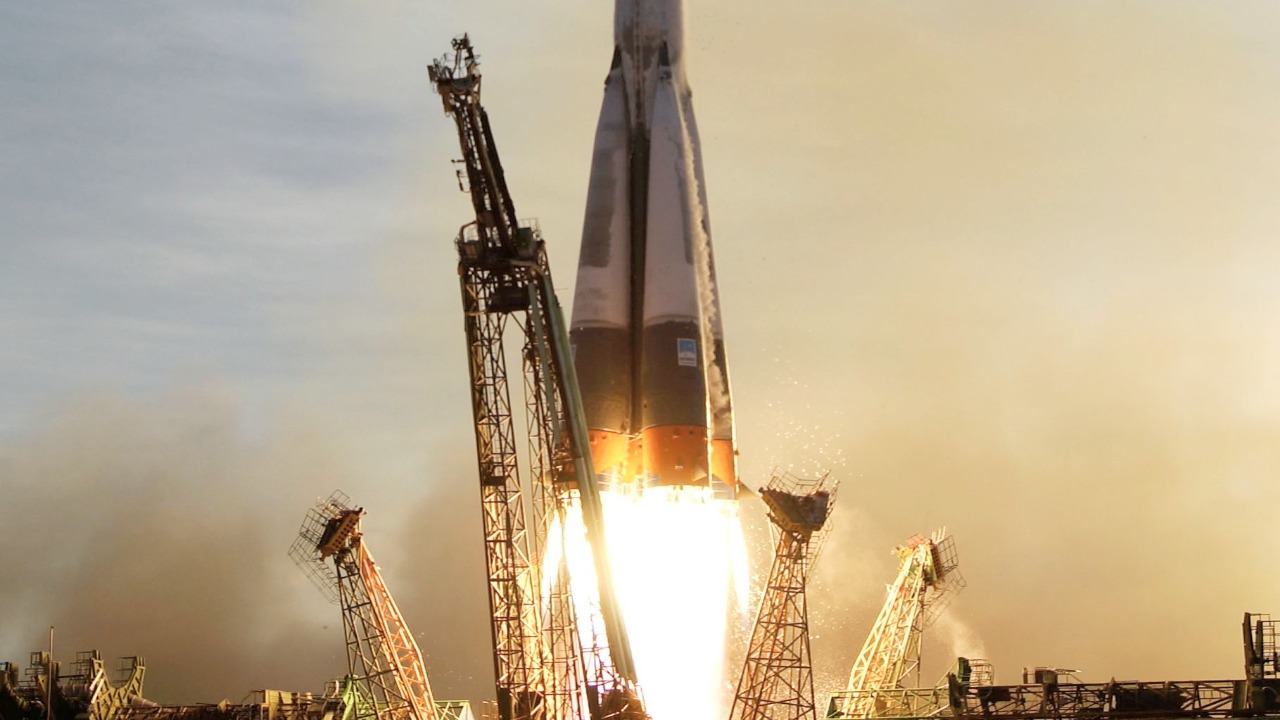

Russia’s only operational launch pad for crewed Soyuz missions has suffered significant blast damage, abruptly turning a routine liftoff into a strategic crisis for the country’s human spaceflight program. The incident has raised immediate questions about how quickly the pad can be repaired and whether Moscow can maintain its commitments to the International Space Station without interruption.
As engineers survey the wrecked concrete and twisted infrastructure at Baikonur Cosmodrome, the episode is exposing how dependent Russia has become on a single aging facility to send its cosmonauts into orbit. I see a story here that is not just about a damaged pad, but about a space power that has allowed its redundancy to erode at the very moment global access to orbit is becoming more contested and more commercial.
How a routine Soyuz launch turned into a ground infrastructure failure
The launch that triggered the damage began as a familiar scene: a Soyuz rocket carrying the Soyuz MS-28 spacecraft and its crew lifting off from Baikonur Cosmodrome in Kazakhstan on a mission to the International Space Station. The ascent itself appears to have gone according to plan, with the crew reaching orbit and heading toward the ISS, but the trouble unfolded in the seconds after liftoff when the exhaust plume and acoustic forces battered the pad’s flame trench and surrounding structures. According to early assessments, the blast tore up reinforced concrete, damaged cable runs, and scattered debris across the complex, leaving the site in far worse condition than after a typical launch.
Initial imagery and on-the-ground reports describe a scene of scorched infrastructure and collapsed sections of the flame deflector, suggesting that something in the pad’s protective systems failed to handle the rocket’s exhaust as designed. Analysts have pointed to the age of the facility and the cumulative wear from decades of launches as likely contributors, with some experts noting that the pad had already shown signs of deterioration before this latest mission. The scale of the visible destruction, documented in detail by post-launch imagery, indicates that this was not a minor spall or cosmetic crack but a structural event that will require extensive reconstruction rather than routine maintenance.
Baikonur’s Pad 1 and Russia’s shrinking launch infrastructure
The damaged facility is not just any launch site, it is Russia’s only active pad capable of sending cosmonauts to orbit on Soyuz rockets. Known historically as Gagarin’s Start, the Baikonur pad has been the workhorse of Soviet and Russian human spaceflight since Yuri Gagarin’s pioneering mission, but over time other crew-capable pads have been retired or repurposed, leaving this single complex as the sole gateway for Russian crews. That concentration of capability has now turned into a glaring vulnerability, since any extended outage at Baikonur directly translates into a halt in Russia’s ability to launch its own personnel.
Russian officials have long talked about shifting more activity to the newer Vostochny Cosmodrome in the Russian Far East, but the infrastructure there is not yet fully certified for crewed Soyuz flights, and the necessary life support and emergency systems remain incomplete or untested for human missions. The result is a human spaceflight architecture that leans almost entirely on one aging pad in Kazakhstan, a dependence that was already risky before the latest blast damage. Reporting that describes Baikonur as Russia’s only active launch pad for crewed Soyuz missions underscores how little redundancy remains in a program that once boasted multiple crew-ready complexes.
What we know about the damage and the repair challenge
Early technical assessments suggest that the blast carved deep into the flame trench, shattered concrete slabs, and may have compromised structural supports that channel exhaust away from the rocket during liftoff. Engineers are now inspecting whether the underlying foundations were affected, since any weakening there would complicate repair timelines and could force more extensive reconstruction. The damage also appears to have affected power and data lines that run through the pad area, which are essential for fueling operations, countdown control, and safety systems during launch campaigns.
Repairing a launch pad is not as simple as pouring new concrete, particularly when the site must withstand the intense thermal and acoustic loads of a Soyuz booster. Specialists will need to remove damaged material, assess rebar and support structures, and then rebuild with materials and geometries that meet strict engineering standards for repeated launches. Some observers have warned that the work could take many months, especially if the pad’s flame deflector and exhaust channel require redesign rather than straightforward replacement. Detailed accounts of the cratered trench and broken infrastructure at Baikonur, including the description of serious blast damage to the pad’s core systems, point to a repair effort that will test Russia’s already stretched space budget.
Immediate impact on ISS crew rotations and logistics
The most urgent question is how the damage will affect crew rotations to the International Space Station, where Russian cosmonauts occupy key roles in operating the Russian Orbital Segment and managing propulsion and attitude control. Soyuz spacecraft are not just transport vehicles, they also serve as lifeboats for station crews, so any disruption in launch cadence can ripple through planning for emergency return capacity and long term staffing. If Baikonur’s pad remains offline for an extended period, Russia will have to decide whether to delay upcoming crewed missions, reduce its on-orbit presence, or seek alternative arrangements with partners.
NASA and other ISS partners have already diversified their access to orbit through commercial crew vehicles like SpaceX’s Crew Dragon, but Russia has continued to rely on Soyuz as its sole human-rated system. That asymmetry now leaves Moscow with fewer options if it wants to maintain its usual number of cosmonauts on the station. Analysts have noted that any prolonged gap in Soyuz launches could force adjustments to the ISS crew complement and might even affect planned cargo and maintenance operations on the Russian side of the outpost. Concerns about how the incident could complicate future space station operations are already surfacing among space policy experts who track the delicate balance of responsibilities on the ISS.
Russia’s dependence on a single human spaceflight pipeline
For years, Russia’s space program has been operating with a single human spaceflight pipeline: Soyuz rockets launching from Baikonur to the ISS. That model worked as long as the pad remained reliable and the Soyuz system maintained its reputation for rugged dependability, but the latest damage exposes how little margin exists if anything goes wrong on the ground. I see this as a structural weakness that has been building quietly, as budget constraints and political priorities limited investment in backup infrastructure or new crew vehicles.
Unlike the era when multiple pads at Baikonur and Plesetsk could support crewed missions, today’s configuration leaves no immediate fallback if Gagarin’s Start is unavailable. The situation is particularly stark when contrasted with the growing redundancy in other programs, such as NASA’s use of multiple launch complexes in Florida for commercial crew and cargo flights. Detailed reporting that describes the Baikonur pad as Russia’s only way to send astronauts to space captures the essence of this dependence, which now threatens to turn a single infrastructure failure into a national spaceflight standstill.
Official reactions, public messaging, and what is left unsaid
Russian space officials have acknowledged the damage but have so far framed it as a manageable setback rather than a crisis, emphasizing that the Soyuz MS-28 mission itself was successful and that the crew reached the ISS safely. Public statements have focused on the absence of casualties and the continuity of on-orbit operations, while promising investigations into the cause of the pad failure and plans for repair. This messaging reflects a familiar pattern in which authorities highlight mission success and downplay infrastructure problems, even when the visual evidence suggests a more serious situation.
At the same time, there has been little detailed discussion from Moscow about specific timelines for restoring the pad or about contingency plans if repairs take longer than expected. Independent analysts and foreign observers have filled some of that gap, pointing to the scale of the visible damage and the lack of an immediately available backup pad for crewed launches. Coverage that notes how the Russian cosmodrome was damaged after the Soyuz launch highlights the contrast between official reassurances and the more cautious assessments emerging from outside experts who have seen similar infrastructure failures in other programs.
Baikonur’s political and economic stakes for Moscow and Kazakhstan
The Baikonur Cosmodrome is not only a technical asset, it is also a geopolitical and economic linchpin in the relationship between Russia and Kazakhstan. Russia leases the site from Kazakhstan under long term agreements that give Moscow operational control while providing Astana with revenue and international visibility as a spacefaring host nation. Any prolonged disruption at Baikonur could therefore have financial implications for Kazakhstan and could prompt new negotiations over investment, safety standards, and future use of the facility.
For Moscow, the incident comes at a time when it is already under pressure to demonstrate technological competence and strategic autonomy in space, particularly as Western sanctions and shifting alliances complicate access to foreign components and markets. A visibly damaged launch pad at Baikonur undercuts the narrative of unbroken continuity from the Soviet space triumphs and may force Russian leaders to weigh the costs of accelerated repairs against other budget priorities. Reports that describe the Baikonur launchpad as heavily damaged after the rocket launch underscore how this single event reverberates beyond engineering circles into the realm of national prestige and regional diplomacy.
Technical clues and open questions about what went wrong
While investigators have not yet released a definitive cause, the pattern of damage offers some technical clues. The concentration of destruction in the flame trench and exhaust channel suggests that the blast effects were not adequately dispersed, which could point to preexisting cracks, blocked ducts, or weakened refractory linings that failed under the intense heat and pressure of the Soyuz exhaust. If maintenance had been deferred or if previous minor damage was not fully repaired, the latest launch may simply have pushed an already compromised structure past its breaking point.
There are also questions about whether any recent modifications to the pad, changes in launch procedures, or variations in the rocket configuration might have altered the load on the infrastructure. Engineers will be looking closely at telemetry, high speed imagery, and post-launch inspections to determine whether the failure was purely a matter of aging concrete or whether operational factors played a role. Technical commentary that highlights the launchpad damage after the Soyuz liftoff underscores how much remains unknown, and how important a transparent investigation will be for restoring confidence in future missions.
What this means for Russia’s long term access to space
Beyond the immediate repair work, the Baikonur incident forces a broader reckoning with Russia’s long term access to space. A country that once prided itself on multiple launch sites and a robust stable of rockets now finds its human spaceflight capability bottlenecked through a single damaged pad and a single aging spacecraft design. If Moscow cannot quickly restore Baikonur or bring an alternative crew-capable pad online, it risks falling behind in a domain where new entrants and commercial players are rapidly expanding their presence.
The episode may also accelerate debates inside Russia about whether to invest more heavily in Vostochny, pursue new crew vehicles, or deepen cooperation with partners who can provide launch services. Each of those paths carries political and financial tradeoffs, especially in an environment where resources are constrained and international relationships are strained. Analysis that warns Moscow could lose access to space if the Baikonur pad remains out of action captures the stakes: without a reliable way to send its own people into orbit, Russia’s status as a leading space power would be more symbolic than operational.
More from MorningOverview