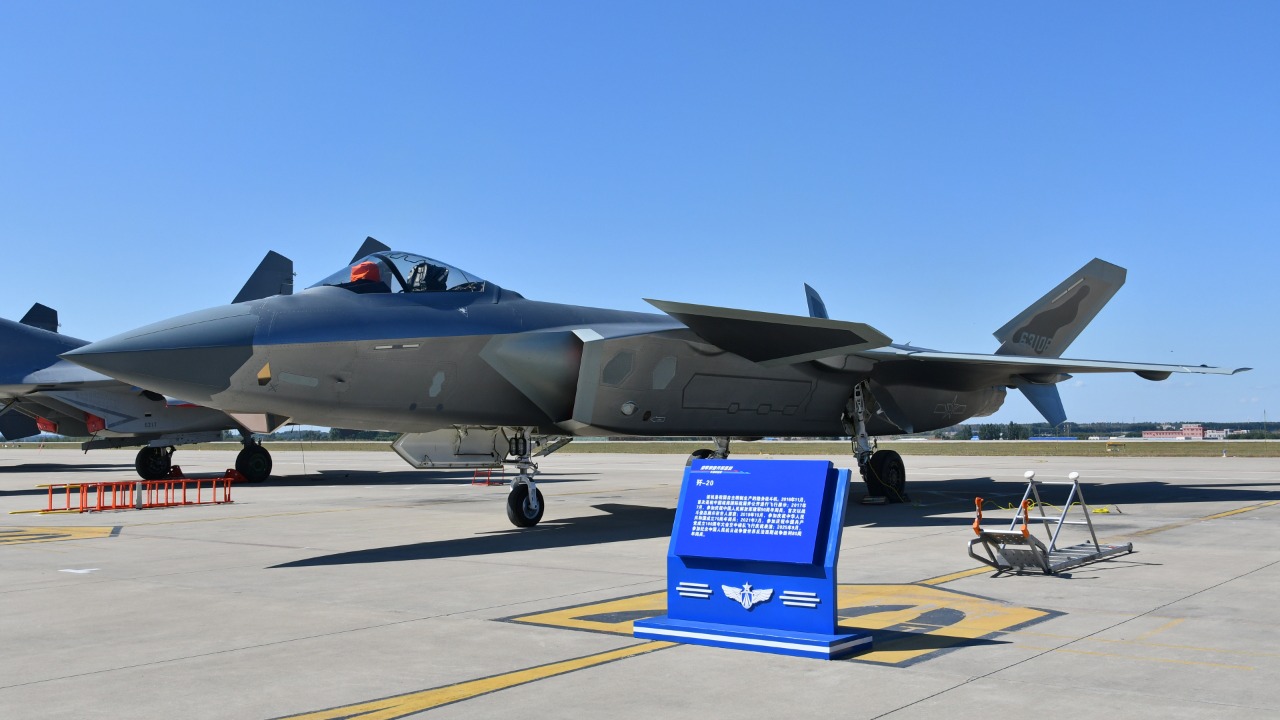

The J-20 has always been framed as China’s answer to the F-22 and F-35, a stealthy spear tip for the Chinese People’s Liberation Army Air Force. What is becoming clearer is that its most disruptive feature may not be the radar-evading shape at all, but a quieter trick that lets the jet slip in and out of the electromagnetic spotlight almost at will.
Instead of relying only on coatings and contours to stay hidden, the J-20 appears to be built around a concept of “electronic invisibility,” using sensors and software to manage when it is seen, what sees it, and how much of its true signature ever leaks out.
Why the J-20’s stealth story is shifting
When the J-20 first emerged, most outside attention fixated on its silhouette, from the canted tailfins to the chiseled intakes that signaled a classic radar low observable design. That focus made sense at the time, because the jet’s planform and coatings were the only visible clues to how far Chinese engineers had pushed into fifth-generation territory. Over time, however, the narrative has started to tilt away from pure shaping and toward the way the aircraft manages its presence in the broader information space, suggesting that the real leap is not just how the jet looks to radar, but how it chooses to appear or disappear in the first place.
As more technical assessments have filtered out, analysts have highlighted that the J-20’s stealth profile is only one layer in a deeper architecture of situational awareness and emissions control. Detailed examinations of China’s new J-20s describe a platform that treats low observability as a starting point, then stacks on top a dense web of sensors, data links, and electronic warfare tools that let the pilot decide when to be a ghost and when to be a beacon. That shift in emphasis is what turns the aircraft from a static stealth object into an active manager of its own detectability.
From physical stealth to “electronic invisibility”
Traditional stealth has always been about physics, from faceted surfaces that scatter radar energy away from the transmitter to coatings that soak up what remains. The J-20 clearly follows that playbook, but the more consequential development is how it uses electronics to blur its outline in the electromagnetic spectrum. Instead of simply presenting a small radar cross-section, the jet appears designed to fuse sensor inputs and then tightly control its own emissions, so that it can see more than it reveals and time its transmissions to avoid lighting itself up.
Reporting on the J-20’s evolution into the J-20S variant underscores this shift, describing how, in addition to physical stealth, the aircraft leans on sensor fusion to excel in what can fairly be called electronic stealth. Analyses published on Oct 3, 2025, frame the J-20S as a platform that uses its integrated sensor suite not just to find targets, but to minimize the kind of telltale emissions that could reveal its position, a capability that matters as much for offensive ambushes as for defensive survival.
The Luneburg lens clue and what it reveals
One of the clearest public hints about how seriously China treats the J-20’s radar signature came from a small, almost mundane detail: the Luneburg lens. These detachable radar reflectors are often bolted onto stealth aircraft during peacetime flights so that civilian and military radars can track them more easily, and so that foreign sensors do not get a clean look at the jet’s true low observable profile. When observers noticed J-20s flying without these lenses, it signaled a new level of confidence in the aircraft’s operational stealth and a willingness to show more of its real signature in controlled settings.
Coverage of those flights stressed that the J-20, described as the most advanced, stealth-capable fighter jet of the Chinese People’s Liberation Army, or PLA, Air Force, had entered a phase where it could operate without the training wheels of a reflector in at least some scenarios. Reports on how the Chinese People’s Liberation Army Air Force manages Luneburg lens use around the J-20 point to a deliberate balance: keep the jet conspicuous in routine training or non-combat flights, then strip away the reflector when crews need to practice or demonstrate the aircraft’s genuine low observable performance.
How sensor fusion becomes a cloaking device
What makes the J-20’s approach feel like a kind of cloaking trick is not any single gadget, but the way its systems appear to work together. Sensor fusion, in this context, is not just a buzzword about combining radar and infrared feeds on a cockpit display. It is a method of building a coherent picture of the battlespace from multiple passive and active sources, then using that picture to decide when to transmit, when to listen, and when to let other platforms do the shouting while the J-20 stays quiet. In practice, that can make the jet far harder to pin down than its radar cross-section alone would suggest.
Analysts who have dug into the J-20S describe an aircraft that uses its fused sensors to support both offensive and defensive operations, while carefully managing the emissions that could betray it. The Oct 3, 2025, assessments of the J-20S emphasize that its electronic stealth is not an add-on, but a core design goal, with the integrated sensor suite explicitly tuned to reduce the kind of radar and data link chatter that would otherwise light up on enemy receivers. That is the essence of the “cloak”: the jet can still see, communicate, and coordinate, but it does so in a way that keeps its own footprint as faint as possible.
Training, peacetime flights, and managed visibility
Stealth aircraft are expensive to operate and maintain, and their low observable coatings are not meant to be worn down by unnecessary exposure. For the J-20, that reality intersects with another priority: keeping the aircraft’s true signature out of foreign databases for as long as possible. The solution, as seen in public reporting, is a kind of managed visibility regime in which the jet’s detectability is dialed up or down depending on the mission profile, especially during training and non-combat flights.
Accounts of how the J-20 is used in routine operations describe a pattern where Luneburg lenses are attached in situations like training or non-combat flights, making the aircraft appear larger and easier to track on radar than it would in wartime. When the Chinese People’s Liberation Army, or PLA, Air Force wants to rehearse more realistic scenarios, those reflectors can be removed, letting crews experience how the jet behaves when it is relying on its true stealth characteristics. The reporting that the J-20 is the most advanced, stealth-capable fighter in the PLA Air Force, and that its radar visibility is deliberately adjusted in peacetime, underscores how seriously planners treat the balance between operational secrecy and day-to-day safety.
What “the secret is out” really means
As more technical detail has seeped into open sources, the phrase “the secret is out” around the J-20 has taken on a specific meaning. It does not suggest that every classified parameter is now public, but rather that the broad contours of China’s approach to fifth-generation airpower are no longer mysterious. The J-20 is not just a stealthy airframe; it is a node in a wider network, built to share data, coordinate with other assets, and manipulate the electromagnetic environment in ways that complicate an adversary’s targeting process.
In-depth examinations of China’s new J-20s highlight how the aircraft’s avionics, data links, and electronic warfare capabilities are central to its concept of operations. Those analyses describe a fighter that is meant to operate as part of a system, not as a lone duelist, using its stealth and electronic tools to open corridors, blind sensors, or quietly pass targeting information to other shooters. That systems-level view is the real revelation, and it is what makes the J-20’s “cloaking” effect as much about information dominance as about radar physics.
Implications for regional airpower balance
For air forces in the region, the J-20’s blend of physical and electronic stealth changes the calculus of air defense and deterrence. Traditional radar coverage and fighter patrol patterns are built around the assumption that a hostile aircraft will either be visible or not, depending on its distance, altitude, and radar cross-section. A platform that can modulate its own signature, using sensor fusion and emissions control to appear only when it chooses, forces planners to think in terms of probabilities and gaps rather than clear lines of detection.
That uncertainty has practical consequences. If the Chinese People’s Liberation Army Air Force can field J-20s that routinely train with Luneburg lenses attached, then remove those reflectors and lean on electronic stealth in more sensitive operations, neighboring states must assume that any radar picture they see in peacetime is incomplete. The fact that the J-20 is described as the most advanced, stealth-capable fighter in the PLA Air Force, and that its operators are already practicing how to manage its visibility in different scenarios, suggests that regional air defense networks will need to invest more heavily in multi-static radar, passive detection systems, and cross-domain sensor fusion of their own to keep pace.
Why the J-20’s “cloak” matters beyond the cockpit
The J-20’s approach to hiding in plain sight is not just a technical curiosity; it is a signal about where air combat is heading. As more platforms adopt similar blends of low observable design and electronic stealth, the contest will shift from who has the smallest radar cross-section to who can best orchestrate the flow of information across a contested battlespace. In that environment, a fighter that can selectively reveal or conceal itself, while still contributing to the larger sensor picture, becomes a powerful tool for shaping an adversary’s perception.
Seen through that lens, the J-20’s “cloaking trick” is less about vanishing entirely and more about controlling the story that enemy sensors tell their operators. By using Luneburg lenses in training, stripping them off when needed, and relying on a tightly integrated sensor and electronic warfare suite to manage its emissions, the aircraft gives the Chinese People’s Liberation Army Air Force a flexible instrument for both signaling and surprise. The reporting that has brought these details into view does not answer every question, and some aspects remain unverified based on available sources, but it does make one thing clear: the future of stealth will be written as much in software and waveforms as in metal and composite.
More from MorningOverview