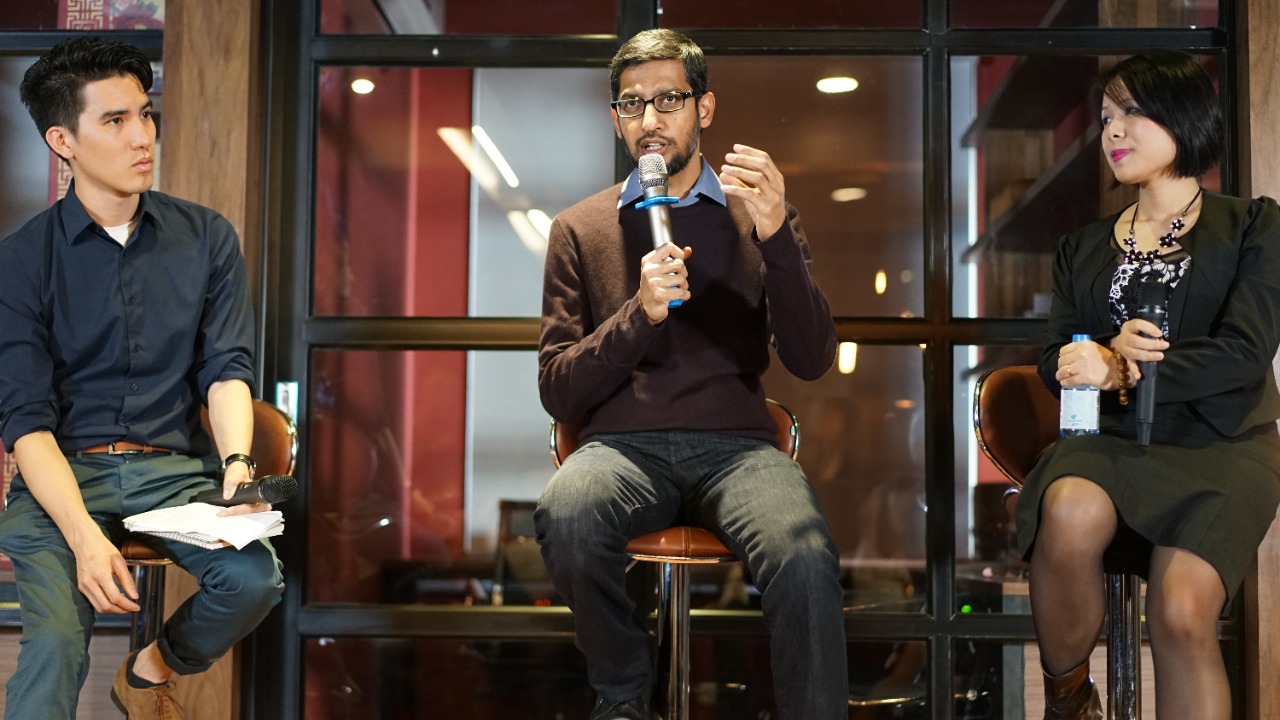

Google is betting that a more conversational, “vibey” way of writing code can pull software development out of its productivity rut and make it feel playful again. Instead of treating programming as a rigid sequence of instructions, the company is pushing tools that let people describe intent in natural language, sketch ideas, and iterate with an AI partner that fills in the boilerplate.
At the center of that shift is what executives have started calling “vibe coding,” a looser, exploratory workflow that leans on large models to translate rough concepts into working software. The pitch is not just faster output, but a cultural reset inside engineering teams, where experimentation, visual feedback, and shared AI workspaces are supposed to make building apps feel less like ticket grinding and more like creative collaboration.
How Google’s CEO framed the new era of “vibe coding”
When Sundar Pichai talks about the future of software development, he increasingly describes it as a conversation rather than a compile cycle. In recent remarks, he highlighted how generative models let developers sketch functionality in plain language, refine it through back-and-forth prompts, and rely on the system to handle syntax and scaffolding. That is the core of what he and his lieutenants have started to describe as vibe coding, a style where the human sets direction and taste while the AI handles the heavy lifting of code generation and refactoring, a framing that aligns with Google’s broader push around its Gemini family of models and the Gemini for Workspace and Gemini for Developers launches.
Pichai’s argument is that this shift is not just about convenience, but about changing how it feels to build software day to day. Instead of staring at a blank editor or wrestling with unfamiliar frameworks, developers can start with a description like “a simple Android app that tracks my 2020 Toyota Corolla’s fuel economy and visualizes it as weekly charts,” then let the AI propose a project structure, starter code, and even UI layouts. Google has already wired that pattern into products such as Gemini in Android Studio, where coders can ask for features in natural language and see suggested implementations inline, and into Cloud-powered app builders that generate backend services from high level prompts.
From autocomplete to creative partner in the IDE
For years, AI in the editor mostly meant smarter autocomplete, but Google is now treating the IDE as a full conversational surface. In Android Studio, for example, Gemini can answer “how do I add a Material 3 bottom navigation bar” and then inject the relevant Kotlin snippets directly into the project, complete with imports and theme references, instead of just suggesting the next token. The company has described how this conversational flow lets developers stay in a creative mindset, iterating on the “vibe” of an app’s behavior or interface while the model handles repetitive wiring, a pattern that is central to the Gemini for Developers experience.
Google is also extending that partnership beyond mobile tooling into its cloud stack. In its recent app development announcements, the company showed how Gemini can generate REST endpoints, database schemas, and even Terraform configurations from a single natural language description of an application, then keep refining those assets as the developer clarifies requirements. That turns the IDE and cloud console into a shared canvas where the human can say “this service should handle 50,000 daily active users and log every failed login attempt,” and the AI responds with concrete implementation details, as described in the Google Cloud app development updates.
Gemini as the engine behind Google’s coding “vibes”
Underneath the marketing language, vibe coding is really a story about model capabilities, and Google is explicit that Gemini is the engine making this possible. The company has positioned Gemini 1.5 Pro and related variants as its primary models for code understanding and generation, emphasizing their long context windows and ability to ingest entire repositories, design documents, and API specs in a single prompt. That lets a developer drop in a full microservices architecture or a complex React Native project and then ask the model to “modernize the authentication flow” or “align the dashboard with our 2024 design system,” a workflow Google highlighted in its developer-focused Gemini briefings.
Google is also threading Gemini into productivity tools that sit adjacent to the editor, which reinforces the sense that coding is now part of a broader conversational loop. In Workspace, for instance, a product manager can draft a feature spec in Docs with Gemini’s help, then a developer can paste that same text into a Gemini-powered coding assistant to generate starter implementations, keeping the “vibe” of the original intent intact across tools. The company’s Gemini for Workspace update described this as a way to keep planning, documentation, and implementation in sync, with the model acting as a connective tissue rather than a siloed bot.
Why Google thinks coding needed to feel fun again
Behind the upbeat language is a sober diagnosis: modern software development has become overloaded with complexity, context switching, and maintenance work that drains energy from teams. Google’s leadership has acknowledged that engineers spend large chunks of their week reading legacy code, updating configuration files, and reconciling conflicting documentation, all tasks that are necessary but rarely satisfying. By offloading much of that toil to AI, the company argues that developers can spend more time on product decisions, experimentation, and polish, which is where the sense of enjoyment tends to return, a theme that runs through its Cloud Next app development roadmap.
That philosophy shows up in specific product choices. Gemini in the IDE is tuned not just to generate new code, but to explain unfamiliar modules, summarize long files, and propose refactors that align with best practices, so a developer can ask “what is the overall purpose of this 1,200 line Java class” and get a concise answer instead of manually tracing every method. Similarly, Google’s cloud tools can auto-generate boilerplate for APIs, IAM policies, and logging, which are essential but rarely inspiring. By reframing those chores as prompts rather than manual labor, Google is betting that teams will recover some of the curiosity and playfulness that drew them to programming in the first place, a bet it has tied directly to the capabilities of Gemini for Developers.
Vibe coding in practice: from sketches to shipping apps
In practical terms, vibe coding looks less like writing a full spec up front and more like sculpting an application through successive prompts and previews. A developer might start by asking Gemini to “create a web dashboard that shows daily charging sessions for a 2023 Tesla Model 3, with filters for location and charger type,” then inspect the generated React components and backend endpoints, tweak the visual style, and iterate on performance. Google’s app development updates describe how its tools can generate not only the UI code but also the underlying data models and API contracts, so that a single high level description can yield a working prototype that runs on Google Cloud, as outlined in the Next app development announcements.
Once that prototype exists, the same conversational loop can drive testing, optimization, and deployment. Instead of manually wiring every integration test, a developer can ask Gemini to “add tests that cover failed payment attempts and network timeouts,” then review and refine the suggestions. When it is time to ship, Google’s tools can propose CI/CD configurations, monitoring dashboards, and alerting rules based on the app’s architecture and traffic expectations. That end to end flow, from rough idea to production-ready stack, is what Google points to when it claims that AI can make software creation feel more fluid and less like a series of brittle handoffs, a claim backed by the integrated capabilities described in its Gemini developer and Cloud app briefings.
How Google is selling vibe coding to enterprises
For large organizations, the appeal of vibe coding is not just morale, but speed and consistency across sprawling codebases. Google is pitching Gemini as a way to encode an enterprise’s patterns and guardrails into the assistant itself, so that when a developer asks for “a new microservice to handle loyalty points for our airline app,” the generated code automatically follows the company’s logging standards, authentication libraries, and deployment templates. The Cloud Next app development materials describe how enterprises can plug internal APIs and style guides into Gemini, turning it into a kind of institutional memory that keeps new features aligned with existing systems.
Security and compliance are central to that pitch. Google has emphasized that Gemini for Cloud and Workspace can be configured to respect data residency, access controls, and audit requirements, which is critical when AI is generating code that touches payment systems, healthcare records, or government workloads. By integrating Gemini into managed services like Cloud Run, Cloud Functions, and Firebase, and by tying it to policy frameworks described in its developer announcements, Google is trying to reassure CIOs that vibe coding will not mean a free for all of unreviewed scripts, but a guided workflow where AI suggestions are traceable, reviewable, and constrained by organizational rules.
The limits and risks of coding by “vibe”
For all the enthusiasm, Google is careful to frame vibe coding as an augmentation of human judgment rather than a replacement. The company’s own documentation stresses that Gemini’s outputs need review, especially in security sensitive contexts, and that developers remain responsible for testing and validation. Large models can hallucinate APIs, misinterpret edge cases, or generate inefficient algorithms, and Google’s guidance encourages teams to treat AI suggestions as drafts that must be checked against real requirements and performance metrics, a caution that appears throughout its Gemini for Developers materials.
There is also a cultural risk if teams lean too heavily on “vibes” without maintaining a clear architecture and documentation discipline. Google’s own tools try to counter that by generating comments, design summaries, and diagrams alongside code, and by letting developers ask Gemini to “explain the data flow for user sign up” or “summarize all services that touch the payments database.” The company’s Cloud app development roadmap highlights these explanation features as a way to keep systems understandable even as AI accelerates change. Still, the balance between speed and rigor will depend on how teams adopt the tools, and Google repeatedly flags human oversight as a non negotiable part of the workflow.
What vibe coding means for the next generation of developers
If Google’s vision holds, the next wave of developers will learn to code in a world where natural language and visual feedback are as fundamental as syntax. Newcomers might start by describing the behavior of a simple app, like “a Pixel 9 camera companion that logs shutter speed and ISO for each photo and syncs to Google Drive,” then study the generated Kotlin or Flutter code to understand how it works. Google’s education oriented messaging around Gemini suggests that this kind of reverse learning, where students move from intent to implementation with an AI tutor explaining each step, could lower the barrier to entry, a possibility hinted at in the broader Gemini updates.
For experienced engineers, the shift may be less about learning to code and more about learning to orchestrate. Prompt design, system decomposition, and cross tool workflows will matter as much as mastery of a single framework, because the AI can handle many of the low level details once the high level intent is clear. Google’s integration of Gemini across Workspace, Android Studio, and Cloud suggests that it expects developers to move fluidly between documents, diagrams, and code, using the same conversational model as a partner in each context. If that happens, vibe coding will not just be a catchy phrase from the CEO, but a new default posture for how software gets imagined, negotiated, and built across the company’s ecosystem.
More from MorningOverview