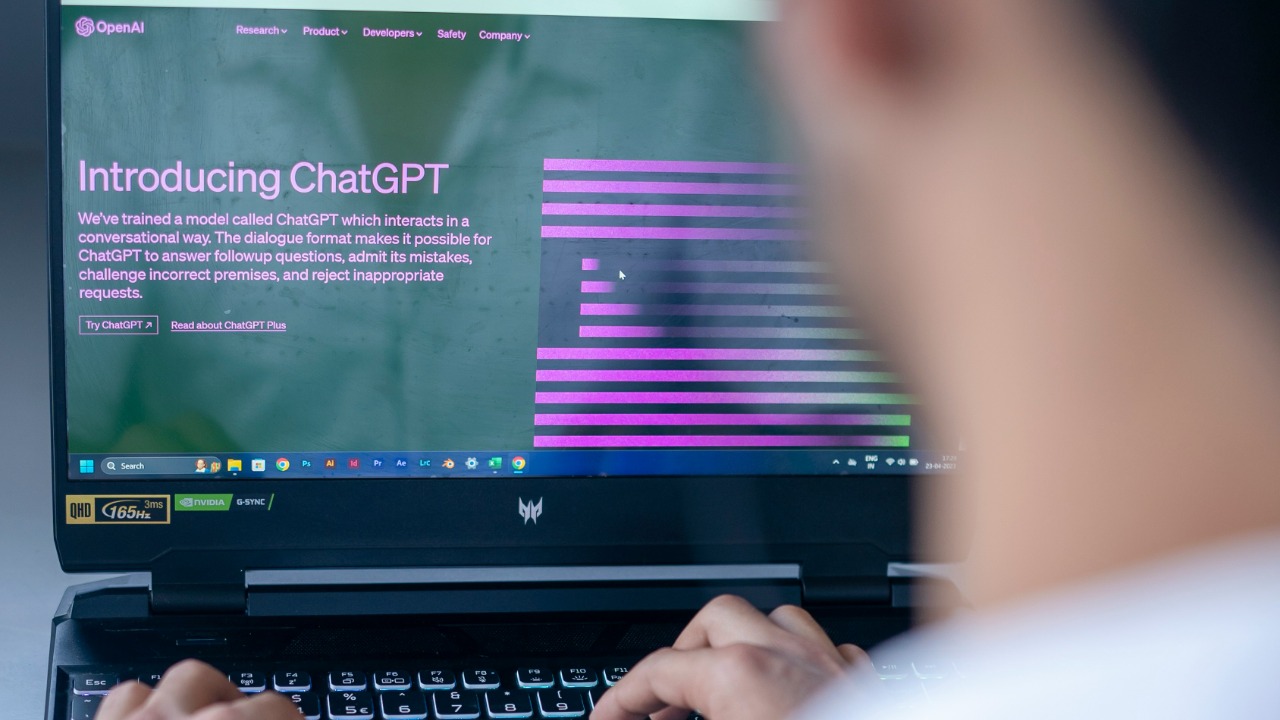

The US Patent and Trademark Office has drawn a bright line around who can be an inventor, and it is not generative AI. By framing systems like ChatGPT and Midjourney as sophisticated but ultimately ordinary tools, the agency is trying to stabilize patent law in an era when algorithms increasingly shape what gets built.
I see this move as a deliberate attempt to keep human accountability at the center of innovation while still giving companies room to lean heavily on AI in their research and development pipelines. The guidance does not just answer the headline question of whether AI can be named on a patent, it quietly rewrites how inventors, lawyers and examiners are supposed to think about machine assistance in every stage of the inventive process.
USPTO’s core message: AI helps, humans invent
The heart of the new guidance is simple: generative AI can contribute to an invention, but it cannot be the inventor. The agency is telling applicants that patent rights attach only to natural persons, even when a model generates key design options or suggests a novel compound. In practical terms, that means the human who meaningfully directs, evaluates or refines the AI’s output is the one who can claim inventorship, not the software that produced the draft idea.
That framing runs through the public explanation that generative systems are now treated as part of an inventor’s toolkit, on the same conceptual shelf as computer-aided design software or simulation engines, rather than as independent creative actors. Reporting on the guidance notes that the office explicitly characterizes generative AI as equivalent to other tools in an inventor’s belt, a position reflected in detailed commentary on how examiners should handle AI-assisted applications in new patent reviews.
Why the agency rejected AI as a named inventor
Behind the tool framing sits a more pointed legal conclusion: under current US law, only a human being can be an inventor. The USPTO is not merely expressing a policy preference, it is reading the Patent Act’s references to “individuals” and “persons” as excluding nonhuman entities. That interpretation aligns with earlier court decisions that rejected attempts to list an AI system as the sole inventor, and the guidance effectively locks that stance into day-to-day examination practice.
Some policymakers had floated the idea that advanced AI might eventually qualify for inventorship status, but the office has now stepped away from that notion. Coverage of the guidance notes that the agency’s answer to whether AI can be considered an inventor is a clear no, and that this position diverges from suggestions previously associated with the Biden administration’s broader AI agenda, as described in a detailed breakdown of how the office has rejected AI inventorship.
Clarifying AI’s role in the inventive process
Where the guidance becomes more nuanced is in explaining how much AI involvement is compatible with a valid human claim to inventorship. The office is effectively saying that a person can still be an inventor even if they rely heavily on generative tools, so long as they exercise intellectual control over the problem framing, the prompts, the evaluation of outputs and the final inventive concept. In other words, the human contribution must be more than pressing a button and accepting the first suggestion.
Legal analysts who have parsed the document emphasize that the USPTO is trying to draw a line between AI as a passive assistant and AI as a supposed co-creator. One summary explains that the agency clarifies AI is a tool in innovation instead of a competing inventor, and that examiners should focus on whether a human “significantly contributed” to the claimed subject matter when AI was used, a standard unpacked in guidance on how the office has recast AI’s role in patent filings.
How the guidance landed in the tech and IP world
The decision to treat generative AI as just another tool has reverberated quickly through the technology and intellectual property communities. For many patent practitioners, the guidance provides long-awaited clarity after a period of uncertainty in which clients were unsure whether to disclose AI use, downplay it, or even experiment with naming systems as co-inventors. The new rules give them a more predictable framework for counseling startups, pharmaceutical companies and hardware makers that are already embedding AI into their R&D workflows.
Tech-focused outlets and aggregators quickly amplified the USPTO’s message, highlighting that the office had issued new guidelines clarifying that generative AI is considered a tool rather than an inventor, a framing that has been widely shared through industry channels. That reaction underscores how central AI has become to patent-heavy sectors, and how much weight companies place on even subtle shifts in how the office talks about inventorship.
Human “significant contribution” as the new test
The most consequential part of the guidance for working inventors is the standard it sets for when a person can claim an AI-assisted invention as their own. The USPTO leans on a “significant contribution” test, asking whether the human involved shaped the inventive concept in a meaningful way, rather than simply accepting whatever the model produced. That test is likely to influence how labs document their workflows, with more emphasis on recording who framed the problem, selected training data, crafted prompts or combined AI outputs into a final design.
Specialist commentary on the guidance explains that the office will allow the use of AI to derive an invention if a human still satisfies this significant contribution threshold, and that applicants should be prepared to explain that role when questions arise, as outlined in a detailed analysis of how the USPTO has codified the standard. I read that as a signal that the agency is less interested in punishing AI use than in ensuring there is a clearly identifiable person who can be held responsible for the inventive step.
Practical implications for patent applicants and examiners
For companies and individual inventors, the guidance reshapes both strategy and paperwork. Applicants now have stronger incentives to document the human reasoning that went into an AI-assisted invention, from the initial problem statement to the decision to pursue a particular output as a patentable concept. That documentation can help show examiners that the named inventors did more than operate a tool, and it may become a standard part of internal invention disclosure forms at large firms.
On the other side of the table, examiners are being asked to probe how AI was used without treating its involvement as disqualifying. Legal practitioners note that the office is effectively training examiners to navigate a new landscape of AI-assisted innovation, including how to ask targeted questions about inventorship and disclosure, a shift explored in guidance on navigating the new landscape of AI in patent practice. I expect that to lead to more nuanced office actions that focus on the human contribution rather than on the mere presence of generative tools.
Global and policy context around AI inventorship
The USPTO’s stance does not exist in a vacuum, it sits within a broader international debate over whether AI systems should ever be recognized as inventors. Courts and patent offices in other jurisdictions have wrestled with similar questions, often in response to test cases that tried to list AI as the sole inventor on applications. By reiterating that only natural persons qualify, the US is aligning itself with a cautious global trend that prioritizes human accountability over machine autonomy in the patent system.
Coverage of the guidance in international outlets underscores how closely other countries are watching the US position, particularly as generative tools become embedded in cross-border research collaborations and multinational product development. One report on the office’s statement that generative AI is equivalent to other tools in an inventor’s belt highlights how this approach could influence parallel debates in Europe and Asia, framing the US move as part of a wider policy conversation about AI and intellectual property that has been picked up in global tech reporting.
How the message is being communicated to the public
Beyond the written guidance, the USPTO and the broader tech ecosystem are using a mix of official and informal channels to explain what the new rules mean. Public-facing videos and webinars walk through hypothetical scenarios, such as a chemist using a generative model to propose new molecules or an engineer relying on AI to optimize a circuit layout, and then map those scenarios onto the significant contribution test. These explanations are designed to reassure both large corporations and solo inventors that they can keep using AI aggressively without jeopardizing their patent rights, provided they stay honest about who did what.
Clips and commentary circulating on social platforms show how quickly the core message has filtered into mainstream tech discourse, with creators summarizing the idea that AI is a powerful assistant but not a legal inventor in short, shareable formats, including a widely viewed social video that distills the guidance into plain language. That kind of translation work matters, because the people experimenting most aggressively with generative tools are not always the ones reading Federal Register notices or dense legal memos.
Industry reaction and evolving best practices
Inside companies, the guidance is already prompting updates to internal policies on AI use in research and product design. General counsels and chief technology officers are revisiting how they train engineers to document their work, when to disclose AI assistance in patent applications, and how to structure collaboration between human experts and automated systems. The goal is to capture the productivity gains of generative tools without creating inventorship disputes that could weaken future patents in litigation.
Practitioners who advise on AI-heavy portfolios are sharing early best practices through conferences, client alerts and online discussions, including commentary that tracks how the USPTO’s tool framing is being interpreted by patent strategists and in-house teams, as reflected in a widely circulated industry thread. I expect those norms to harden into checklists and templates over time, shaping how everything from biotech startups to automotive suppliers integrate AI into their invention pipelines.
What this means for the future of AI-assisted innovation
By insisting that generative AI is a tool rather than an inventor, the USPTO is betting that the patent system can absorb a wave of machine-assisted creativity without rewriting its core human-centered assumptions. That choice keeps the focus on who is accountable for an invention, who can be deposed in litigation, and who can be incentivized through exclusive rights, even as the underlying technical work becomes more automated. It also signals to AI developers that, for now, their models are infrastructure for innovation, not rights holders in their own right.
Public discussions and explainers have stressed that this is unlikely to be the final word on AI and patents, but it does set the baseline from which future debates will start. Educational content, including detailed walk-throughs of the guidance and its implications for inventors who rely on generative systems, has framed the decision as a pragmatic compromise between embracing new tools and preserving legal clarity, a balance explored in a widely viewed video breakdown. As AI systems grow more capable, the pressure to revisit that compromise will only increase, but for now the message from the patent office is unambiguous: the machines may help, yet the inventive spark, in the eyes of the law, still belongs to people.
More from MorningOverview