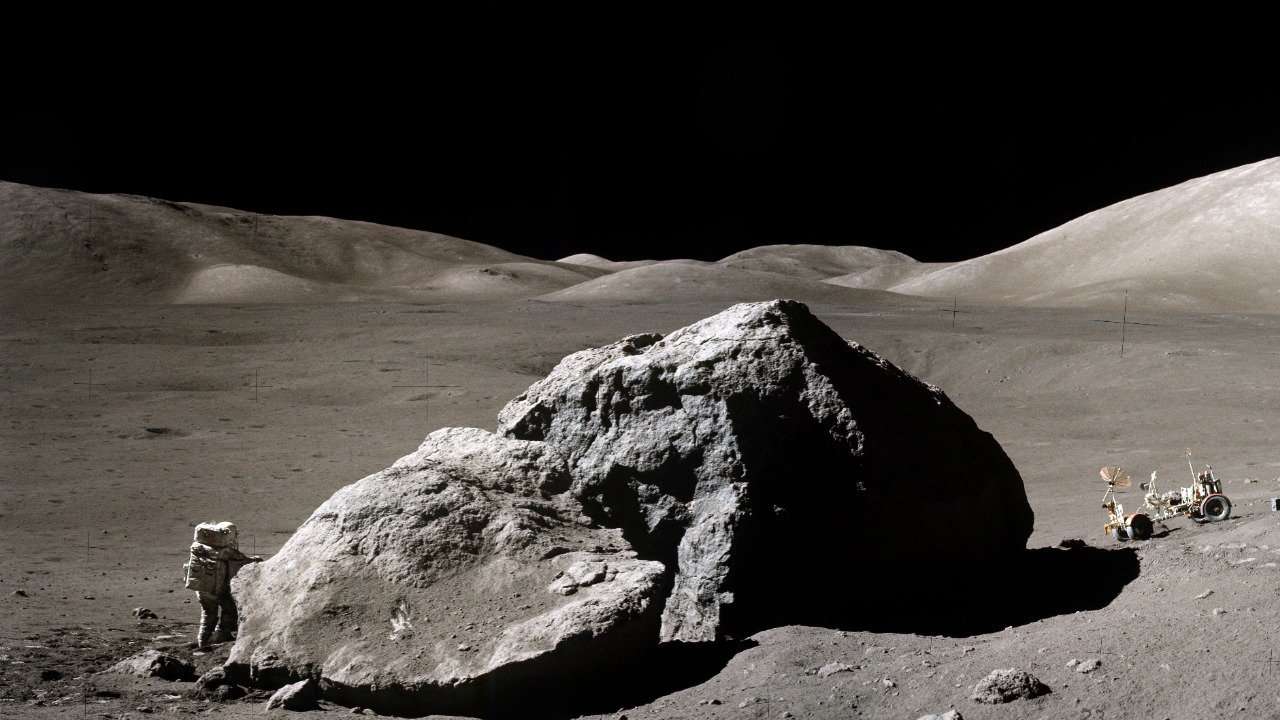

A half-century-old Moon rock, sealed away since the Apollo era, has just forced scientists to rethink what they thought they knew about our nearest neighbor. By slicing into a sample that had been treated as routine for decades, researchers uncovered a hidden structure that points to a more complex, more violent lunar history than the textbooks have long suggested.
The discovery does more than refresh a dusty chapter of space history. It shows how material collected 50 years ago can still overturn assumptions about how the Moon formed, how long its interior stayed active, and even how we should design the next generation of missions that will bring new rocks back to Earth.
What scientists actually found inside the 50‑year‑old rock
When researchers finally cracked open the Apollo-era sample, they did not just see another gray, fine-grained fragment of basalt. Instead, they found a surprisingly intricate mix of minerals and textures that pointed to a complicated journey through the Moon’s crust, including evidence that the rock had been partially melted and reworked long after the Moon’s surface first solidified. That internal structure, revealed only after modern instruments probed the sample in detail, is what turned a seemingly ordinary rock into a scientific jolt supported by fresh analysis of lunar material.
The key twist is that the rock’s composition and age do not line up neatly with the standard story of a Moon that cooled quickly and then went geologically quiet. Instead, the mineral assemblage suggests that parts of the lunar crust stayed hot and mobile for longer than expected, and that impacts or internal heating reshaped the rock well after the Moon’s earliest epoch. That conclusion, grounded in updated measurements of the sample’s isotopes and crystal structure, is what makes this 50‑year‑old specimen feel new again.
Revising the Moon’s age and early history
The unexpected features inside the rock have sharpened a long-running debate over how old the Moon really is and how fast it cooled. By re-dating minerals inside the sample with more precise techniques, researchers have been able to narrow the window for when the Moon’s primordial magma ocean solidified, and their results suggest that the satellite may be slightly younger than some classic estimates implied. Those findings build on earlier work that used Apollo samples to argue for a refined lunar timeline, including new age constraints derived from decades-old rocks that were reexamined with modern tools.
What emerges is a picture of a Moon that did not simply freeze into place and stay static. Instead, the revised ages indicate that the crust and upper mantle remained dynamic for a significant span of time, with heat from radioactive elements and large impacts continuing to stir the interior. The rock at the center of the latest study appears to have recorded at least one of those late episodes, preserving a time stamp that forces modelers to stretch out the Moon’s active youth rather than compress it into a brief, early burst.
Why a single rock can reshape lunar science
It might seem risky to lean heavily on one sample, but in planetary science, a single well-characterized rock can carry the weight of an entire chapter of history. The Apollo missions brought back a limited set of materials from specific regions, so each piece that turns out to be unusual can expose a gap in the prevailing models. In this case, the 50‑year‑old rock’s internal layering and age relationships challenge the assumption that all crustal rocks from that region formed in a narrow time band, a reminder that even a small dataset can reveal big blind spots when it is interrogated with new techniques.
There is also a methodological lesson here. The rock sat in storage for decades, cataloged and occasionally sampled, but only when researchers applied more sensitive instruments and more sophisticated statistical methods did its full story come into focus. That pattern mirrors how other fields have squeezed new value from old data, and it underscores why space agencies are investing in curated sample archives that can be revisited as technology improves rather than exhausted in a single generation of studies.
How modern tools unlocked a decades‑old sample
The leap in insight from this rock is less about luck and more about instrumentation. High-resolution imaging, micro-scale chemical mapping, and improved isotope ratio measurements allowed scientists to distinguish between minerals that once looked identical under older microscopes. By tracing tiny variations in elements such as uranium, lead, and rare earths, they could reconstruct the sequence of heating and cooling events that the rock endured, turning a static object into a timeline of lunar processes that had been invisible to earlier teams.
That approach reflects a broader shift in research culture, where scientists treat archived material as a renewable resource rather than a finished story. The same logic drives reanalysis of meteorites, Antarctic ice cores, and even historical economic records, all of which can yield fresh patterns when examined with new algorithms or imaging tools. In the case of the Moon rock, the payoff is especially vivid, because the new measurements directly feed into models of planetary formation and the evolution of rocky worlds around other stars.
From Moon rocks to mission planning and funding
Discoveries like this do not stay confined to the lab; they ripple into how agencies justify and design future missions. When a single archived sample can rewrite parts of lunar history, it strengthens the argument for returning to the Moon’s surface to collect more diverse rocks from new locations. That case matters in budget debates, where mission planners must persuade finance ministries and legislatures that expensive sample-return projects can deliver outsized scientific returns, much like a well-targeted portfolio in financial marketing is judged by the value it extracts from limited capital.
In practice, that means mission proposals increasingly highlight the long tail of scientific value, emphasizing that samples gathered today may fuel discoveries half a century from now. The 50‑year gap between this rock’s collection and its most important analysis is a powerful example for advocates who argue that exploration should be seen as a multi-decade investment rather than a one-off spectacle. When policymakers see that a single box of rocks can keep paying intellectual dividends for generations, it becomes easier to frame lunar exploration as a form of patient capital in knowledge.
The creative mindset behind reexamining old data
Reopening a long-studied sample and asking if everyone missed something requires a particular kind of scientific temperament. It is less about chasing the newest instrument and more about questioning the assumptions that have settled around a dataset, a habit that mirrors the way nonconformists in other fields challenge inherited wisdom. The decision to treat a dusty Apollo rock as a fresh puzzle rather than a closed case reflects the same mindset that drives innovators to revisit familiar problems with unconventional angles, a pattern explored in work on original thinkers who move established fields forward.
In lunar science, that creative skepticism shows up in how teams design their studies. Instead of simply confirming earlier measurements, they look for tensions between models and observations, then target samples that might resolve those conflicts. The 50‑year‑old rock became a candidate precisely because its earlier age estimates did not quite fit with newer crater-counting models, and rather than smoothing over that mismatch, researchers leaned into it. That willingness to treat anomalies as opportunities rather than errors is what turned an archival specimen into a catalyst for rethinking the Moon’s early evolution.
Reading the rock like a complex text
To make sense of the rock’s tangled history, scientists had to treat it less like a simple object and more like a layered narrative. Each mineral grain, fracture, and melt pocket functions as a line in a story that can be misread if context is ignored. That interpretive challenge is not far from the way scholars approach dense literature, where meaning emerges from the interplay of structure, language, and historical background, as outlined in research on reading practices that emphasize multiple perspectives.
In the lab, that means geologists must constantly shift between scales, zooming in to examine microscopic textures and zooming out to place those details within the broader chronology of lunar events. Misinterpreting one feature can skew the entire reconstruction, just as misreading a key passage can distort an analysis of a novel. The success of the new study rests on that careful, multi-layered reading of the rock, where each observation is cross-checked against models of impact dynamics, crust formation, and thermal evolution before it is folded into the final narrative of how the sample came to be.
Risk, optionality, and the value of sample archives
Keeping thousands of rock samples in climate-controlled storage for decades can look, on paper, like an expensive luxury. Yet the surprise inside this 50‑year‑old specimen illustrates why maintaining such archives is a rational strategy in a world where technology and theory keep evolving. By preserving material that can be interrogated in new ways, space agencies create a form of scientific optionality, a reservoir of future choices that can be exercised when new tools or ideas emerge, much like the flexible strategies described in analyses of optionality in volatile environments.
From that perspective, the Apollo sample vaults are not just historical artifacts; they are strategic assets. The cost of maintaining them is relatively small compared with the potential upside of discoveries that can recalibrate models of planetary formation or guide the search for habitable worlds. The newly analyzed rock demonstrates how one carefully stored object can unlock a new line of inquiry, validating the decision to keep other samples untouched until the right combination of questions and instruments comes along.
How the story is communicated to the public
Once the scientific results are in, the next challenge is explaining why a single rock matters without overselling or distorting the findings. Responsible coverage has to balance the genuine excitement of a revised lunar timeline with the caution that comes from working with a limited sample set. That balance is guided by long-standing principles of accuracy and fairness in science reporting, the same standards that underpin broader discussions of ethics and press freedom that shape how complex research reaches the public.
In practice, that means avoiding the temptation to declare that the Moon’s history has been completely rewritten, and instead explaining that the new rock data refine and complicate existing models. It also means being transparent about uncertainties, such as how representative this sample is of the wider lunar crust, and about the methods used to derive its age. When journalists and scientists collaborate to present those nuances clearly, they help readers see the discovery not as a one-off miracle but as part of a cumulative process in which each new piece of evidence nudges our understanding forward.
Why old discoveries still feel new
The idea that a rock collected half a century ago can still surprise us speaks to a broader cultural fascination with archives and forgotten corners of history. Whether it is a rediscovered recording in a digitized magazine archive or a long-buried dataset resurfacing in a new analysis, there is a recurring pattern in which the past becomes newly relevant when technology or curiosity shifts. The reexamination of this lunar sample fits that pattern, echoing the way researchers mine historical documents such as mid‑20th‑century issues preserved in digitized archives to answer questions that their original authors never imagined.
That sense of rediscovery helps explain why the story of a single Moon rock resonates beyond the scientific community. It taps into a wider recognition that progress often comes not just from collecting new things, but from looking again at what we already have with sharper tools and fresher questions. In that light, the rock is less an isolated curiosity and more a symbol of how knowledge accumulates, stalls, and then leaps forward when someone decides that an old object deserves a second look.
The Moon rock in a noisy digital culture
In an online environment saturated with novelty, it is striking that a story about a decades-old rock can still cut through. Part of the appeal lies in the contrast between the slow, meticulous work of sample analysis and the rapid churn of digital content, a tension that is often highlighted in commentary on how the internet surfaces oddities and deep dives side by side. Coverage of the lunar finding has circulated alongside eclectic cultural links and commentary in spaces that track the web’s stranger corners, similar in spirit to the curated miscellany found in certain online roundups.
That juxtaposition can actually work in the rock’s favor. When readers encounter a carefully reported piece on lunar geology amid memes and viral clips, the sheer difference in tempo can make the science feel more substantial. The challenge for communicators is to preserve the nuance of the research while adapting to formats and attention spans shaped by social feeds, a task that requires the same kind of selective focus scientists use when deciding which features of a complex rock to highlight and which to leave in the background.
What this means for the next era of lunar exploration
The surprise inside the 50‑year‑old rock arrives at a moment when multiple countries and private companies are planning new missions to the Moon. The finding strengthens the case for targeting regions that Apollo never reached, including the far side and the polar areas where ice and unusual rock types may be preserved. It also encourages mission designers to think carefully about how they will store and catalog the samples they bring back, so that future scientists can apply tools that do not yet exist, much as today’s researchers did with the newly analyzed Apollo specimen.
At the same time, the rock’s story is a reminder that exploration is not just about planting flags or testing hardware. It is about creating a long-lived conversation between the field and the lab, between the moment a sample is collected and the many moments when it is reinterpreted. As I look at how this one piece of the Moon has reshaped our sense of lunar history, I see a strong argument for treating every new sample as a potential time capsule, one that may hold its most important secrets for the scientists who will open it, and be astonished by it, half a century from now.
More from MorningOverview