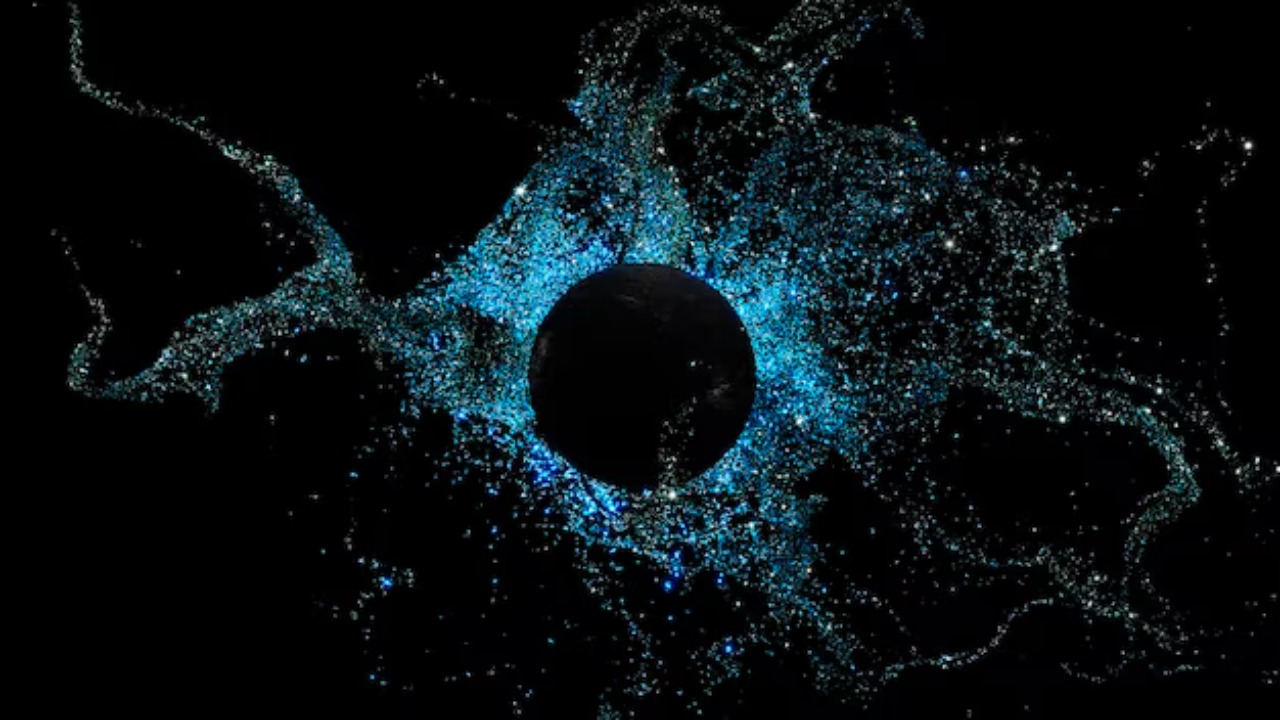

Hints that dark matter might be destroying itself have flickered through astronomical data for more than a decade, but a new analysis claims the clearest signal yet of that violent process. Instead of a vague statistical bump, the latest work points to a sharp feature in high‑energy light that behaves exactly as many theorists expect if invisible particles are colliding and annihilating in space.
If the result holds up under scrutiny, it would mark a turning point in one of physics’ longest hunts, shifting dark matter from a purely gravitational ghost into something that leaves a direct, measurable imprint. I see this as a moment when a once speculative idea, that dark matter can self‑destruct and light up the cosmos, is finally being tested with the kind of precision that can survive the field’s famously unforgiving cross‑checks.
The lone astronomer who lit the fuse
The latest excitement began with a single researcher who decided to re‑examine public gamma‑ray data with fresh eyes and a stubborn willingness to chase an anomaly. Working largely outside the big collaborations, this astronomer reported a narrow excess in the energy spectrum that lines up with what many models predict for dark matter annihilation, a claim that immediately drew both curiosity and skepticism from colleagues who have seen similar hints evaporate before. The story of a “lone astronomer” pushing a bold interpretation underscores how much of modern cosmology still depends on individuals willing to dig through archival data and question the consensus that previous searches had already squeezed out all the easy signals.
According to reporting on this work, the researcher argues that the feature cannot be easily explained by known astrophysical sources such as pulsars or supernova remnants, and instead matches the pattern expected if heavy dark matter particles are colliding and converting their mass into high‑energy photons. That interpretation, laid out in detail in the original analysis and subsequent commentary, has been framed as a potential breakthrough in dark matter annihilation studies, even as other experts stress that extraordinary claims will require equally extraordinary confirmation from independent teams and instruments.
What “annihilation” means in dark matter physics
To understand why this signal matters, I need to be clear about what physicists mean when they say dark matter “annihilates.” In many leading theories, dark matter is made of weakly interacting massive particles, or WIMPs, that can collide and convert their mass into other particles, often including pairs of high‑energy photons. This process is similar in spirit to how ordinary matter and antimatter annihilate into pure energy, a phenomenon that has been explored for years in both particle accelerators and speculative discussions of how such reactions might power future spacecraft or exotic weapons.
Earlier coverage of annihilation physics has emphasized that when particles and antiparticles meet, they can release energy according to Einstein’s E = mc², producing a characteristic spray of gamma rays and other debris that can, in principle, be detected across vast distances. That same logic underpins many dark matter searches, which look for excess gamma rays or other particles in regions where dark matter is expected to be dense, such as the Galactic Center. Long before the current claim, researchers were already drawing analogies between antimatter reactions and hypothetical dark sector processes, using insights from antimatter annihilation to design instruments and analysis techniques that could catch the faint glow of invisible particles destroying themselves.
A sharp signal in the biggest explosions in the universe
The new claim does not emerge in a vacuum, it builds on years of work combing through the brightest and most violent events in the cosmos for subtle patterns. One line of evidence comes from a signal buried inside what has been described as the most energetic explosion ever recorded, a transient event whose gamma‑ray output dwarfed typical supernovae and rivaled the most extreme gamma‑ray bursts. When researchers dissected that outburst, they found a narrow spectral feature that looked less like the messy emission of a collapsing star and more like the clean line expected from particle annihilation, a tantalizing hint that something beyond standard astrophysics might be at work.
Follow‑up analyses argued that the feature’s energy and shape could be consistent with heavy dark matter particles annihilating into photons, especially if those particles were concentrated in a dense region near the source of the explosion. That interpretation remains controversial, since extreme magnetic fields and shock waves can also sculpt gamma‑ray spectra in complex ways, but it helped establish a template for what a genuine annihilation line might look like. The current study leans on that precedent, pointing to a similar kind of narrow excess and drawing on earlier work that identified a signal buried in a record‑breaking blast as a proof of concept that such features can, in principle, be extracted from chaotic astrophysical fireworks.
The Milky Way’s core as a dark matter laboratory
Closer to home, the center of the Milky Way has long been treated as a natural laboratory for dark matter physics, precisely because gravity has packed so much mass into a relatively small volume there. Earlier gamma‑ray observations of the Galactic Center revealed an unexplained glow, often called an excess, that did not match the distribution of known sources like pulsars or cosmic ray interactions with gas. Some teams argued that the spatial pattern and energy spectrum of this glow fit neatly with expectations for dark matter annihilation, especially if the particles had masses in the tens of giga‑electronvolts and interacted with roughly the strength needed to produce the observed relic abundance in the early universe.
Other researchers pushed back, suggesting that unresolved populations of millisecond pulsars or other conventional sources could mimic the signal, and the debate has simmered for years without a definitive resolution. Within that context, the new claimed feature is especially provocative, because it appears as a sharper, more line‑like structure superimposed on the broader excess, which is exactly what many annihilation models predict when dark matter particles annihilate directly into photon pairs. Earlier work that linked a powerful gamma‑ray signal from the Milky Way’s core to possible dark matter destruction, arguing that dark matter destruction was “probably responsible” for the observed emission, now serves as a key reference point for evaluating whether the new analysis is sharpening that picture or simply reinterpreting the same ambiguous data.
From tentative hints to a claimed “signature”
What sets the latest work apart is the claim that the signal is not just an excess but a “signature,” a word that in this context implies a pattern so specific that it is hard to explain without invoking dark matter. In the new analysis, the astronomer reports a spectral feature whose energy, width, and spatial distribution align with a class of models in which dark matter particles annihilate into photon pairs or into intermediate particles that quickly decay into photons. The argument is that known astrophysical processes tend to produce broader, smoother spectra, while the observed line is narrow and concentrated in regions where dark matter density is expected to peak, such as the inner halo of the Milky Way or the outskirts of certain galaxy clusters.
Independent teams have been moving in a similar direction, with one group recently announcing what they described as a detected “signature” of dark matter annihilation in gamma‑ray data, based on a careful statistical analysis that attempted to subtract all known backgrounds. That work, which focused on the Galactic Center and nearby dwarf galaxies, reported a feature that matched theoretical expectations for WIMP annihilation and argued that the probability of it arising from random fluctuations was extremely small. The new lone‑astronomer study effectively strengthens that narrative by pointing to a comparable pattern in a different dataset, and it is now being weighed against earlier claims that a signature of dark matter annihilation had already been seen, with the field trying to determine whether these are independent confirmations or overlapping interpretations of the same underlying noise.
How the data were modeled and cross‑checked
Behind the headline claim lies a dense layer of modeling, and this is where the debate will likely be won or lost. The astronomer’s analysis relies on fitting the observed gamma‑ray spectrum with a combination of known astrophysical components and a hypothetical dark matter contribution, then asking whether the fit improves significantly when the annihilation term is included. This approach has a long pedigree in the field, with earlier studies using similar techniques to argue for or against potential signals in data from instruments like the Fermi Large Area Telescope and ground‑based Cherenkov arrays, and the new work positions itself squarely in that tradition while claiming a cleaner, more robust excess.
Previous theoretical and phenomenological papers have laid out the mathematical framework for such fits, specifying how different annihilation channels would shape the gamma‑ray spectrum and how uncertainties in the dark matter distribution translate into uncertainties in the predicted signal. One influential study, for example, explored how various particle physics models could explain a gamma‑ray excess in the Galactic Center, using detailed simulations to compare annihilation scenarios with alternative astrophysical explanations. The current analysis draws heavily on that kind of groundwork, effectively plugging a new dataset into a well‑tested pipeline that was originally developed in work such as the gamma‑ray excess modeling that has been widely cited in discussions of dark matter signals in the inner Milky Way.
Why some researchers remain unconvinced
Despite the excitement, many physicists are treating the new claim with caution, shaped by a long history of apparent dark matter signals that faded under closer scrutiny. In the past, features in cosmic ray positrons, gamma rays, and even X‑ray lines have all been hailed as potential breakthroughs, only to be reinterpreted as the product of mundane astrophysical sources or subtle instrumental systematics. That track record has made the community wary of over‑interpreting any single dataset, especially when the claimed signal sits near the edge of an instrument’s sensitivity or relies on complex background subtraction that can be sensitive to modeling choices.
Some of the skepticism focuses on the fact that the new analysis comes from a single astronomer working largely outside the big collaborations that built and operate the relevant telescopes, which means the work has not yet gone through the internal vetting processes those teams typically apply before announcing major discoveries. Others point out that the Galactic Center and similar regions are notoriously messy, with overlapping sources and diffuse emission that can easily conspire to produce apparent lines or bumps in the spectrum if the modeling is even slightly off. Earlier theoretical work that examined the robustness of claimed dark matter signals in gamma‑ray data, including detailed studies of systematic uncertainties in the Galactic Center excess, such as the analysis summarized in the 2016 Physical Review D abstract, has already shown how sensitive these conclusions can be to assumptions about the interstellar medium and cosmic ray propagation.
Connecting to earlier “new signal” claims
The current excitement also echoes earlier moments when researchers announced that a “new signal” might be evidence of dark matter, only to see the case weaken as more data arrived. One widely discussed example involved an excess in gamma rays from a particular region of the sky that did not match known source populations, prompting some teams to suggest that it could be the long‑sought glow of annihilating dark matter. At the time, the signal’s energy and spatial distribution seemed to line up with certain WIMP models, and the phrase “may be evidence of dark matter” captured both the hope and the uncertainty surrounding the result.
Subsequent analyses, however, showed that small changes in how the diffuse background was modeled could significantly alter the apparent excess, and alternative explanations involving unresolved point sources gained traction. That episode is a reminder that the path from intriguing anomaly to accepted discovery is rarely straightforward in this field, and it is shaping how researchers are reacting to the latest claim. The new work is being compared directly with those earlier “new signal” reports, including the gamma‑ray excess that some researchers argued may be evidence of dark matter, as the community looks for patterns in how such claims emerge and either survive or collapse under the weight of additional data.
How theory and machine learning are evolving the search
While the current claim is rooted in relatively traditional spectral analysis, the broader search for dark matter annihilation is increasingly drawing on new theoretical tools and machine learning techniques. On the theory side, model builders are exploring a wider range of dark sector possibilities, including particles that interact through new forces or that annihilate into long‑lived intermediates, which can produce more complex gamma‑ray signatures than the simple lines often discussed in early WIMP scenarios. These models can generate signals that vary across the sky in distinctive ways, giving observers more handles to distinguish dark matter from astrophysical backgrounds if the data are rich enough.
At the same time, data scientists are beginning to apply natural language processing and other machine learning architectures to astronomical datasets, treating spectra and sky maps as sequences that can be parsed for subtle patterns. Character‑level models, originally developed to understand text by analyzing strings of characters rather than whole words, are being adapted to scan through high‑dimensional data for anomalies that might escape traditional binned analyses. The vocabulary files and tokenization schemes used in these models, such as those distributed with tools like the character‑level BERT implementation, illustrate how techniques from language modeling can be repurposed to handle the noisy, structured signals that emerge from telescopes, potentially opening new avenues for identifying dark matter signatures hidden in plain sight.
Public scrutiny and the role of open data
One reason a lone astronomer can credibly claim a potential dark matter breakthrough is the increasing availability of open astronomical data, which allows independent researchers to reanalyze observations that were once accessible only to large collaborations. Space‑based gamma‑ray observatories and ground‑based telescopes now routinely release calibrated datasets and software tools, inviting outside experts to test new hypotheses and challenge official interpretations. This democratization of data has already led to several high‑profile reanalyses, including fresh looks at the Galactic Center excess and other anomalies that have reshaped the debate over dark matter annihilation.
Public engagement has also grown, with scientists turning to online platforms to explain their methods and invite scrutiny in real time. Detailed video breakdowns of complex analyses, for example, allow both specialists and interested non‑experts to follow the logic of a claimed discovery step by step, pausing to examine key plots and statistical arguments. In the case of the current signal, explanatory content such as a video walkthrough of the data and modeling choices is helping to accelerate the community’s response, compressing what might once have been months of closed‑door discussion into a more transparent, collaborative process that will ultimately determine whether this is truly the strongest evidence yet of dark matter annihilation or simply the latest mirage in a notoriously challenging search.
More from MorningOverview