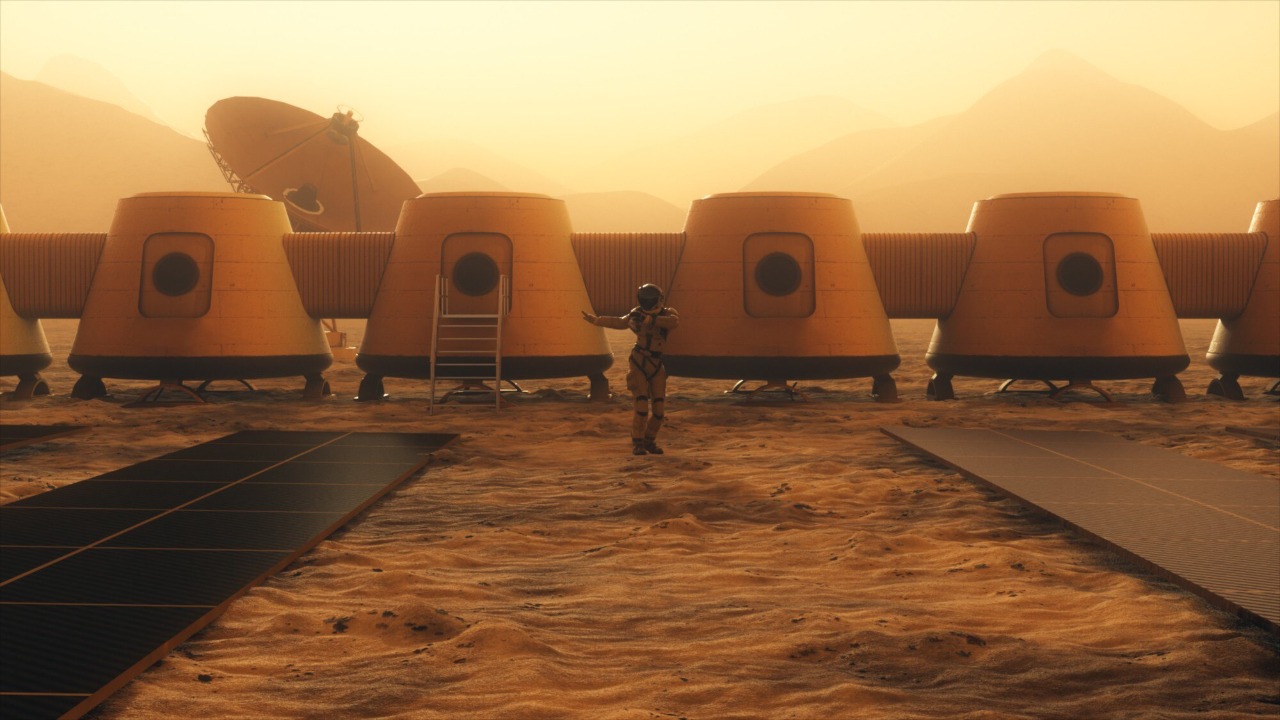

NASA is treating food as mission-critical hardware for Mars, designing future habitats where crops grow alongside life-support systems instead of arriving only in cargo holds. The agency’s long-term exploration plans now assume that crews will need to cultivate fresh plants on and en route to the Red Planet to stay healthy, productive, and psychologically resilient during multi-year expeditions. As I look across the latest research campaigns, it is clear that growing food off Earth is no longer a side experiment but a central pillar of how humans will live on Mars.
Why Mars missions now hinge on fresh food
Sending people to Mars turns nutrition from a logistics problem into a survival strategy, because no realistic launch schedule can keep a crew supplied with only prepackaged meals for years at a time. Stored food loses flavor, texture, and some nutrients over long durations, and the sheer mass of shipping every calorie from Earth would crowd out other essential hardware. I see NASA’s planners treating fresh crops as a way to close that gap, using plants to stretch stored rations, recycle resources, and give astronauts something that feels alive in an otherwise metallic environment.
That shift is baked into the agency’s broader Mars campaign, where human missions are framed as the next phase of a stepwise exploration roadmap that already includes orbiters, landers, and sample return. In official planning documents, future crews are expected to operate within surface habitats that integrate power, life support, and food production as a single system rather than separate add-ons, a vision laid out in the long-term Mars exploration strategy. I read that as a clear signal that agriculture is being treated with the same seriousness as propulsion or radiation shielding, not as an optional comfort feature.
Inside CHAPEA, NASA’s Mars food testbed on Earth
To turn that strategy into something measurable, NASA is running a series of simulated Mars missions in a sealed habitat in Texas, where crews live for a year at a time under strict resource limits. In this analog environment, volunteers follow a regimented schedule of tending crops, preparing meals, and tracking their health, giving researchers a controlled way to see how well different food systems hold up under isolation and stress. I see CHAPEA as the closest thing NASA has to a dress rehearsal for Martian living, especially when it comes to understanding how much time and energy astronauts can realistically devote to farming.
Within that habitat, the crew is tasked with testing both shelf-stable ingredients and small-scale plant growth systems, logging everything from water use to how often they crave fresh produce. The experiment is designed to probe whether a mix of packaged meals and on-site crops can keep people physically nourished and mentally engaged over a full mission cycle, rather than just a few weeks. NASA has described how the analog team is being used to test food systems and crop growth under Mars-like constraints, and the lessons from that sealed habitat will shape what future astronauts are actually asked to plant on another world.
Designing a menu that can survive deep space
Growing plants on Mars will only work if the overall menu is engineered to stay safe, nutritious, and appealing over years, which is why NASA’s food scientists are rethinking everything from packaging to recipe design. They are building a pantry that mixes thermostabilized entrees, freeze-dried ingredients, and ready-to-eat snacks with fresh harvests, so crews can assemble varied meals without relying on constant resupply. When I look at their work, I see a deliberate attempt to balance strict mass and volume limits with the reality that astronauts will need comfort foods and cultural familiarity as much as calories.
The agency has outlined how deep-space meals must deliver precise levels of protein, vitamins, and minerals while also being simple to prepare in microgravity or reduced gravity, where crumbs and liquids behave unpredictably. That means reformulating sauces, textures, and portion sizes so they are both safe and satisfying in a cramped galley, and then stress-testing those options in ground-based labs and analog missions. NASA’s nutrition experts describe this effort as designing a deep space food system that can support long-duration health, and the crops grown on Mars will have to slot into that carefully engineered menu rather than replace it outright.
How much food a Mars crew really needs
Behind the scenes, mission planners are running detailed calculations of how many calories, liters of water, and kilograms of food a Mars crew will require from launch to landing and back again. Those models factor in transit time, surface operations, and contingencies, then compare the mass of shipping everything from Earth against the potential savings from growing part of the diet on site. When I examine those tradeoffs, it becomes clear that even modest crop yields could translate into significant reductions in cargo mass, especially for bulky items like fruits and leafy greens that do not store well for years.
NASA has used public outreach videos to explain how food availability shapes mission architecture, walking through scenarios where crews rely on a mix of pre-positioned supplies and in-situ production. These analyses highlight that food is not just a life-support line item but a driver of launch cadence, habitat size, and even crew selection, since different activity levels change nutritional needs. In one explainer on food availability for a mission to Mars, the agency underscores that every kilogram of provisions must be justified against competing payloads, which is why any reliable crop system that can offset stored food becomes strategically valuable.
What will actually grow in Martian habitats
Not every plant belongs in a Mars greenhouse, so NASA and its partners are narrowing in on crops that deliver high nutritional value, fast growth, and efficient use of water and light. Leafy greens, herbs, and compact fruiting plants are strong candidates because they can be harvested repeatedly and fit into stacked growing racks, while root vegetables and grains pose tougher challenges in confined volumes. From what I see in current research, the goal is to build a small but powerful crop portfolio that can meaningfully diversify the menu without overwhelming crews with agricultural chores.
Scientists and engineers are also wrestling with how to adapt these plants to reduced gravity, limited natural light, and a closed-loop water system that recycles every drop. That means experimenting with LED spectra, hydroponic and aeroponic setups, and automated monitoring so astronauts can spend more time on science and less on weeding. In a recent episode of the agency’s Gravity Assist podcast, experts discussed how candidate crops must be evaluated not only for yield but for how they affect crew morale, since the act of tending a small garden can be as important as the calories it produces.
Robotic pathfinders and the Mars Future Plan
Before any astronaut plants a seed on Mars, robotic missions will scout the best locations for habitats, power systems, and potential agricultural modules. These spacecraft are tasked with mapping water ice deposits, characterizing dust and radiation, and testing technologies that future crews will rely on, including systems that could support greenhouses. I see this robotic groundwork as essential, because it will determine where it is practical to build long-term bases that can host both science labs and crop production facilities.
NASA has laid out a detailed roadmap for this robotic campaign, describing how orbiters and landers will feed into a broader human exploration timeline that includes surface infrastructure and resource utilization. A recent strategy document, released as part of the agency’s Mars Future Plan, outlines how upcoming missions are expected to inform decisions about where and how to build habitats that could eventually house crop systems. Coverage of that roadmap has emphasized that robotic exploration is being explicitly tied to human needs, a point reinforced when NASA’s long-term strategy for robotic Mars exploration highlighted support for future crews as a core objective rather than a distant afterthought.
Lessons from space farming videos and demonstrations
While formal documents sketch the big picture, NASA and its collaborators have also turned to video to show how space farming might look in practice, using demonstrations to make abstract engineering problems tangible. In one widely shared segment, researchers walk through the constraints of growing plants in controlled environments, from managing humidity to tuning LED lighting, and then connect those lessons to what a Mars greenhouse would require. I find these visual explanations useful because they reveal the practical tradeoffs behind each design choice, such as why certain crops are favored or how much automation is realistic.
Public-facing clips have also highlighted prototype growth chambers and experimental setups that test how plants respond to simulated Martian conditions, including altered day-night cycles and limited resources. A video focused on space-based food systems walks viewers through how engineers integrate sensors, nutrient delivery, and lighting into compact units that could eventually be scaled up for planetary habitats. Another demonstration on controlled-environment agriculture underscores how lessons from Earth-based vertical farms are feeding directly into designs for off-world crop modules, suggesting that the line between terrestrial and extraterrestrial agriculture is already starting to blur.
Community interest and citizen conversations about Mars crops
Beyond official channels, discussions about what to grow on Mars have spilled into online communities where space enthusiasts, engineers, and hobby gardeners trade ideas and critiques. These conversations often dig into practical questions that mirror NASA’s own concerns, such as how to balance calorie-dense staples with fresh vegetables, or whether certain heritage varieties might perform better in confined environments. When I read through these threads, I see a kind of informal peer review emerging, where non-experts stress-test assumptions and surface creative suggestions that sometimes echo professional research.
One example comes from a dedicated Mars-focused group on social media, where members have debated everything from the merits of potatoes versus legumes to the psychological value of colorful flowers in an otherwise utilitarian habitat. A post in a Mars discussion group captures this blend of technical curiosity and human-centered thinking, with participants weighing how crops might support both nutrition and mental health. While these exchanges are not official policy, they reflect a growing public sense that food will be central to any credible plan for living on another planet, and they help keep the conversation grounded in everyday experience rather than abstract engineering alone.
From testbeds to real Martian greenhouses
Pulling these threads together, I see NASA’s food strategy for Mars evolving from isolated experiments into an integrated system that spans analog habitats, robotic scouts, and detailed menu engineering. CHAPEA provides a human-scale testbed for how crews interact with crops under stress, deep-space menu design ensures that fresh harvests fit into a nutritionally complete diet, and robotic missions map the resources and environments where future greenhouses might thrive. Each piece informs the others, reducing uncertainty about how much food can realistically be grown off Earth and how that will reshape mission logistics.
The remaining challenges are substantial, from proving that closed-loop water and nutrient cycles can run reliably for years, to ensuring that crop yields are predictable enough to count as part of the life-support budget rather than a bonus. Yet the direction of travel is unmistakable: Mars missions are being planned around the assumption that astronauts will cultivate at least part of their own food, turning agriculture into a core capability of human spaceflight. As those plans mature, the first green shoots in a Martian habitat will represent more than a scientific milestone, they will mark the moment when living on another world starts to look less like camping and more like building a home.
More from MorningOverview