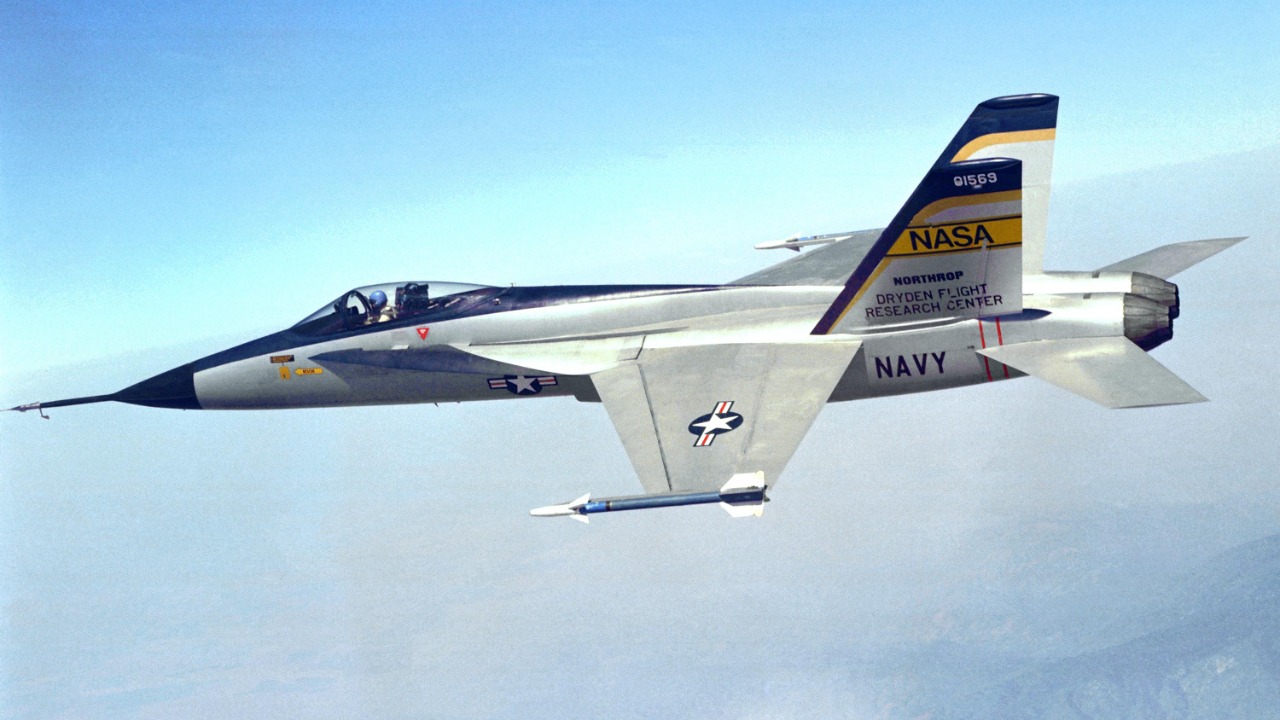

The Northrop YF-17 is remembered as the fighter that lost the U.S. Air Force’s Lightweight Fighter competition to the YF-16, yet its design did not die with that decision. Instead, the compact twin‑engine prototype became the foundation for the U.S. Navy’s F/A‑18 Hornet, one of the most versatile carrier aircraft of the late Cold War and beyond. By tracing how a losing prototype evolved into a frontline multirole jet, I can show how procurement choices, naval requirements, and clever engineering turned a near‑miss into a long‑running success story.
The YF‑17’s journey from “also‑ran” to the basis of a major fighter family illustrates how airframes can be repurposed when the mission changes. What began as a lean air‑to‑air specialist for the Air Force was reshaped into a rugged, carrier‑capable strike fighter that served with the Navy, Marine Corps, and several allies, proving that in military aviation, losing one contest can open the door to a very different victory.
From Lightweight Fighter contender to “incredible loser”
The YF‑17 started life as Northrop’s entry in the U.S. Air Force Lightweight Fighter program, a head‑to‑head competition with General Dynamics’ YF‑16 to produce an agile, affordable air‑to‑air fighter. The Air Force ultimately chose the YF‑16, a decision that locked in the single‑engine design as the service’s next front‑line fighter and left the YF‑17 without a production order. Contemporary and retrospective accounts describe how the YF‑17’s strong performance was not enough to offset the Air Force’s preference for the lighter, more fuel‑efficient YF‑16, which promised lower operating costs and higher acceleration in the specific test regime the service prioritized, according to program histories of the YF‑16/YF‑17 competition.
That loss has given the YF‑17 a kind of cult status among aviation enthusiasts, who often describe it as an “incredible loser” that nonetheless seeded a major fighter line. Online communities have revisited the aircraft’s unusual proportions, twin‑tail layout, and high‑mounted leading‑edge extensions, treating the prototype as a fascinating what‑if for Air Force service and a stepping stone to the Hornet. One widely shared discussion of the YF‑17 Cobra prototype underscores how a design that failed in its original competition still captured imaginations once its later naval evolution became clear.
Designing the Cobra: a lightweight twin‑engine fighter
Northrop’s engineers conceived the YF‑17, nicknamed “Cobra,” as a compact, highly maneuverable fighter that could match or out‑turn heavier opponents. The prototype featured twin General Electric YJ101 engines, a narrow fuselage, and prominent leading‑edge root extensions that generated extra lift at high angles of attack, all wrapped in a design that emphasized agility over raw speed. Historical profiles of the Northrop YF‑17 detail how the aircraft’s twin vertical tails and widely spaced engines were chosen to improve stability and survivability, while the cockpit and control layout reflected the emerging “energy‑maneuverability” thinking of the era.
The YF‑17’s first flight marked the moment when those design choices left the drawing board and entered the test range, demonstrating that a relatively small, twin‑engine fighter could deliver the handling qualities the Air Force wanted. Aviation historians note that the prototype’s early sorties validated its high‑alpha performance and controllability, even if the Air Force later judged the YF‑16’s overall package to be more attractive. Coverage of the YF‑17’s first flight highlights how the Cobra’s flight test program laid the aerodynamic groundwork that McDonnell Douglas and Northrop would later adapt for carrier operations.
Inside the YF‑16 vs. YF‑17 flyoff
The Lightweight Fighter program pitted the YF‑16 and YF‑17 against each other in a structured flyoff that examined performance, handling, and cost. Official retrospectives on the competition describe how both prototypes met or exceeded many of the Air Force’s maneuverability goals, but the YF‑16’s single‑engine layout and relaxed static stability gave it a slight edge in acceleration and sustained turn performance in the test envelope the service emphasized. Program documentation on the Lightweight Fighter proposals notes that the Air Force also weighed logistics and life‑cycle costs, areas where a single‑engine design promised savings.
From a procurement standpoint, the YF‑17’s twin‑engine configuration was a liability for the Air Force even as it offered redundancy and safety. The service was focused on fielding large numbers of relatively inexpensive fighters, and evaluators concluded that the YF‑16’s simpler powerplant and slightly better performance metrics aligned more closely with that goal. In that context, the YF‑17’s loss was less a verdict on its quality and more a reflection of how tightly the Air Force had defined its priorities, a nuance that becomes clear when reading detailed accounts of the YF‑16 and YF‑17 test program and the tradeoffs that shaped the final decision.
Why the Navy saw potential where the Air Force did not
While the Air Force moved ahead with the F‑16, the U.S. Navy was searching for a new generation of carrier aircraft to replace aging F‑4 Phantoms and A‑7 Corsair IIs. Naval planners needed a design that could survive catapult launches, arrested landings, and long deployments at sea, and they were far more sensitive to the risks of losing a single engine over water. In that environment, the YF‑17’s twin‑engine layout, wide landing gear stance, and robust structure suddenly looked less like a cost penalty and more like a promising foundation for a carrier‑capable fighter, a shift in perspective that underpins later analyses of how the Navy turned the YF‑17 into the F/A‑18.
Naval aviators and acquisition officials have since explained that engine redundancy was a central factor in their thinking, particularly for night or bad‑weather operations far from divert fields. One detailed account from a former naval flight officer describes how the number of engines became a decisive discriminator when the Navy weighed adapting either the YF‑16 or the YF‑17 for carrier use, with the twin‑engine option seen as inherently safer for blue‑water operations. That perspective is laid out clearly in a discussion of why the Navy favored the YF‑17’s two engines, which underscores how different mission environments can flip the perceived strengths and weaknesses of a design.
From Cobra to Hornet: engineering a carrier‑capable strike fighter
Transforming the YF‑17 into what became the F/A‑18 Hornet required more than simply reinforcing the airframe; it meant reimagining the aircraft as a true multirole platform. McDonnell Douglas and Northrop enlarged the fuselage, strengthened the landing gear and structure for catapult and arresting‑gear loads, and integrated advanced avionics and radar suitable for both air‑to‑air and precision strike missions. Analyses of how the YF‑17 was turned into the F/A‑18 emphasize that the Hornet retained the Cobra’s basic aerodynamic layout, including its leading‑edge extensions and twin tails, while evolving into a larger, more capable aircraft tailored to naval requirements.
The redesign also reflected the Navy’s desire to consolidate roles, replacing separate fighter and attack types with a single “F/A” platform that could switch from fleet defense to strike missions in the same sortie. That concept demanded robust stores stations, sophisticated weapons integration, and a cockpit optimized for managing complex missions, all of which went far beyond the original Lightweight Fighter brief. Video explainers on the YF‑17’s evolution into the Hornet highlight how the design grew in weight and capability while preserving the Cobra’s core handling qualities, turning a pure fighter prototype into a flexible workhorse of carrier air wings.
What the prototypes tell us today
Decades after the flyoff, the surviving YF‑17 airframes have become valuable artifacts that show how close the Air Force came to a very different fighter fleet and how the Navy’s Hornet lineage began. Museums that display the Cobra emphasize its role as a bridge between the Lightweight Fighter program and the eventual F/A‑18 family, giving visitors a tangible sense of the design features that carried over to the fleet. One preserved Northrop YF‑17 prototype is presented with context about its test career and its influence on later naval aircraft, underscoring that its legacy lies less in what it did in service and more in what it enabled.
Enthusiast videos and archival footage further reinforce that point by juxtaposing the Cobra’s compact lines with the more muscular stance of the production Hornet, inviting viewers to trace the continuity in planform and control surfaces. A widely shared clip of the YF‑17 as the “loser that became the F/A‑18” captures how public perception has shifted from seeing the aircraft as a failed competitor to recognizing it as the seed of a successful family. In that sense, the prototypes function as three‑dimensional footnotes to a procurement story that still shapes modern carrier aviation.
How the Hornet validated the YF‑17’s core ideas
The operational record of the F/A‑18 Hornet and its derivatives effectively validated many of the YF‑17’s original design instincts, particularly the emphasis on agility, twin‑engine safety, and a compact footprint suitable for crowded decks. Hornets went on to serve in U.S. Navy and Marine Corps squadrons across multiple conflicts, performing air defense, close air support, and precision strike missions from carriers and austere land bases. Analyses that trace the Hornet’s lineage back to the YF‑17’s aerodynamic layout point out that the Cobra’s leading‑edge extensions and twin‑tail configuration gave the F/A‑18 the high‑angle‑of‑attack handling and control authority that pilots later praised in combat and carrier operations.
At the same time, the Hornet’s success highlighted how a design optimized for one service can flourish in another when the mission set aligns more closely with its inherent strengths. The YF‑17’s twin engines, which counted against it in the Air Force’s cost calculus, became a selling point for naval aviators who valued redundancy over marginal fuel savings. Video retrospectives on the YF‑17 and F/A‑18 relationship often frame the Hornet as proof that the Cobra was never a bad design, only one that needed the right customer and mission to reach its potential.
Lessons from a “lost” competition
Looking back at the YF‑17’s path from losing prototype to the basis of a major fighter family, I see a cautionary tale about treating competition outcomes as final judgments on an aircraft’s worth. The Air Force’s choice of the YF‑16 was grounded in its specific priorities and budget assumptions, but the Navy’s later embrace of the YF‑17’s architecture shows how different operational contexts can flip the value of key design traits. Detailed program histories of the Lightweight Fighter proposals make clear that both prototypes were strong performers, and that the YF‑17’s eventual naval success was less a surprise than a reapplication of a solid concept to a different set of requirements.
The Cobra’s story also underscores the importance of preserving and studying prototypes, not just as museum pieces but as case studies in how design decisions age over time. Enthusiast discussions of the “incredible loser” YF‑17 and curated exhibits of surviving airframes show how much insight can be gained from revisiting what might have been. In the end, the YF‑17 did not disappear into obscurity after losing to the F‑16; it simply changed services, missions, and names, proving that in military aviation, a loss on paper can still evolve into a lasting operational win.
More from MorningOverview