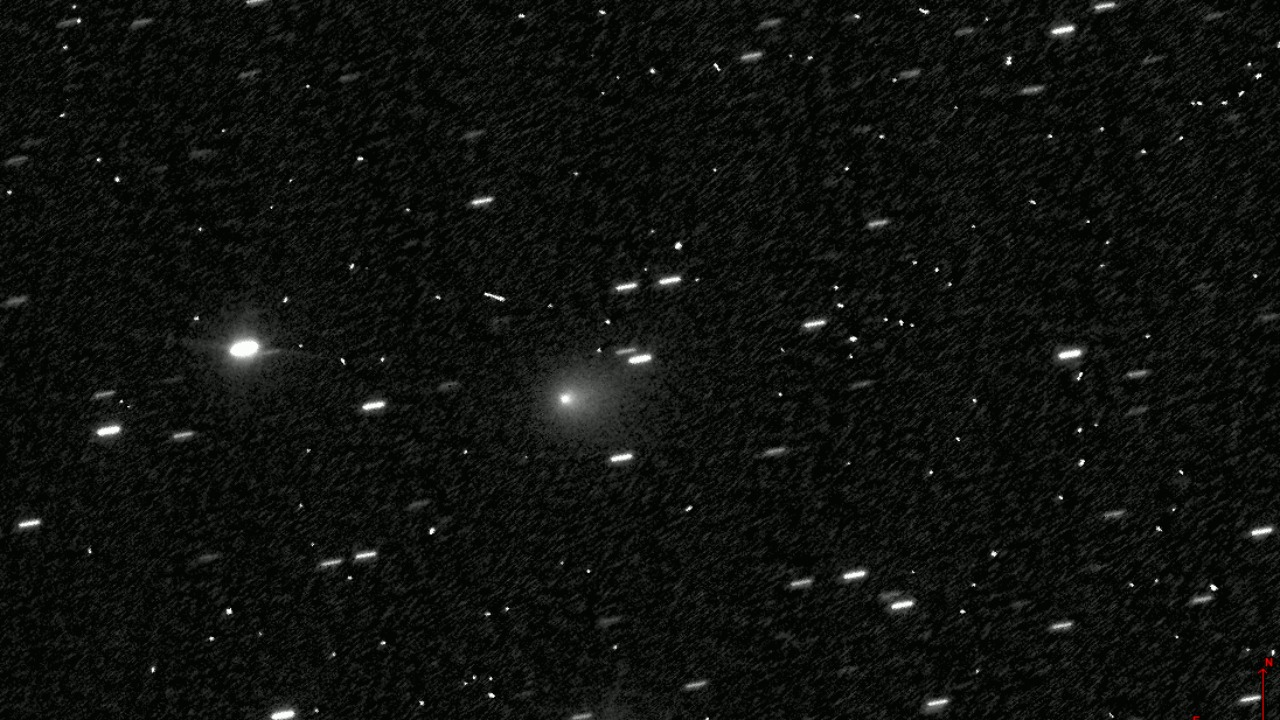

Interstellar objects used to be the stuff of theory problems and science fiction, but 3I/ATLAS has pushed them squarely into the realm of public anxiety. As another visitor from beyond the solar system sweeps through, the question is no longer whether such objects exist, but how much danger they actually pose to Earth and to our long‑term security. To answer that, I need to separate what astronomers can measure from what the internet is imagining.
What 3I/ATLAS actually is
The first step in judging risk is to be clear about what 3I/ATLAS appears to be from the data, not from speculation. Astronomers classify it as the third known interstellar object, following 1I/ʻOumuamua and 2I/Borisov, and the available observations show a body on a hyperbolic trajectory that is not gravitationally bound to the Sun. Orbital calculations, brightness measurements and its path through the sky all point to a natural object that has wandered in from another stellar system, which is why official descriptions refer to it as an interstellar comet or small body rather than as a spacecraft or probe, a framing reflected in the technical overview of 3I/ATLAS facts and FAQs.
From a physical standpoint, the object’s size, activity and behavior look broadly consistent with a modest comet rather than a planet‑killer asteroid. Analyses of its brightness and coma suggest a nucleus that is far smaller than the multi‑kilometer bodies that worry planetary‑defense specialists, and its incoming path keeps it at a safe distance from Earth even at closest approach. Researchers who have broken down its motion and outgassing patterns describe a set of “mysteries” around its exact composition and origin, but they still treat it as a natural visitor whose main scientific value is what it can reveal about other planetary systems, a framing that runs through detailed explainers on 3I/ATLAS’s biggest mysteries.
How its trajectory and size translate into impact risk
When people ask whether 3I/ATLAS is dangerous, they are usually imagining a catastrophic collision with Earth, so I start with the geometry. The object’s hyperbolic orbit means it is whipping through the solar system on a one‑time flyby, and the calculated closest approach keeps it far outside the narrow corridor that would be required for an impact. Planetary‑defense teams track such trajectories precisely because even small uncertainties matter, but in this case the combination of high relative speed and a miss distance that is large on human scales leaves no realistic path to a surprise strike, a conclusion that underpins the calm tone of official briefings on what we know about 3I/ATLAS.
Even if the orbit were less forgiving, the object’s estimated size and composition would still limit the worst‑case scenario. A small, icy nucleus would tend to fragment and burn up in the atmosphere more readily than a dense metallic asteroid of the same diameter, and the energy release scales steeply with size, so the difference between a tens‑of‑meters body and a multi‑kilometer one is the difference between a regional airburst and a global climate‑shifting event. Current estimates place 3I/ATLAS well below the threshold for a civilization‑ending impact, and that is before factoring in the fact that it is not on a collision course at all, a point that professional observers have reiterated in public Q&A sessions and technical deep dives on interstellar comets.
Why “alien tech” claims keep surfacing
The lack of impact risk has not stopped a different kind of fear from spreading, centered on the idea that 3I/ATLAS might be an artificial object sent by an extraterrestrial civilization. A small number of researchers have argued in preprints and conference talks that some aspects of its motion or activity could, in principle, be consistent with a controlled probe, and one recent paper framed the object as a potentially “hostile” piece of alien technology. That framing has been amplified in popular coverage that highlights the controversy, even as most astronomers stress that the data are sparse and that natural explanations remain far more likely, a tension that is evident in reporting on the paper questioning whether 3I/ATLAS is alien tech.
From a risk‑assessment perspective, the key point is that extraordinary claims about intent or technology are not supported by direct evidence. The object has not exhibited unambiguous signs of propulsion, communication or maneuvering that would distinguish it from a comet responding to sunlight and outgassing, and the “hostile” label rests on speculative scenarios rather than on observed behavior. That does not mean scientists should ignore unusual data, but it does mean that policy makers and the public should treat these claims as hypotheses to be tested, not as established facts, a distinction that experienced observers have tried to reinforce in measured video explainers about interstellar visitors.
How scientists actually evaluate interstellar visitors
To understand how risky 3I/ATLAS is, I look at how astronomers systematically study such objects rather than at isolated hot takes. Once an interstellar trajectory is confirmed, teams race to gather spectra, light curves and high‑resolution images, building a profile of the object’s composition, rotation and activity. Those measurements are then compared with models of comets and asteroids from our own solar system, as well as with the limited data from 1I/ʻOumuamua and 2I/Borisov, to see whether the newcomer fits within known categories or demands new physics, a process laid out in technical discussions of how 3I/ATLAS is being observed and modeled.
Risk enters that process in two ways: through orbital analysis, which determines whether the object could hit anything important, and through physical characterization, which reveals whether it could survive long enough to matter. For 3I/ATLAS, both lines of evidence point toward a transient, natural body that will pass through the inner solar system and then fade into the background, leaving behind data but not debris. Researchers are also using it as a test case for how quickly the community can mobilize telescopes and instruments when the next interstellar object appears, a theme that runs through broader reflections on why the scientific questions around such visitors go far beyond aliens.
Public anxiety, social media, and the rumor mill
Outside observatories, the conversation around 3I/ATLAS has followed a familiar pattern in which snippets of technical debate are reinterpreted as evidence of cover‑ups or looming threats. On social platforms and in comment threads, users trade screenshots of orbital diagrams and out‑of‑context quotes, often blending legitimate curiosity with a deep mistrust of official reassurance. In one widely shared discussion, participants asked bluntly whether the object is “something to worry about,” only to have more technically minded users walk through the orbital data and explain why the geometry rules out an impact, a dynamic that plays out clearly in community threads such as one popular r/space discussion.
Facebook groups and other closed communities have also become echo chambers for more speculative narratives, including claims that 3I/ATLAS is a disguised craft or a harbinger of imminent disaster. Posts in some of these groups circulate unverified diagrams and alleged “insider” warnings, even as members who link to mainstream astronomical resources are accused of naivety or complicity. In at least one large space‑focused group, a long thread about the object mixed genuine questions about interstellar dynamics with memes and alarmist commentary, illustrating how quickly nuance can be lost once a topic leaves expert circles, as seen in a widely commented Facebook discussion about 3I/ATLAS.
What experts say about the “should we worry” question
When I strip away the noise and focus on expert assessments, a consistent message emerges: 3I/ATLAS is scientifically exciting but not a practical threat. Astronomers who specialize in small bodies emphasize that the object’s orbit keeps it at a safe distance, and that its modest size and likely icy composition further reduce any conceivable hazard. They also point out that the detection itself is a sign of progress, because it shows that survey telescopes are now sensitive enough to spot such visitors early and track them accurately, a point that comes through in detailed analyses of how 3I/ATLAS was found and followed.
That expert consensus has filtered into public Q&A platforms, where users pose direct questions about whether the object could be alien technology or a hidden danger. In one widely read exchange, respondents with astronomy backgrounds walked through the available data and concluded that there is no credible basis for alarm, stressing that extraordinary scenarios would require extraordinary evidence that simply is not present. They also highlighted the difference between a thought experiment about possible alien probes and a concrete risk assessment for a specific object, a distinction that is spelled out in responses to the question of whether we should be concerned about 3I/ATLAS.
Why interstellar objects matter even when they are not dangerous
Calling 3I/ATLAS “safe” does not mean it is unimportant, and in many ways the real stakes lie in what such objects can teach us rather than in what they might do to us. Each interstellar visitor carries material that formed around another star, so its ices and dust grains encode information about chemistry and planet formation conditions that we cannot access any other way. By dissecting its spectrum and activity, scientists can test models of how common certain molecules are in planetary nurseries and how similar or different other systems are from our own, an opportunity that researchers have highlighted in their breakdowns of the scientific puzzles 3I/ATLAS might help solve.
There is also a practical dimension to treating these visitors as laboratories rather than threats. The techniques developed to spot, track and characterize interstellar objects feed directly into planetary‑defense capabilities, because the same wide‑field surveys and rapid‑response observations are used to find potentially hazardous asteroids. In that sense, every successful campaign to study an object like 3I/ATLAS is a rehearsal for the day when a genuinely risky body appears, and the lessons learned about coordination, data sharing and public communication will matter far more than any speculative scenario about alien intent, a perspective that scientists have emphasized in essays about why the alien question is not the main issue.
How I weigh the real risks against the imagined ones
When I weigh the evidence, I see three distinct categories of risk around 3I/ATLAS: physical impact, technological threat and social disruption. The first is the easiest to dismiss, because orbital mechanics and size estimates leave no room for a plausible collision scenario that would endanger Earth. The second, the idea of a hostile probe, currently lacks any observational support and rests on speculative readings of limited data, so I treat it as an interesting thought experiment rather than as a basis for policy. The third, however, is already visible in the way misinformation and fear can spread faster than peer‑reviewed analysis, shaping public trust in science and institutions.
That social risk is why communication choices around 3I/ATLAS matter as much as telescope time. When experts engage early and explain both what is known and what remains uncertain, they can channel curiosity into constructive questions instead of panic. Some of the most effective outreach has come from astronomers who walk through the data step by step in accessible formats, showing viewers how to interpret light curves and orbital plots for themselves, an approach that is on display in educational videos that unpack interstellar‑object hype. The more transparent that process becomes, the less room there is for unfounded claims to take root.
What 3I/ATLAS tells us about the next visitor
Looking ahead, I see 3I/ATLAS less as a one‑off curiosity and more as a preview of a future in which interstellar objects are routine discoveries. As survey telescopes grow more powerful, astronomers expect to find many more such visitors, each with its own quirks and mysteries. The experience of tracking this object, debating its nature and responding to public concern is already shaping plans for how to handle the next one, from refining alert systems to coordinating follow‑up observations across continents, a process that has been described in technical planning documents for interstellar‑object campaigns.
For the rest of us, the lesson is that not every strange object in the sky is a crisis, but each is a chance to stress‑test our scientific and social systems. If we can learn to distinguish between genuine hazards and speculative fears, and if institutions can respond with clarity instead of obfuscation, then visitors like 3I/ATLAS will be remembered less for the rumors they spawned and more for the window they opened onto other worlds. In that sense, the real risk is not that an interstellar object will destroy us, but that we will be too distracted by imagined threats to recognize the opportunity it represents, a point that thoughtful observers have underscored in long‑form discussions of what interstellar comets mean for humanity.
More from MorningOverview