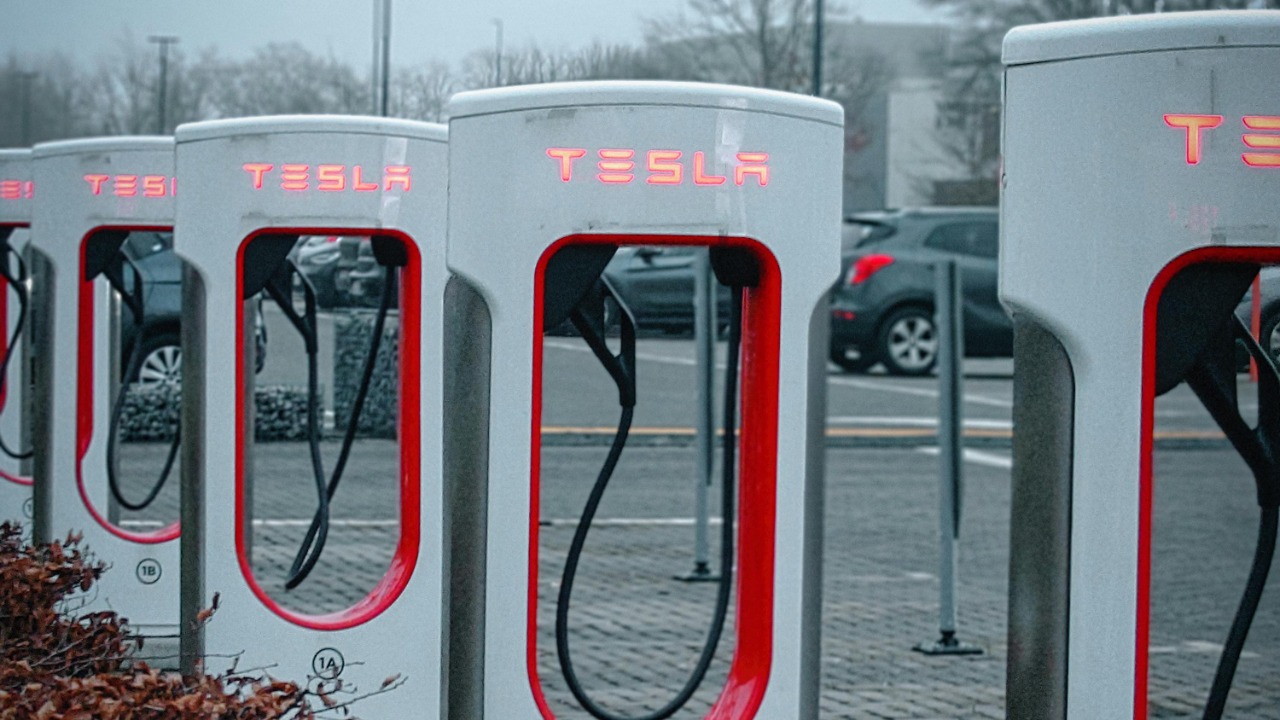

Tesla has switched on what is being described as its largest solar-powered Supercharger hub to date, a sprawling site designed to keep electric vehicles moving while leaning heavily on renewable energy. The project marks a new phase in the company’s charging strategy, pairing high-speed plugs with a vast canopy of solar panels and on-site batteries to ease pressure on the grid and cut operating emissions.
By scaling up both the number of stalls and the clean energy behind them, Tesla is signaling that the future of long-distance EV travel will depend as much on smart infrastructure as on the cars themselves. The new station is built to function as a kind of highway oasis, with enough capacity to serve a surge of drivers and enough storage to keep charging even when the sun is not shining.
A landmark Supercharger built around solar power
The new site is being framed as a Landmark Solar Supercharger Deployment, a phrase that captures both its physical size and its ambition to anchor charging in on-site generation rather than distant power plants. Tesla has been adding solar canopies to select locations for years, but this installation pushes that idea further, treating the solar array as a core design element instead of an optional add-on. The company is effectively turning a charging lot into a compact power plant, with rows of panels feeding energy directly into the Supercharger hardware and the batteries that back it up.
Reporting on the project notes that Tesla has unveiled its largest Supercharger station to date in California, describing it as a massive buildout that goes beyond earlier high-capacity sites such as a previous location in Barstow that offered 120 stalls, and emphasizing that the deployment was highlighted in Nov 24, 2025 coverage as a major step for Tesla’s Supercharger network in the state, a development characterized as a Landmark Solar Supercharger Deployment.
Lost Hills as a new Supercharging “oasis”
The station is located in Lost Hills, California, a small community along a heavily traveled stretch of highway that connects major population centers and freight routes. By choosing Lost Hills, Tesla is targeting a corridor where drivers often need to recharge in the middle of long trips, turning what might once have been a quick fuel stop into a more substantial pause that can support dozens of vehicles at once. The company is effectively using geography as a force multiplier, placing a high-capacity hub where it can intercept both commuter traffic and long-haul travelers.
Coverage of the opening describes the site as Tesla’s largest Supercharging oasis, noting that the station in Lost Hills, California is now fully open and built to handle a significant flow of EVs, including vehicles towing trailers, which typically require more space and can be harder to accommodate at smaller charging locations.
Scale, stall count, and the push beyond earlier mega-sites
What sets this Supercharger apart is not only its solar canopy but also its sheer scale, with a stall count that pushes beyond earlier mega-sites that already felt oversized compared with typical highway chargers. Tesla has been steadily increasing the capacity of its flagship locations, moving from dozens of plugs to triple-digit counts as EV adoption grows and as the company opens parts of its network to non-Tesla models. The new build is designed to absorb peak holiday traffic and weekend surges without forcing drivers into long queues, a problem that has occasionally surfaced at smaller stations during busy travel periods.
Reports on the Lost Hills project describe it as Tesla’s largest Supercharging oasis, with a layout that supports a very high number of stalls and dedicated spaces for EVs with trailers, and they highlight that the site is now fully open as of coverage dated Nov 25, 2025, underscoring how quickly Tesla has moved from earlier large sites, such as the Barstow location with 120 stalls, to this new flagship hub that is intended to redefine what a busy highway charging stop can look like, according to the detailed description of Tesla’s Largest Supercharging Oasis.
Solar generation and battery storage behind the scenes
The backbone of the site is its energy system, which combines a large solar array with substantial on-site storage so that the station can keep operating even when grid conditions are tight. Instead of drawing all of its power from utility lines, the station uses its solar canopy to generate electricity during the day, then stores a portion of that energy in batteries that can discharge when demand spikes or when the sun goes down. This setup is meant to reduce both the carbon intensity of each charging session and the strain that fast charging can place on local infrastructure.
Technical details from coverage of the Lost Hills station note that the site features 11 MW of solar panels paired with a battery energy storage system rated at 39 MWh, a combination that gives the hub a significant buffer against grid fluctuations and allows it to smooth out the peaks and valleys of charging demand, with the figure of 39 M highlighted as a key metric in understanding the scale of the storage component.
Designing a highway hub for drivers, not just cars
Tesla is also treating the new station as a place where drivers can spend meaningful time, not just a row of plugs where people wait in their cars. The company has been experimenting with amenities at some of its larger locations, adding rest areas, food options, and shaded walkways so that a 20 to 40 minute charging stop feels less like a chore. At a site of this size, those design choices become more important, because the station is likely to host a constant flow of travelers who may arrive tired, hungry, or in need of a break from the road.
Reporting on the opening notes that Tesla has officially activated what is described as the world’s largest Supercharger site and that the company has emphasized features that make it easier for drivers to relax while their vehicles charge, describing the location as a place where the charging experience is integrated with rest and convenience facilities, a point underscored in coverage that framed the development under the banner Tesla Just Opened Its Biggest Supercharger Ever.
What the new station signals for Tesla’s wider network
For Tesla, this project is more than a one-off showcase, it is a template for how the company may approach future high-traffic corridors as EV adoption accelerates. By pairing a large number of stalls with significant solar and storage capacity, the company is testing a model that could be replicated along other busy routes where grid upgrades are slow or expensive. If the Lost Hills hub performs as intended, it will strengthen Tesla’s argument that fast charging can scale without overwhelming local utilities, provided that stations are built with on-site generation and batteries from the start.
The choice of location and the emphasis on solar align with Tesla’s broader push to integrate energy products with its vehicle business, a strategy that has been visible at other sites but reaches a new level here, and the significance of the build is reinforced by the way it has been highlighted in coverage of a Landmark Solar Supercharger Deployment in California and in reports that describe the Lost Hills station as Tesla’s largest Supercharging oasis, as well as by the fact that the project is associated with a specific place entry for the Supercharger site that identifies the location and layout of the new hub in mapping data.
How this reshapes expectations for long-distance EV travel
For drivers, the practical impact of this station is a shift in what they can expect from long-distance EV travel on major routes. Instead of hunting for a handful of plugs at a small lot, they can arrive at a site that is designed to absorb heavy traffic and keep wait times low, even during peak holiday weekends. The presence of on-site solar and storage also helps reassure drivers who worry about whether the grid can handle a growing fleet of electric vehicles, since a portion of the power is generated and buffered locally.
From my perspective, the Lost Hills project shows how quickly the conversation around charging is moving from whether there are enough stations to how intelligently those stations are built and powered, and the fact that Tesla has tied this build to a Landmark Solar Supercharger Deployment in California, highlighted in Nov coverage, and to a fully open Supercharging oasis in Lost Hills as of Nov 25, 2025, suggests that the company sees large, solar-backed hubs as central to its strategy rather than as experimental one-offs, a direction that is consistent with the detailed descriptions of the California site and its evolution from earlier large locations such as Barstow with 120 stalls, as reported in the coverage of Tesla’s largest solar-powered Supercharger site and its largest Supercharging oasis.
More from MorningOverview