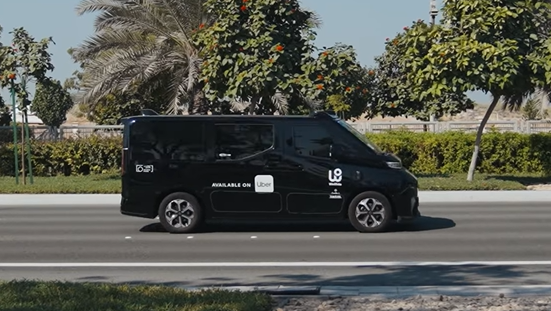

Driverless robotaxis are no longer a test-bed curiosity in Abu Dhabi, they are now a commercial reality that anyone with a smartphone can hail. Uber and Chinese autonomous driving specialist WeRide have switched their joint service in the UAE capital to fully autonomous operation, removing safety drivers from behind the wheel and turning a high-profile pilot into a live urban deployment. The move positions Abu Dhabi as the first market in the Middle East to host a fully driverless ride-hailing service at scale, and it raises fresh questions about how quickly similar services could spread across other global cities.
Abu Dhabi’s leap to a fully driverless robotaxi service
The core shift in Abu Dhabi is simple but profound: rides that were previously supervised by human safety operators are now handled by vehicles driving themselves from pickup to drop-off. Uber and WeRide say their joint robotaxi fleet in the city has transitioned to what they describe as “fully driverless” operation, meaning no one sits in the driver’s seat and the car is responsible for all dynamic driving tasks within its approved operating area. That change turns what had been a cautious, human-in-the-loop experiment into a live test of whether residents and visitors are ready to trust software with their daily commutes, airport runs, and late-night trips home.
According to the companies, the driverless rollout builds on an earlier phase in which WeRide’s autonomous vehicles ran with safety drivers while the partners gathered data on traffic patterns, rider behavior, and edge cases unique to Abu Dhabi’s roads. The new phase, described in Uber’s own announcement of fully driverless operations, removes that human fallback and relies instead on remote monitoring and detailed pre-mapped routes. Reporting on the launch notes that the service is being treated as a commercial offering rather than a limited demo, with the expectation that paying customers will be able to book these rides as they would any other Uber trip, subject to geographic and time-of-day constraints that define the current operating domain.
How the Uber–WeRide partnership works on the ground
At street level, the partnership is structured so that Uber provides the familiar consumer-facing layer while WeRide supplies the autonomous driving stack and vehicle operations. Riders open the standard Uber app, request a trip within the supported Abu Dhabi zone, and may be matched with a WeRide-powered robotaxi instead of a human driver. The vehicle arrives without anyone in the front seats, and passengers unlock the doors, start the ride, and communicate with support through in-car interfaces and the app. This division of labor lets Uber lean on its existing user base and payments infrastructure while WeRide focuses on the complex task of perception, planning, and control.
Coverage of the launch explains that the service uses WeRide’s production-ready robotaxis, which are equipped with lidar, radar, cameras, and high-precision positioning hardware tuned for the region’s wide boulevards and multi-lane highways. One detailed report on the officially driverless robotaxi service notes that the vehicles are integrated directly into Uber’s dispatch system, so the matching logic treats them as another supply pool alongside human drivers. Another account of the now fully driverless Abu Dhabi service emphasizes that the cars can handle typical urban scenarios such as roundabouts, lane merges, and complex intersections, although they still operate within a defined set of roads cleared by regulators and engineers.
Regulation, safety, and the UAE’s autonomous playbook
None of this would be happening without a regulatory framework that explicitly allows vehicles with no human driver to carry paying passengers. Authorities in the United Arab Emirates have spent the past several years positioning the country as a test bed for advanced mobility, and Abu Dhabi’s transport regulators have now authorized Uber and WeRide to run a commercial robotaxi service without safety drivers in specific districts. That approval signals a high degree of confidence in both the underlying technology and the operational safeguards, including remote oversight centers, detailed incident reporting, and strict performance thresholds that the vehicles must meet before expanding their coverage.
Reports on the launch highlight that the UAE’s approach is not simply permissive, it is structured around staged approvals and data sharing. One analysis of the driverless robotaxi rollout in the UAE notes that regulators required extensive testing with safety drivers, simulation runs, and real-world miles before signing off on fully autonomous rides. Another piece describing the milestone of going fully driverless in Abu Dhabi points out that the government sees autonomous transport as part of a broader smart-city strategy, tying robotaxis to goals around congestion management, emissions reduction, and digital infrastructure. That context helps explain why approvals have moved faster here than in many Western markets, even as officials insist that safety metrics remain the primary gatekeeper for expansion.
Where and when riders can actually hail a robotaxi
For all the futuristic headlines, the service is not yet citywide, and its availability is carefully bounded. Uber and WeRide are operating their driverless fleet in designated parts of Abu Dhabi, focusing on areas with consistent road layouts, strong mapping coverage, and high demand from residents, office workers, and tourists. Within those zones, riders can request trips during approved hours, with the companies gradually extending both geography and operating times as the system proves itself in live traffic. That incremental approach mirrors the way other robotaxi operators have scaled in cities like Phoenix and Shanghai, using constrained service areas as a way to manage risk and refine performance.
Coverage of the launch makes clear that this is not a small, one-off demo limited to a handful of streets. A detailed dispatch on the launch of driverless robotaxis in Abu Dhabi reports that the companies are targeting key districts that include residential neighborhoods, commercial hubs, and routes to major attractions, though they are not yet serving the entire metropolitan area. Another account of the fully driverless UAE robotaxi deployment notes that the operating design domain is defined down to specific roads and intersections, with the vehicles avoiding construction zones, certain highway segments, and other areas that have not yet been validated. That level of precision is typical for early-stage robotaxi services, which rely on high-definition maps and detailed route planning to maintain safety margins.
Why Abu Dhabi matters in the global robotaxi race
Abu Dhabi’s move into fully autonomous ride-hailing is not happening in isolation, it is part of a broader global contest over who will set the norms and capture the value of driverless mobility. By enabling Uber and WeRide to run a commercial service without safety drivers, the UAE is positioning itself alongside early adopters in the United States and China, but with a twist: it is doing so through a partnership that blends a global platform with a Chinese autonomous driving specialist in a Middle Eastern city. That triangulation gives all three parties a stake in proving that robotaxis can operate safely and profitably outside their home markets, and it offers a template for similar cross-border alliances in other regions.
Analysts tracking the sector point out that this deployment could influence how investors and regulators view the viability of robotaxis after years of hype and setbacks. A detailed look at the fully driverless operations in parts of Abu Dhabi notes that the service is being watched as a bellwether for whether autonomous fleets can scale in markets with hot climates, high-speed roads, and a mix of local and expatriate driving styles. Another report on how the Middle East’s first fully driverless robotaxi service came together argues that success here could accelerate similar projects in neighboring Gulf states that are also investing heavily in smart infrastructure. In that sense, Abu Dhabi is not just another dot on the robotaxi map, it is a test case for how quickly autonomous mobility can spread across an entire region once a flagship deployment is in place.
Rider experience, public perception, and adoption hurdles
For riders, the most immediate difference is psychological rather than technical: stepping into a car with no one behind the wheel forces people to confront how much they trust software to make life-and-death decisions in real time. Early adopters in Abu Dhabi are being asked to accept that the vehicle’s sensors and algorithms can handle everything from sudden lane changes to pedestrians stepping off the curb, all while they sit in the back seat watching a steering wheel turn itself. That experience can be both thrilling and unsettling, and the companies know that word-of-mouth from these first users will shape broader public perception far more than any marketing campaign.
Reports on the launch suggest that Uber and WeRide are trying to make the experience feel as familiar as possible, with clear in-car instructions, prominent emergency stop buttons, and responsive support channels accessible through the app. One account of how driverless robotaxis hit the road in Abu Dhabi notes that the vehicles provide audio and visual cues to explain what the car is doing, such as announcing lane changes or upcoming turns, in an effort to build trust. At the same time, coverage of the fully driverless Abu Dhabi rollout underscores that adoption will depend on more than novelty; riders will judge the service on reliability, wait times, pricing, and how well it integrates into their daily routines. If the cars arrive quickly, complete trips smoothly, and cost roughly what people expect to pay for a standard UberX, then the absence of a human driver may start to feel less like a leap of faith and more like the new normal.
What comes next for Uber, WeRide, and the region
The launch of fully autonomous rides in Abu Dhabi is a milestone, but it is also a starting point for a longer process of scaling, refining, and potentially exporting the model. Uber and WeRide will now be under pressure to expand the service area, increase fleet size, and demonstrate that the economics of driverless operations can support sustainable growth rather than just headline-grabbing pilots. That will mean proving that the vehicles can handle more complex routes, heavier traffic, and a wider range of weather conditions, all while maintaining or improving safety metrics compared with human drivers.
Regional governments and competitors will be watching closely. If the Abu Dhabi deployment delivers on its promise, it could spur rival platforms and automakers to accelerate their own autonomous plans in the Gulf, from dedicated robotaxi fleets to self-driving shuttles linking airports, business districts, and new megaprojects. Detailed reporting on the Abu Dhabi milestone suggests that policymakers see this as a foundation for broader autonomous logistics, including driverless delivery vans and freight corridors that build on the same mapping and connectivity infrastructure. For Uber and WeRide, success here could strengthen their case when approaching other regulators around the world, allowing them to point to a live, fully driverless service in a major capital as evidence that the technology is ready for prime time, at least within carefully defined limits.
More from MorningOverview