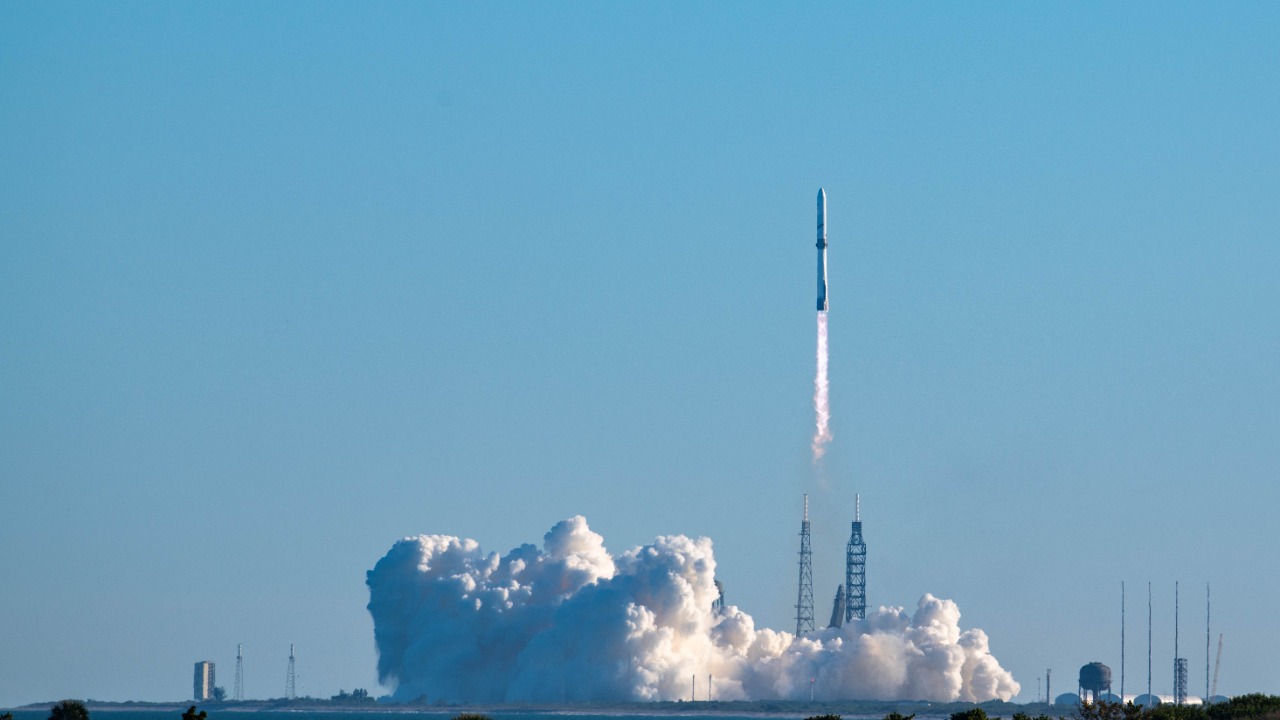

Blue Origin’s New Glenn has moved from PowerPoint to pad, and now to a successful orbital debut, just as SpaceX’s Starship program hits a more complicated stretch of its test campaign. The result is a rare moment in the commercial launch market where Jeff Bezos’s rocket company is not just catching up, but shaping the competitive narrative around heavy lift and reusability.
As New Glenn proves it can fly, land, and return hardware for reuse, Starship is wrestling with the realities of scaling the world’s largest launch system while keeping regulators, customers, and engineers aligned. I see a shift underway: instead of a one‑company race toward fully reusable super‑heavy rockets, the field is starting to look like a genuine duel, with each misstep or milestone on one side immediately reframing expectations for the other.
New Glenn’s breakthrough launch and barge landing
New Glenn’s first orbital mission did more than light up a new pad in Florida, it validated Blue Origin’s long‑promised entry into the heavy‑lift market. The NG‑1 mission lifted off from Cape Canaveral and placed its payload into orbit, while the first stage executed a controlled return and touchdown on a drone ship, a choreography that instantly placed the vehicle in the same technical conversation as Falcon 9 and Falcon Heavy. Blue Origin framed NG‑1 as the start of an operational cadence rather than a one‑off demo, underscoring that the rocket is designed from the outset for partial reuse and high‑energy missions, a point the company highlighted in its detailed NG‑1 mission overview.
The booster’s landing on a barge at sea was not just a crowd‑pleasing replay of SpaceX’s early feats, it was a critical proof that Blue Origin’s recovery architecture can work at scale. Analysts have noted that bringing a New Glenn first stage back to a ship rather than a land pad gives the rocket more flexibility in trajectory and payload performance, especially for high‑inclination or high‑energy orbits. A technical analysis of the flight argued that this successful barge recovery will broaden the commercial spaceflight market by adding another reusable heavy‑lift option for satellite operators and institutional customers, a conclusion drawn from the detailed breakdown of the booster landing and its implications for cost and access to orbit.
How New Glenn is being reshaped into a super heavy rival
Even as the base New Glenn configuration reaches orbit, Blue Origin is already signaling that the rocket is a platform, not a finished product. The company has outlined plans for more capable variants that push the vehicle deeper into Starship territory, both in payload and mission profile. Internal design work and external reporting describe stretched stages, upgraded engines, and expanded fairing options that would move New Glenn from a heavy‑lift launcher into the lower band of super‑heavy performance, a trajectory that mirrors how Falcon 9 evolved into Falcon Heavy but with a cleaner sheet of paper.
Some of the most detailed hints about this evolution have come from industry watchers and enthusiasts parsing new configuration diagrams and performance claims. A widely discussed analysis described a “super heavy makeover” for New Glenn, with additional boosters and structural changes aimed at challenging SpaceX’s dominance in the highest‑mass segment of the market, a concept laid out in a report on the rocket’s super heavy makeover. In parallel, community discussions have highlighted Blue Origin’s announcement of two new New Glenn variants, including a more powerful upper stage and a configuration optimized for deep‑space missions, details that surfaced in a technical thread on two new variants that would significantly expand the rocket’s role beyond standard geostationary and constellation launches.
Starship’s mixed test campaign and regulatory friction
While New Glenn is enjoying the clean narrative of a first‑flight success, SpaceX’s Starship is deep in a more ambiguous phase where spectacular progress and visible setbacks arrive in the same launch window. Recent integrated flights have demonstrated powerful ascent performance and partial mission objectives, but they have also ended in vehicle loss, debris concerns, or incomplete reentry profiles that keep the system in a test status rather than an operational one. That duality was on display during a closely watched launch day when both companies flew, with Blue Origin notching a clear win as Starship’s latest attempt fell short of all its goals, a contrast captured in coverage of how the two firms experienced success and failure during the same round of launches.
Regulatory oversight has added another layer of complexity to Starship’s path. Each test flight triggers a fresh review of environmental impacts, flight safety, and debris handling, and those investigations can stretch timelines in ways that frustrate both SpaceX and its customers. In public hearings and technical forums, engineers and observers have dissected telemetry, structural failures, and range safety events from recent flights, noting that while the data haul is invaluable, the pattern of rapid iteration is colliding with the slower tempo of licensing. A detailed discussion thread on a specialist forum has tracked these issues in real time, with contributors cataloging how each anomaly feeds into the next round of design tweaks and regulatory conditions, a dynamic laid out in the ongoing Starship test campaign analysis.
A tale of two launch days: perception versus engineering reality
The most striking illustration of the shifting balance between New Glenn and Starship came on a single Thursday when both companies attempted headline‑grabbing missions. On that day, Blue Origin’s heavy‑lift rocket delivered its payload and recovered its booster, while SpaceX’s giant stainless‑steel vehicle suffered a failure that cut short its test objectives. From a public‑relations standpoint, the split screen was brutal: one company finally doing what it had promised for years, the other reminding viewers that experimental hardware can still come apart under stress, a contrast that shaped coverage of how the two firms shared the launch window yet walked away with very different narratives.
From an engineering perspective, however, the story is more nuanced than a simple win‑loss scoreboard. Starship’s partial successes still represent incremental progress toward a fully reusable super‑heavy system, and each failure feeds back into design improvements that could pay off in future flights. New Glenn, for its part, is still early in its flight history, with only a single orbital mission and recovery under its belt, so its reliability and reusability claims remain to be proven over dozens of launches. Technical commentators have stressed that both rockets are in different phases of maturity, a point underscored in a detailed launch‑day breakdown that juxtaposed New Glenn’s clean profile with Starship’s fiery end, as seen in a widely shared launch analysis that walked through the telemetry and failure modes for each vehicle.
Market stakes: contracts, cadence, and customer confidence
Behind the spectacle of launch videos and booster landings lies a more consequential contest for contracts and customer trust. New Glenn’s successful debut immediately strengthens Blue Origin’s hand with commercial satellite operators and government buyers who have been waiting for a second reusable heavy‑lift option. The ability to land the booster on a barge and potentially turn it around for multiple flights promises lower marginal costs and more flexible scheduling, a combination that could appeal to constellation builders looking to hedge against Falcon 9 bottlenecks and Starship’s uncertain ramp. Analysts have argued that this new capacity will broaden the commercial spaceflight market by giving customers another path to orbit that does not depend solely on SpaceX, a theme explored in depth in the assessment of how New Glenn’s booster landing could reshape pricing and availability.
For SpaceX, Starship’s stumbles matter less to near‑term revenue than to long‑term strategy. Falcon 9 and Falcon Heavy remain workhorses with a packed manifest, but the company has positioned Starship as the backbone of future deep‑space missions, high‑volume Starlink deployments, and even point‑to‑point transport. Each delayed or partially successful test pushes that vision further out, giving rivals more time to close the gap. Industry observers have noted that customers are watching not just raw performance numbers but also launch cadence and demonstrated reliability, metrics that will only become clear for New Glenn after several more flights. A recent video breakdown of the evolving launch market highlighted how Blue Origin’s new entrant could pressure SpaceX to accelerate Starship’s path to operational status while maintaining safety margins, a tension explored in a detailed market analysis of how both companies are positioning their heavy‑lift fleets.
Engineering philosophies: incrementalism versus giant leaps
The contrast between New Glenn and Starship is not just about size or timing, it reflects two very different philosophies of how to build a next‑generation rocket. Blue Origin has taken a more conservative path, scaling up from suborbital New Shepard flights to an orbital heavy‑lift vehicle that borrows heavily from proven architectures like Falcon 9: kerosene‑fueled engines, a recoverable first stage, and a conventional upper stage. That approach has meant slower public progress but fewer high‑profile explosions, culminating in a first flight that looked more like a mature product rollout than a prototype test. Commentators have pointed out that this incrementalism may appeal to risk‑averse customers and agencies that prioritize predictable performance over bleeding‑edge innovation, a theme that surfaced in a technical discussion of New Glenn’s design choices in a recent engineering deep dive.
SpaceX, by contrast, has embraced a “build it big, break it often” ethos with Starship, pushing directly to a fully reusable super‑heavy system that dwarfs anything else on the pad. That strategy has yielded rapid learning but also a string of dramatic failures that play out in front of a global audience, feeding both admiration and skepticism. The company’s willingness to accept vehicle loss in pursuit of faster iteration has clashed at times with regulatory expectations and environmental concerns, especially as debris and overpressure events affect surrounding communities. A detailed video analysis of recent Starship flights underscored how this philosophy drives both the program’s breathtaking pace and its recurring setbacks, walking through how each test informs the next design cycle in a candid flight review that has become required viewing for industry insiders.
What comes next in the heavy‑lift rivalry
New Glenn’s early success and Starship’s uneven test record have created a moment where Blue Origin looks ascendant and SpaceX appears more vulnerable than at any point in the past decade. I see that perception as fragile, however, because both rockets are still in flux. For Blue Origin, the next milestones will be repeat flights, demonstrated booster reuse, and the rollout of the more capable variants that have been teased in technical circles. For SpaceX, the priority is to turn Starship from a spectacular prototype into a workhorse that can launch, land, and relaunch with a rhythm that matches or exceeds Falcon 9, while satisfying regulators that the system can operate safely at scale.
In the near term, customers and policymakers will judge both companies less by their most viral launch clips and more by their ability to deliver on schedules, pricing, and mission complexity. A single flawless New Glenn flight does not erase years of delays, just as a string of fiery Starship endings does not negate the transformative potential of a fully reusable super‑heavy vehicle. The rivalry is finally real, though, and that alone marks a turning point for the launch market. For the first time, SpaceX faces a competitor that can credibly contest the upper end of the payload spectrum, while Blue Origin must prove it can sustain the kind of cadence and innovation that has defined its rival, a dynamic that will shape every launch, landing, and contract award in the years ahead.
More from MorningOverview