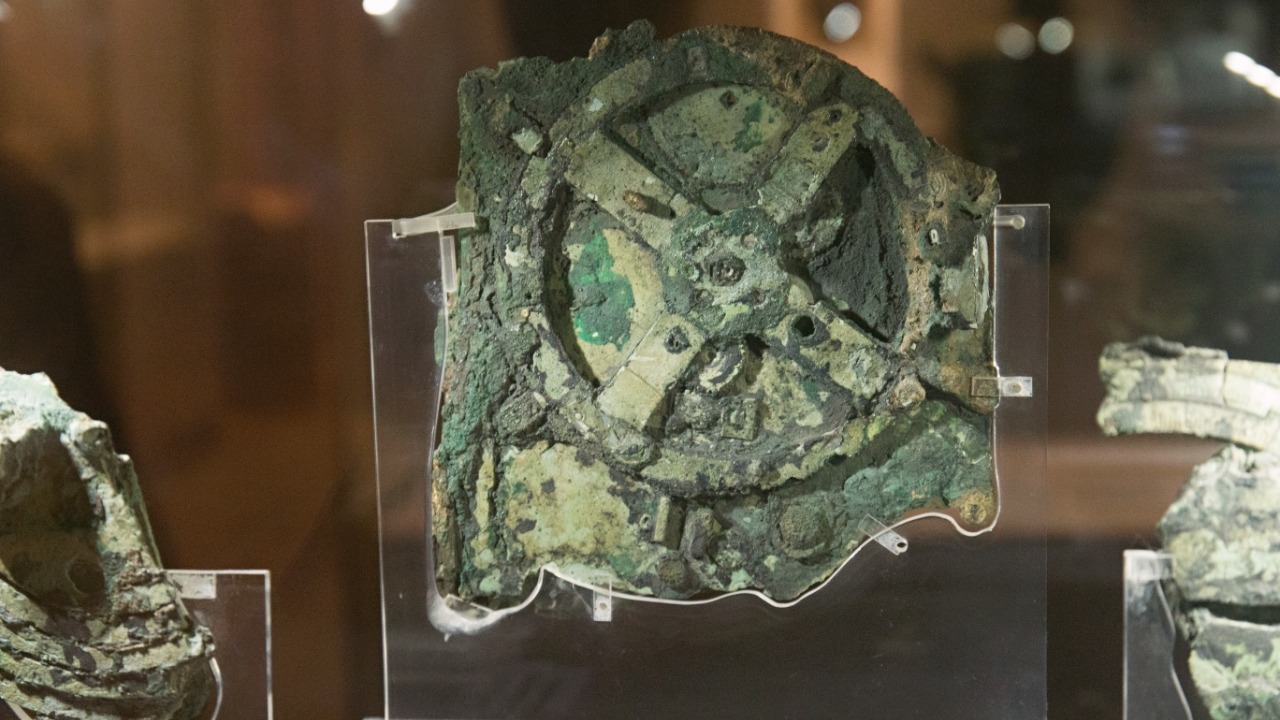

More than two millennia ago, Greek craftsmen built a bronze machine that could track the heavens with a precision that would not be matched for centuries. Hidden inside a corroded lump recovered from a shipwreck, their device anticipated core ideas of modern computing by turning astronomical data into mechanical predictions. Today, researchers are still piecing together how this ancient instrument worked and what it reveals about the scientific ambitions of the world that created it.
What has emerged is a portrait of a culture that treated the sky as a problem to be solved with gears, ratios, and careful observation. The device now known as the Antikythera mechanism was not a computer in the digital sense, but it performed the same essential task: it transformed inputs into outputs through a designed system, compressing complex calculations into a form sailors, priests, and scholars could hold in their hands.
The shipwreck that hid a mechanical marvel
The story begins with a disaster at sea, when a large cargo ship sank off the Greek island of Antikythera sometime in the first or second century BCE. When sponge divers stumbled on the wreck in the early twentieth century, they surfaced with statues, jewelry, and a small, unremarkable mass of corroded bronze that looked more like a rock than a precision instrument. Only after conservators noticed traces of gear teeth inside the fragments did archaeologists realize they were dealing with something unprecedented in the ancient record, a compact assembly of interlocking wheels and dials now identified as the Antikythera mechanism.
Those fragments, broken into dozens of pieces and fused by centuries underwater, forced researchers to reconstruct the device almost the way detectives reconstruct a crime. X‑ray imaging revealed hidden inscriptions and internal gears, while careful study of the ship’s cargo helped date the wreck and situate the machine in the broader trade networks of the eastern Mediterranean. The very fact that such a sophisticated object was traveling among luxury goods suggests it was valuable, portable, and meant to be used, not simply displayed as a curiosity.
Inside the world’s first known mechanical computer
When I look at the surviving fragments, what stands out is not just the craftsmanship but the logic encoded in metal. The mechanism used a hand‑cranked system of bronze gears to model the motions of the Sun, Moon, and planets, turning a single rotational input into coordinated movements across multiple dials. Researchers have shown that its gear trains captured subtle astronomical cycles, including the varying speed of the Moon through an ingenious pin‑and‑slot arrangement that translated uniform turning into irregular motion, a mechanical solution to a mathematical problem that modern analysts have traced in detail through gear reconstructions.
On the outside, the device presented information through scales and pointers that could display calendar dates, zodiac positions, and eclipse predictions. Inscriptions on the casing acted as a kind of user manual, explaining which dials corresponded to which cycles and how to read the results. Later studies have argued that the mechanism effectively functioned as a compact analog computer, since it encoded astronomical theories in hardware and allowed users to generate future positions and events by turning a crank, a characterization reinforced by modern analyses that describe it as the world’s oldest computer.
Reconstructing a shattered device
Because the original instrument survives only in fragments, every claim about its full design has to be tested against the physical evidence. Over the past several decades, teams have used advanced imaging to map the internal structure of the surviving pieces, reading faint lettering and counting gear teeth that are no longer visible to the naked eye. Those measurements have allowed researchers to propose detailed models of the front and back displays, including how many dials the device carried and which astronomical cycles each one represented, an effort that has been documented in depth through modern historical reconstructions.
More recently, a group of scientists and historians developed a new physical model that attempts to match every surviving inscription with a corresponding mechanical function. Their design uses nested gear trains to reproduce the known cycles of the visible planets, aligning them with the zodiac and calendar scales in a way that fits the cramped dimensions of the original casing. The team has argued that this configuration resolves long‑standing puzzles about missing gears and unexplained labels, a claim that has been explored in detail in reports on how new research illuminates its operation.
How the mechanism modeled the cosmos
At its core, the Antikythera mechanism was a physical expression of a particular view of the universe. Greek astronomers treated celestial motions as combinations of regular cycles, and the device translated that conceptual framework into gear ratios that could be turned and read. The front display appears to have shown the positions of the Sun and Moon in the zodiac, while the back carried spiral dials that tracked longer rhythms such as the Saros cycle of eclipses, a structure that modern commentators have described as a kind of three‑dimensional astronomical textbook in bronze, as seen in analyses of how the world’s first computer worked.
One of the most striking features is the way the mechanism handled irregularities in the Moon’s motion. Instead of assuming a perfectly circular orbit, the designers built in a mechanical approximation of the known variation, using an off‑center gear system to speed up and slow down the lunar pointer at the right points in its cycle. That level of nuance suggests the makers were not simply copying a set of numbers but were deeply engaged with contemporary astronomical theory, a conclusion supported by technical studies that argue the device captured the sophistication of Hellenistic science and may have incorporated ideas associated with figures like Hipparchus, as discussed in work that examines how the mystery of the mechanism may have been solved.
What the inscriptions reveal about its users
Beyond the gears, the engraved text on the mechanism offers rare insight into how its makers expected people to use it. The inscriptions describe eclipse predictions, calendar cycles, and possibly even athletic games, suggesting the device linked celestial events to civic and religious life. Rather than a purely abstract calculator, it seems to have been a practical tool that could tell a user when an eclipse would occur, in which part of the sky, and with what characteristics, a reading supported by detailed translations of the surviving Greek lettering in studies of the ancient Greek computer’s inscriptions.
The language and layout of the text also hint at the intended audience. Some scholars see the mechanism as an elite teaching instrument, perhaps used in a philosophical school to demonstrate the harmony of the cosmos. Others emphasize its portability and the practical information it provided, arguing that it could have served navigators, astrologers, or wealthy patrons who wanted a tangible link between the heavens and human affairs. The ongoing debate underscores how little direct evidence survives about its owners, but the combination of technical detail and explanatory prose points to a user who was expected to read, interpret, and apply the information, a perspective echoed in accounts that frame the device as a bridge between scientific theory and everyday decision‑making in the ancient world, such as those that explore how Greeks used the world’s oldest computer.
Modern replicas and the limits of our knowledge
To test competing theories, researchers and artisans have built working replicas that translate the proposed gear layouts into metal and plastic. These models do more than illustrate a hypothesis; they expose practical constraints, such as whether a suggested gear train actually fits inside the known dimensions or whether a pointer can move freely without colliding with neighboring parts. Some reconstructions have been displayed in museums and galleries, where visitors can turn a crank and watch the dials advance through years of celestial motion, an experience captured in reports on how artists and engineers have reconstructed the ancient device.
Despite these advances, significant uncertainties remain. Portions of the mechanism are missing, and even the most sophisticated imaging cannot recover metal that has been lost entirely. That means any full reconstruction must make educated assumptions, guided by the surviving inscriptions, the logic of gear ratios, and the constraints of ancient manufacturing techniques. Some recent models propose a more crowded front display that includes planetary indicators, while others keep the design simpler, focusing on the Sun and Moon. The range of plausible designs is a reminder that, for all the progress in understanding the mechanism, parts of its story remain unverified based on available sources, a caution that surfaces in technical discussions of how far current research can go.
Why this ancient machine still matters
For anyone used to smartphones and laptops, it can be tempting to see the Antikythera mechanism as a quaint ancestor of modern gadgets, but its real significance lies in what it reveals about human problem‑solving. The device shows that by the first century BCE, Greek artisans and scholars were willing to invest extraordinary effort in turning abstract models of the cosmos into tangible, interactive tools. That mindset, which treats knowledge as something to be embodied in instruments, foreshadows later developments in clocks, navigational aids, and eventually digital computers, a continuity that historians have traced in narratives about how this ancient computer reshaped our view of Greek technology.
The mechanism also challenges older assumptions that ancient science was purely theoretical or that complex machinery only emerged in the modern era. Its existence implies a broader tradition of precision engineering that has largely vanished from the archaeological record, either because devices were recycled for their metal or because they were too rare to survive in quantity. Each new study of the fragments, from gear counts to inscription analysis, adds another layer to our understanding of that lost tradition, a process documented in comprehensive surveys of the mathematical ingenuity behind the mechanism and in accessible explainers that introduce general audiences to the engineering that powered it.
As research continues, the Antikythera mechanism remains both a solved and unsolved puzzle. Scholars now agree that it modeled complex astronomical cycles through a dense network of gears, and working replicas demonstrate that such a device could indeed have functioned as described. Yet questions linger about who commissioned it, how many were made, and how widely such instruments were used. Those open threads keep the mechanism at the center of scientific and public fascination, sustained by ongoing projects that probe its structure, such as detailed overviews of the latest mechanical models and broad syntheses that situate it within the wider history of technology, including encyclopedic treatments of the device’s discovery and study.
More from MorningOverview