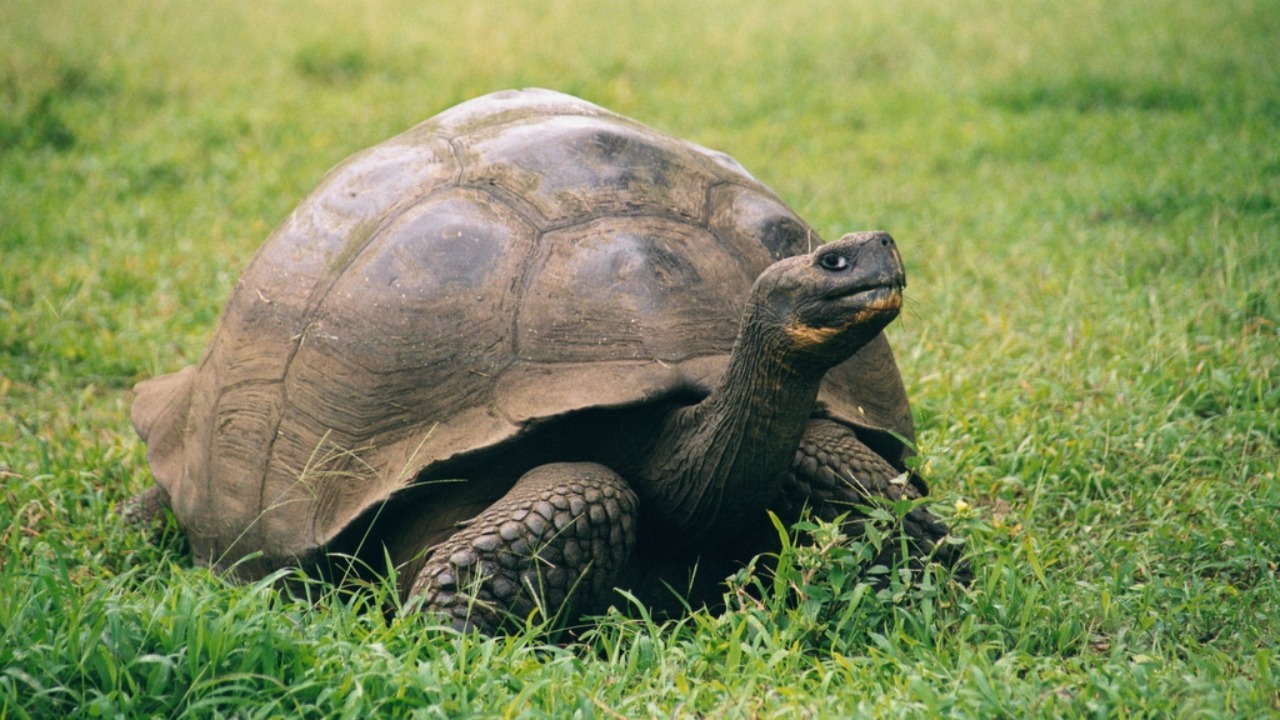

Across nearly a century and a half, a single Galápagos tortoise watched the world change around her, outlasting wars, cultural revolutions, and more than twenty occupants of the White House. Now Gramma, the San Diego Zoo’s oldest resident and one of the longest-lived animals in captivity, has died at an estimated age of 141, leaving behind a story that doubles as a living timeline of modern history. Her passing closes a chapter in conservation and in the quiet, daily relationship between people and a reptile who moved slowly but spanned generations.
Her life, which began in the late nineteenth century, stretched from the era of steamships to the age of smartphones, from the first telephones to video calls and social media. In that time, she became both a symbol of her species’ fragility and a familiar presence for millions of visitors who grew up visiting her enclosure, then returned decades later with children and grandchildren of their own.
From remote islands to a California landmark
Gramma’s story started in the Galápagos Islands, where giant tortoises evolved in isolation and became icons of both evolutionary science and human exploitation. She was believed to have hatched in the early 1880s, a period when sailors and traders still removed tortoises from the archipelago in large numbers, often as shipboard food. By the time she arrived in San Diego in the early twentieth century, she had already survived the most dangerous chapter for her species, when hunting and habitat disruption pushed several Galápagos populations to the brink.
At the San Diego Zoo, Gramma eventually became the institution’s longest-lived resident, a fixture in the reptile collection whose age was estimated at about 141 when she died earlier this week. Zoo officials described her as a Galápagos tortoise who had lived through more than 20 United States presidents and two world wars, a span that underscores just how long a single animal can persist when given stable care and protection, a point echoed in coverage that highlighted the tortoise who had “experienced more than 20 U.S. presidents and 2 world wars” in her lifetime, including in reports from national broadcasters.
A life measured in slow, steady routines
For visitors, Gramma’s appeal was rarely about spectacle. Her days were defined by slow walks, long stretches of basking, and the deliberate way she accepted leafy greens from keepers and, on supervised occasions, from children leaning over the barrier. Staff members have described her as calm and tolerant of human presence, a reptile who seemed unbothered by the crowds that gathered around her habitat on busy weekends. That predictability, the sense that she would always be there in the same corner of the zoo, became part of her quiet charm.
Accounts from keepers and visitors describe a tortoise who responded to routine, lifting her head for scratches along the neck and shoulders, and who remained active well into very old age. Reports on her final years note that she continued to roam her habitat and interact with caretakers, even as age-related issues gradually emerged, with one detailed obituary explaining that she had been under close veterinary observation as her health declined and that her estimated age of about 141 made her one of the oldest known Galápagos tortoises in human care, a status highlighted in coverage of the “about 141” year old reptile from national news outlets.
Outliving more than twenty presidents and two world wars
Gramma’s lifespan is easiest to grasp when set against the human timeline she quietly outlasted. She was already alive before Theodore Roosevelt entered the White House and remained so through the administrations of Franklin D. Roosevelt, John F. Kennedy, Ronald Reagan, Barack Obama, and into the current presidency of Donald Trump. Zoo officials and outside observers have emphasized that she lived through more than 20 U.S. presidencies, a shorthand that captures how her life bridged eras that, for people, are separated into distinct historical periods.
She also survived both World War I and World War II, conflicts that reshaped global politics and technology in ways that would have been unimaginable when she first hatched on the Galápagos. By the time she died, the world had moved through the Cold War, the space race, the rise of the internet, and the climate crisis, all within a single reptile’s lifetime. Several reports have framed her story explicitly in those terms, noting that the same tortoise who once lived in a world without airplanes or radio later shared a planet with satellites and streaming video, a contrast drawn sharply in coverage of the Galápagos tortoise who “experienced 20 U.S. presidents and 2 world wars” in her 141 years, as detailed in reports carried by regional affiliates.
How veterinarians cared for a 141-year-old reptile
Caring for a tortoise who has lived more than a century is as much about patience as it is about medicine. Gramma’s keepers and veterinarians had to adapt to the realities of geriatric reptile care, monitoring her diet, mobility, and shell condition with the same vigilance that a hospital might reserve for elderly human patients. As she aged, they adjusted her habitat to reduce fall risks, modified her nutrition to account for changing metabolism, and conducted regular exams to track subtle shifts in weight or behavior that could signal deeper problems.
Reports on her final months describe a careful balance between intervention and comfort, with veterinary teams evaluating her quality of life and ultimately making the decision to humanely euthanize her when it became clear that age-related complications could no longer be managed without suffering. Coverage of her death notes that she died surrounded by the staff who had cared for her for decades, with one detailed account explaining that the zoo’s wildlife care specialists and veterinarians had been monitoring her closely before making that decision, a process described in depth in reporting on the Galápagos tortoise’s final days from national cable coverage.
A symbol of conservation and a changing zoo
Gramma’s presence at the San Diego Zoo coincided with a profound shift in how zoos see their mission. When she first arrived, institutions like hers were often collections of exotic animals displayed for public curiosity, with limited focus on breeding programs or habitat restoration. Over the decades, that model evolved into one centered on conservation, research, and education, and Gramma became a living reminder of both the damage humans had done to Galápagos tortoises and the responsibility to protect what remained.
Her species, Chelonoidis niger, has been the focus of intensive conservation work, including captive breeding and reintroduction efforts in the Galápagos, and Gramma’s long life in San Diego helped keep that story in front of visitors who might otherwise have seen tortoises as static background animals. Reports on her death emphasize that she was not just a curiosity but a flagship resident whose story was woven into the zoo’s broader messaging about endangered species and habitat loss, a role underscored in coverage that described her as the zoo’s “oldest resident” and a key part of its conservation narrative, as detailed in accounts of the oldest San Diego Zoo resident’s death at 141 from national outlets.
The public’s relationship with a very old tortoise
For generations of San Diegans and tourists, Gramma was less an exhibit and more a familiar neighbor, the animal people pointed out on every visit. Parents who had seen her as children later introduced her to their own kids, creating a chain of personal memories that stretched across decades. Social media posts and local interviews after her death are filled with stories of school field trips, family photos taken in front of her habitat, and the quiet thrill of watching such a large, ancient-looking animal move with deliberate grace.
Several accounts highlight how visitors often learned of her age only after stopping to read the signage or listening to a keeper talk, and that realization, that the tortoise in front of them had been alive since the nineteenth century, frequently shifted the tone from casual observation to awe. Coverage of her passing notes that zoo guests and staff alike reacted with a mix of sadness and gratitude, with one widely shared story describing how people left flowers and handwritten notes near her enclosure after the announcement, a response captured in reports on the popular zoo resident whose death at 141 prompted an outpouring of local reflection, as described in coverage of the zoo’s longest-lived resident from regional news outlets.
What Gramma’s lifespan tells us about Galápagos tortoises
Gramma’s 141 years are remarkable, but they are not an outlier for her species. Galápagos tortoises are known for their longevity, with documented lifespans that can exceed a century and, in some cases, approach or surpass 150 years. Her life in human care, with consistent food, veterinary attention, and protection from predators, likely extended her natural potential, offering scientists and keepers a rare, long-term window into how these reptiles age. Observing her over decades helped refine husbandry practices for other tortoises, from diet composition to enclosure design.
Her death has prompted renewed attention to the biology behind such long lives, including slow metabolisms, efficient immune systems, and genetic traits that may protect against age-related diseases. Detailed obituaries have noted that researchers and zoo staff used her case to better understand how to care for other aging reptiles, and that her longevity will continue to inform best practices for Galápagos tortoise conservation programs worldwide, a point emphasized in in-depth reporting on her species and its extraordinary lifespan from science-focused coverage of the San Diego Galápagos tortoise’s death at 141, as outlined in a comprehensive analysis from national science reporting.
Remembering Gramma, in life and on screen
In the days since her death, Gramma’s image has circulated widely, not only in still photographs but in archival video that shows her moving through her habitat, stretching her neck toward the camera, or sharing space with younger tortoises. Those clips have become a kind of digital memorial, allowing people who never visited San Diego to see the animal whose life spanned so much human history. For longtime zoo-goers, the footage is a reminder of specific visits and of the way she anchored that corner of the grounds.
Some of the most affecting tributes have come from keepers and staff who worked with her for years, describing the daily routines of feeding, cleaning, and quiet observation that defined their relationship with a reptile who could not speak but whose behavior they came to know intimately. National and local outlets have compiled those images and recollections into short films and video essays, including a widely shared piece that intercuts archival footage of Gramma with commentary on her age and significance, a portrait captured in a dedicated video on the 141-year-old Galápagos tortoise’s life and death from a national video report.
A legacy that outlives a single shell
Gramma’s passing leaves a literal empty space in the San Diego Zoo, but her influence persists in the people and programs shaped by her presence. Children who first learned the word “endangered” while standing at her enclosure have grown into adults who support conservation organizations, vote on environmental policy, or pursue careers in biology and veterinary medicine. For many of them, she was the first tangible proof that the natural world contains lives that operate on a very different timescale from our own.
Her story has also become a touchstone in broader media coverage of animal longevity and zoo ethics, with commentators using her life to discuss how institutions balance individual animal welfare with species-level goals. Several outlets have framed her as both a beneficiary of and a witness to the transformation of zoos into conservation centers, and they have noted that her death is prompting renewed conversations about how to honor aging animals who have become public figures in their own right, a theme explored in human-interest coverage that described her as the zoo’s beloved elder and detailed the public’s emotional response, as seen in reports on the oldest San Diego Zoo resident’s death from national lifestyle media.
What comes after a 141-year-old icon
In practical terms, the zoo now faces the question of how to reimagine the space Gramma once occupied and how to tell her story to visitors who will never see her in person. Institutions often respond to the loss of a signature animal by updating exhibits with educational displays, interactive timelines, or new residents whose presence is explicitly linked to the one who came before. In Gramma’s case, that might mean signage that situates her life within the broader arc of Galápagos conservation, or digital kiosks that play archival footage and interviews with the people who knew her best.
Early coverage suggests that the San Diego Zoo is already treating her death as both a moment of mourning and an opportunity to deepen public understanding of long-lived species, with officials emphasizing her role in inspiring curiosity and care for wildlife. Live news segments from the zoo grounds have shown reporters standing near her former habitat, relaying staff reflections and visitor reactions, including one broadcast that captured the scene as people stopped to read the announcement of her death and share their own memories, a moment documented in on-the-ground coverage of the San Diego Zoo tortoise’s passing from live local reporting.
More from MorningOverview