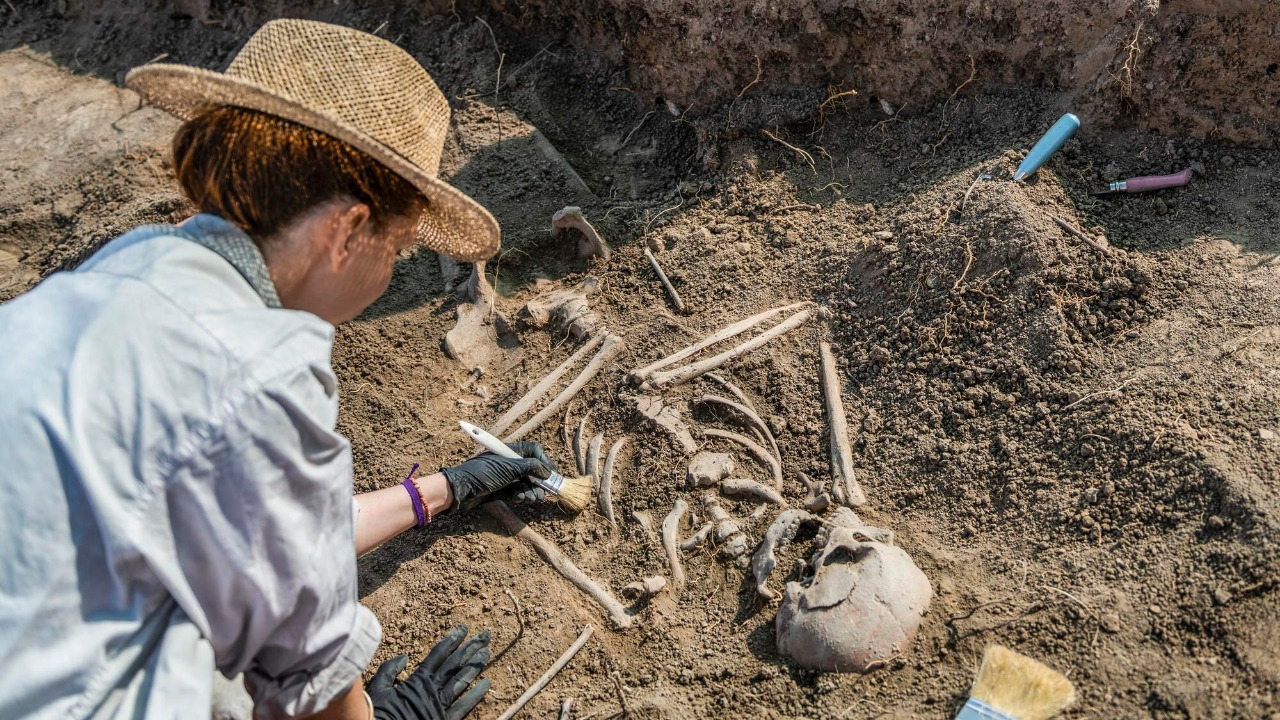

A small cluster of fossilized bones from Ethiopia has reopened one of paleoanthropology’s most enduring debates, suggesting that Lucy’s species was not the only upright walker on the African landscape more than 3 million years ago. The partial foot, preserved in ancient sediments of the Afar region, appears to belong to a very different kind of hominin that walked in a different way and likely lived in a different habitat from the famous Australopithecus afarensis skeleton. Together, the two species sketch a more crowded and complex picture of early human evolution than the tidy single-line story many of us learned in school.
Instead of a lone ancestor steadily marching toward modern humanity, the new evidence points to parallel experiments in walking, climbing, and surviving in a changing East African environment. By comparing the mystery foot’s anatomy with Lucy’s, and by placing both in their geological and ecological context, researchers argue that multiple hominin lineages were already sharing the same region, each with its own mix of ape-like and human-like traits. That coexistence, rather than a simple succession, is now at the center of how I understand this pivotal chapter in our origins.
Lucy’s world and the surprise of a second walker
When scientists first described Lucy, they presented Australopithecus afarensis as a small-bodied, small-brained but fully bipedal ancestor that walked upright long before the emergence of our own genus. Her skeleton, recovered from Hadar in Ethiopia, showed a pelvis, knee, and lower limb adapted for habitual two-legged locomotion, even as her long arms and curved fingers hinted at climbing ability. The new fossil foot, discovered in the Burtele area of the Afar region, comes from roughly the same time window, yet its structure points to a very different way of moving, with a grasping big toe and more flexible midfoot that would have been better suited to clambering in trees than striding across open ground, according to the original anatomical descriptions in the Burtele foot report.
That contrast matters because it shows that Lucy’s species was not the only hominin adapting to the mosaic of woodlands and more open habitats in East Africa. The Burtele fossils, cataloged as BRT-VP-2/73, include bones from the front of the foot that preserve the hallux (big toe) and parts of the arch, and these elements lack the inline, rigid configuration that characterizes Australopithecus afarensis. Instead, the big toe appears abducted, more like that of Ardipithecus ramidus, a 4.4‑million‑year‑old hominin from the same general region, suggesting that a more primitive, tree-friendly lineage persisted alongside Lucy’s more ground-oriented relatives, as detailed in the comparative analysis of Burtele and Ardipithecus.
What the fossil foot actually looks like
The Burtele foot is not a complete skeleton, so its impact rests on a handful of bones that preserve crucial functional details. The medial cuneiform, which helps anchor the big toe, shows a joint surface that would have allowed the toe to diverge from the rest of the foot, creating a grasping structure rather than the forward-pointing lever seen in modern humans and in Lucy’s species. The metatarsals and associated tarsal bones also indicate a more flexible midfoot, with less evidence of the stiff longitudinal arch that stabilizes the human foot during long bouts of walking, as described in the original morphological breakdown of the Burtele assemblage.
In practical terms, that anatomy suggests an animal that could push off the ground and walk bipedally for at least short distances, but that still relied heavily on climbing and grasping branches. The researchers who studied the bones compared them with a wide range of modern primates and fossil hominins, and they concluded that the Burtele individual combined features seen in Ardipithecus with some traits that are more derived, yet still distinct from Australopithecus afarensis. That mix of characteristics led them to propose that the foot represents a previously unrecognized hominin species, one that retained a more ancient style of locomotion while Lucy’s kind was evolving a more committed form of upright walking, a conclusion they supported with detailed measurements in the comparative dataset.
Dating the bones and placing them beside Lucy
To argue that this mystery foot truly lived at the same time as Lucy, rather than belonging to a much older or younger lineage, the team had to anchor it in the local geology. The Burtele site lies within the Woranso-Mille study area of the Afar region, where volcanic ash layers and sedimentary sequences have been carefully mapped and dated. By correlating the fossil-bearing strata with known tuffs and using radiometric techniques, the researchers estimated the age of the foot at about 3.4 million years, which overlaps with the 3.0 to 3.7 million year range for Australopithecus afarensis fossils from nearby Hadar and other localities, as summarized in the regional stratigraphic framework for Woranso-Mille and Hadar.
That temporal overlap is crucial because it rules out a simple ancestor–descendant relationship between the Burtele hominin and Lucy’s species. Instead, the two lineages appear to have been neighbors, occupying the same broad landscape at roughly the same time. The sedimentology and associated fauna at Burtele point to a relatively wooded environment with riverine elements, while some Australopithecus afarensis sites show more open, mixed habitats, suggesting that each hominin may have favored slightly different ecological niches. The authors of the Burtele study argue that this pattern fits a scenario in which multiple hominin species, each with its own locomotor strategy, navigated the patchwork of East African ecosystems, a view they ground in the combined geological and faunal evidence from Afar localities.
Rethinking the “single lineage” story of human evolution
For decades, popular accounts of human evolution leaned on a tidy ladder-like sequence, with one species giving rise to the next in a straight line from ape-like ancestors to modern Homo sapiens. The coexistence of Lucy’s species and the Burtele hominin undercuts that narrative by showing that, even in the mid-Pliocene, hominin evolution already looked more like a branching bush. Instead of a single experiment in bipedalism, there were at least two, and likely more, each testing different anatomical solutions to the challenges of moving, feeding, and avoiding predators in a changing climate, a pattern that aligns with broader fossil evidence for overlapping hominin species summarized in regional syntheses of Afar hominins.
This more tangled picture has implications for how I interpret the role of Australopithecus afarensis in our own ancestry. Lucy’s species still sits near the base of the line that leads to Homo, based on cranial, dental, and postcranial traits, but the presence of a contemporary hominin with a different locomotor repertoire suggests that our lineage was not the only one with a claim to upright walking. It also raises the possibility that some traits we associate with later hominins, such as more efficient long-distance walking, evolved in a context where multiple species were competing or at least coexisting, rather than unfolding in isolation. The Burtele foot, in this sense, becomes a reminder that evolutionary success is measured not just by who appears first, but by which lineages persist and diversify, a point underscored in discussions of Pliocene diversity.
How scientists infer behavior from a handful of bones
Reconstructing how an extinct hominin moved from a partial foot is an exercise in careful inference rather than direct observation. Researchers start by documenting every contour and angle of the fossil bones, then compare those measurements with large reference collections of modern humans, chimpanzees, gorillas, and other primates, as well as with previously described fossils. In the case of the Burtele foot, the orientation of joint surfaces, the curvature of articular facets, and the relative proportions of the metatarsals all pointed toward a grasping big toe and a flexible midfoot, which in living primates correlate strongly with climbing and branch grasping, as detailed in the functional analyses presented in the Burtele study.
At the same time, scientists are cautious about overinterpreting such evidence, especially when the sample is small. The Burtele assemblage lacks the heel bone (calcaneus) and ankle joint, which are key to understanding the full mechanics of bipedal walking, and there is always the possibility that some traits reflect individual variation rather than species-level differences. To address these uncertainties, the original team used statistical methods to test whether the Burtele bones fell within the known range of Australopithecus afarensis or other hominins, and they concluded that the differences were too great to be explained by variation alone. That conclusion remains open to further testing as new fossils are found, but for now it rests on a transparent comparison with existing datasets, as laid out in the morphometric tables.
A crowded Afar: multiple hominins in one region
The Afar region of Ethiopia has long been a focal point for human origins research because its rift valley geology preserves thick sequences of fossil-rich sediments. Within a relatively compact area, scientists have documented Ardipithecus ramidus at about 4.4 million years, Australopithecus afarensis between roughly 3.0 and 3.7 million years, and now the Burtele hominin at around 3.4 million years, among other finds. This temporal and spatial clustering means that, over a span of just a few million years, at least three distinct hominin lineages occupied overlapping landscapes, each leaving behind fragmentary traces in the same depositional basins, as summarized in regional overviews of Afar fossil sites.
Such diversity is not unique to Afar, but the density of evidence there makes the region a kind of natural laboratory for testing ideas about how early hominins partitioned resources and habitats. The Burtele foot’s arboreal-friendly design suggests that its owner may have spent more time in trees than Lucy’s species, perhaps feeding on different plant resources or avoiding predators in a different way. Meanwhile, Australopithecus afarensis, with its more human-like foot, may have been better suited to foraging across more open ground. These complementary adaptations fit a scenario in which multiple hominins reduced direct competition by exploiting slightly different ecological niches, a hypothesis that researchers have begun to explore using the combined anatomical and environmental data from Woranso-Mille and Hadar.
What this means for the future of human origins research
The discovery of the Burtele foot underscores how much of the human story still lies in the ground, waiting for the right combination of erosion, fieldwork, and luck to bring it to light. A single partial foot has been enough to challenge a long-standing assumption about the uniqueness of Lucy’s bipedalism, and it hints that other, equally surprising lineages may yet be found in underexplored parts of East Africa and beyond. As researchers refine dating methods, expand comparative collections, and integrate new technologies such as micro-CT scanning and 3D modeling, I expect more fossils to emerge that complicate the simple narratives and force us to revise our evolutionary family tree, a trajectory already visible in the expanding record from Afar sites.
For now, the mystery foot from Burtele stands as a small but potent reminder that evolution rarely proceeds in a straight line. Lucy remains a central figure in our understanding of early hominins, yet she was part of a broader cast of characters, some of whom left only a few bones to mark their passage. By treating those fragments not as footnotes but as key pieces of evidence, scientists are gradually assembling a richer, more nuanced account of how multiple upright walkers shared the same ancient landscapes, each following its own evolutionary path. The Burtele hominin may never be as famous as Lucy, but its unusual foot has already reshaped how I think about who was walking beside her.
More from MorningOverview