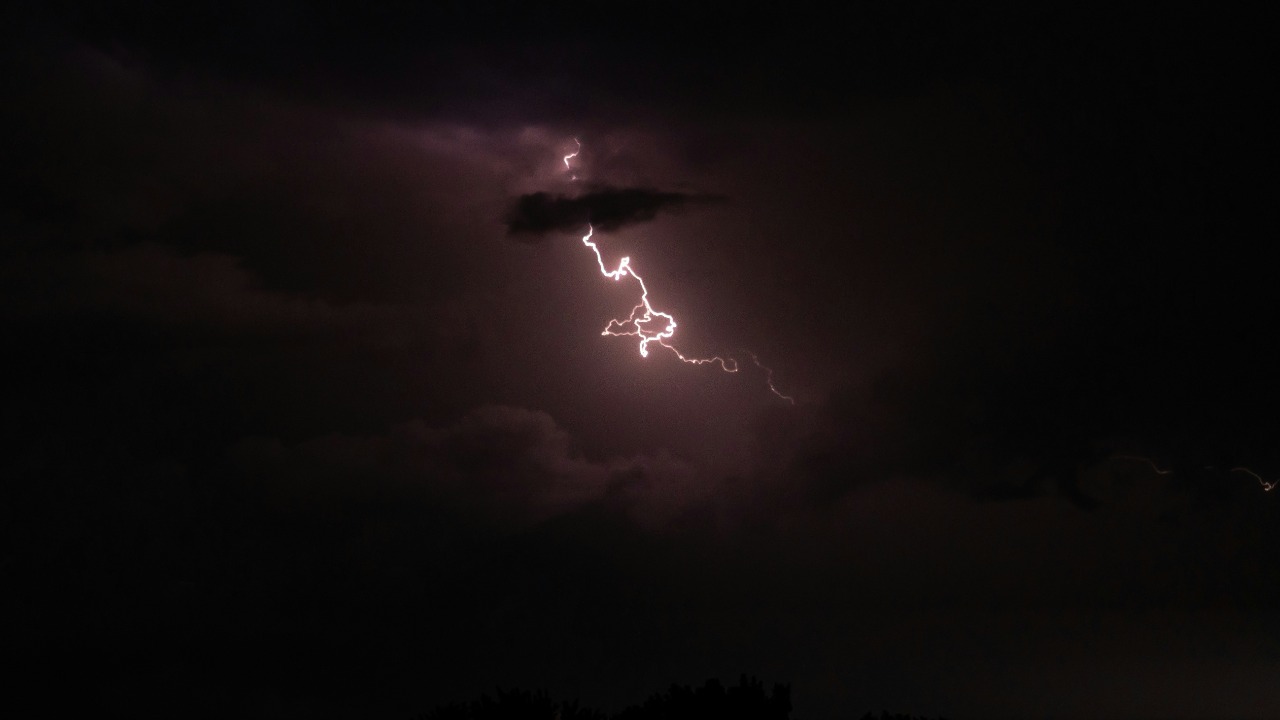

Lightning is one of the most familiar spectacles in the sky, yet the exact spark that starts a bolt has remained stubbornly out of reach. Now a physicist has managed to trap a microscopic particle and watch it discharge under controlled conditions, turning a single speck of matter into a laboratory stand-in for a thundercloud.
By capturing and probing these tiny particles, researchers are beginning to map how electric fields build, break down, and suddenly erupt into flashes of current that resemble the first instants of lightning. The work is still at the scale of micrometers and microseconds, but it is already reshaping how I think about what really happens inside a storm.
The long search for lightning’s first spark
For more than a century, scientists have tried to pinpoint where lightning truly begins, not in the blinding channel that reaches the ground, but in the subtle electrical breakdown that precedes it. Teams have launched weather balloons into thunderclouds, flown research aircraft through storms, and planted sensor arrays across open plains, all to capture the elusive conditions that tip a cloud from charged to eruptive. Those efforts have mapped the broad outlines of storm electrification, yet the very first spark has stayed hidden inside a chaotic mix of ice, water, and turbulent air.
Recent reporting describes how Scientists have spent years sending up instruments to measure electric fields and particle collisions inside thunderclouds, only to find that the measured fields often look too weak to trigger lightning on their own. That mismatch between theory and observation has pushed researchers to look for overlooked processes at much smaller scales, where individual particles might concentrate charge in ways that bulk measurements smooth out. The new particle trapping experiments grow directly out of that frustration, turning the focus from entire storms to a single grain suspended in a beam of light.
From storm chasing to tabletop physics
Instead of chasing storms across continents, the latest work pulls the problem into a quiet lab, where a single microscopic particle can stand in for a fragment of cloud. The idea is simple but powerful: if lightning begins with charge imbalances on tiny bits of ice or dust, then isolating one such particle and subjecting it to controlled electric fields should reveal how those imbalances form and discharge. By stripping away the noise of wind, turbulence, and complex cloud structures, the experiment lets researchers watch the birth of a spark in slow motion and with exquisite precision.
Reports from Nov describe how a team used lasers to trap a single silica particle in midair and then monitored its behavior as electric fields were applied and removed. In that setup, the particle acts like a miniature cloud droplet, accumulating charge until it suddenly releases it in a burst that looks, electrically, like a tiny version of a lightning initiation event. The shift from field campaigns to this kind of tabletop physics does not replace traditional storm research, but it gives scientists a new, complementary lens on the same mystery.
Using lasers as tweezers for a single grain
The core of the experiment relies on optical trapping, a technique that uses focused light to hold microscopic objects in place as if they were caught in invisible tweezers. In this case, the researchers direct a laser at a single silica particle, balancing the forces so that the grain hovers in space while remaining free to rotate and respond to electric fields. This delicate control lets them dial up the surrounding field strength, then watch how the particle’s charge state evolves, without the confounding influence of neighboring grains or droplets.
Coverage from Nov explains that the team effectively used lasers as tweezers to study cloud electrification, a strategy highlighted in a report on Trapping particles and kicking out electrons. In that work, the laser trap becomes both a microscope and a test chamber, allowing the scientists to measure tiny discharges, shifts in motion, and changes in the particle’s charge as it interacts with the imposed field. By carefully tuning the laser power and field strength, they can reproduce conditions that might exist around an ice crystal in a storm, then see how easily that crystal could seed a larger electrical breakdown.
Andrea Stöllner’s microscopic lightning lab
At the center of this research is Andrea St, a researcher at the Austrian Institute of Science and Technolo, who has effectively turned a single trapped particle into a model thundercloud. Working with colleagues, she set out to understand how microscopic objects behave in strong electric fields, and in the process, she captured what looks like the first step of a lightning flash on a scale small enough to sit on a microscope slide. The experiment shows that even a lone grain can accumulate enough charge to produce a sudden, measurable discharge when the surrounding field crosses a critical threshold.
Reporting from Nov 20, 2025 describes how, Using a laser and a microscopic particle, Andrea St of the Austrian Institute of Science and Technolo and her team captured a tiny spark that may reveal the origins of lightning. In their setup, the particle’s motion and emitted light signal when a discharge occurs, letting the researchers correlate the timing of each spark with the applied field and the particle’s charge history. That level of detail is impossible to achieve inside a real storm, which is why this controlled, microscopic lightning lab is so valuable.
The “tiny spark” that mimics a storm
What makes the experiment so striking is that the discharges from the trapped particle are not just random flickers, they follow patterns that resemble the early stages of lightning seen in larger scale measurements. As the electric field around the particle increases, the team observes a series of brief, localized breakdowns, each one a tiny spark that relieves some of the built up charge. These microdischarges occur rapidly and repeatedly, hinting at how a cloud might transition from a stable, charged state to one where a full lightning channel can form.
Coverage from Nov 19, 2025 notes that in their recent study, Stöllner and her colleagues used lasers to trap a single microscopic particle of silica and recorded a cascade of what they call microdischarges, a behavior detailed in a report on microdischarges observed in the experiments. Those tiny sparks are not lightning in the everyday sense, but they share the same physics of electric field breakdown, electron acceleration, and rapid current flow. By cataloging how often they occur, how strong they are, and how they depend on the surrounding field, the team can begin to scale up their findings to the much larger, more complex environment of a thundercloud.
Connecting lab sparks to cloud electrification
The obvious question is how a single trapped particle relates to the sprawling, turbulent volume of a storm cloud. The answer lies in the way charge is distributed across countless ice crystals, droplets, and bits of dust, each one a potential site for local field enhancement. If one microscopic grain can trigger a discharge under the right conditions, then a cloud filled with billions of such grains may be riddled with similar microdischarges, some of which could link up into the larger structures that eventually become lightning leaders.
Reports from Nov on Using lasers as tweezers to understand cloud electrification suggest that the same process of kicking out electrons from a trapped particle could also be happening in clouds, where collisions and freezing processes separate charge on a massive scale. In that context, the lab experiment serves as a simplified model of how individual particles respond when the ambient field grows strong enough to strip electrons away. By comparing the measured thresholds in the lab to the electric fields inferred from balloon and aircraft data, researchers can test whether these microscopic breakdowns are plausible seeds for the macroscopic flashes we see from the ground.
Why the exact date of discovery matters less than the mechanism
The reporting pegs key developments in this work to Nov 19, 2025 and Nov 20, 2025, but the precise calendar dates are less important than the conceptual shift they represent. For decades, the field has been dominated by large scale measurements and statistical models of storm behavior, which are essential for forecasting and safety but often gloss over the messy details of how individual particles behave. By contrast, the trapped particle experiments focus on mechanism, showing in real time how a single grain can accumulate, hold, and suddenly release charge.
In that sense, the Nov timeline is a marker of when this microscopic perspective began to crystallize, not a hard boundary on the science itself. The work builds on earlier advances in optical trapping and plasma physics, but it is the decision to apply those tools directly to the problem of lightning initiation that stands out. Whether the first tiny spark was recorded on Nov 19, 2025 or Nov 20, 2025, the lasting impact will come from how these experiments reshape models of cloud electrification and guide future measurements inside real storms.
Implications for forecasting and safety
Understanding how lightning starts at the particle level is not just an academic exercise, it has practical implications for how we predict and manage lightning risk. If microdischarges on individual grains turn out to be reliable precursors to full lightning channels, then instruments designed to detect similar signatures in clouds could provide earlier or more accurate warnings. That might influence how airports manage ground operations during storms, how utilities protect power lines, or how outdoor events decide when to clear large crowds.
The detailed measurements of charge thresholds and discharge behavior from the trapped particle experiments could also refine the design of lightning protection systems, from the placement of rods on skyscrapers to the shielding of sensitive electronics in aircraft. By knowing more precisely how and when a field is likely to break down, engineers can better anticipate where currents will flow and how strong they will be. The work reported in Nov on microscopic sparks and trapped particles is still at an early stage, but it points toward a future where lightning forecasts are grounded not only in radar and satellite imagery, but also in a deep understanding of what happens on the scale of a single grain of silica.
What comes next for microscopic lightning research
The success of the initial experiments opens several paths for follow up work, many of which involve making the lab environment more closely resemble a real cloud. One obvious step is to move beyond silica and test particles made of ice, mixed-phase water, or realistic atmospheric dust, each with different electrical and thermal properties. Another is to vary temperature and pressure to mimic conditions at different altitudes, then see how those changes affect the onset and strength of microdischarges. By systematically exploring these variables, researchers can build a library of particle behaviors that feed directly into cloud and storm models.
There is also room to scale up the experiments, trapping not just one particle but small clusters to study how nearby grains influence each other’s fields and discharge patterns. That kind of interaction is likely crucial in real clouds, where particles rarely exist in isolation. As the work progresses, I expect to see tighter integration between these tabletop studies and in situ measurements from balloons and aircraft, with each informing the other. The Nov reports on trapped particles, tiny sparks, and microdischarges mark the beginning of that convergence, where the physics of a single speck of matter helps explain one of the most dramatic phenomena in the sky.
More from MorningOverview