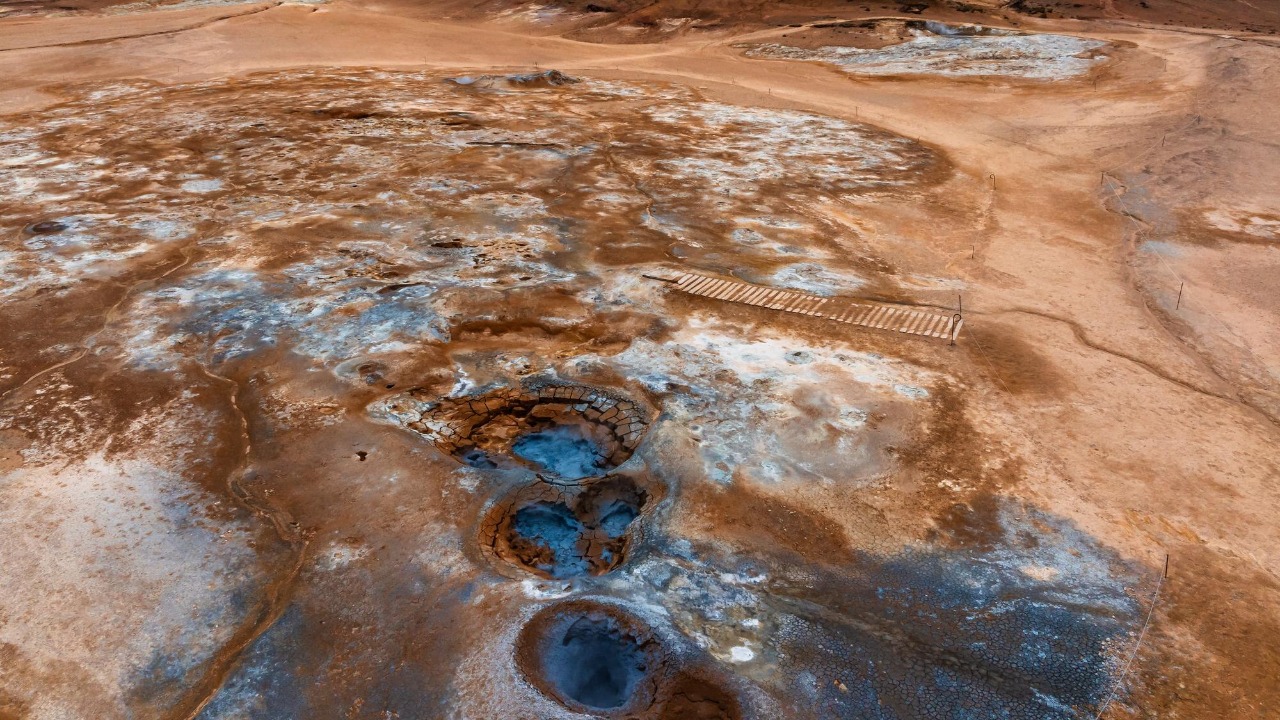

Planetary scientists are turning to Iceland’s geologically young mudrocks to rehearse how they will handle the first drilled cores from Mars, using the island’s volcanic landscapes as a stand-in for the Red Planet’s ancient lake beds. By treating these fragile sediments as if they were already Martian, researchers are stress‑testing every step from field sampling to lab analysis so that when real samples arrive on Earth, the techniques are already proven.
The work is reshaping how I think about Mars exploration, because it shifts the focus from spectacular rover images to the quiet, meticulous craft of reading layered rocks. Iceland’s fast‑evolving terrains, shaped by basaltic eruptions, glaciers, and hydrothermal systems, give scientists a rare chance to practice decoding planetary history in mud that is still “young” by geological standards yet formed under conditions that echo early Mars.
Why Iceland’s mudrocks matter for Mars
The core scientific bet is that Iceland’s fine‑grained volcanic sediments capture processes that once operated on Mars, especially where water interacted with basaltic crust. Mars orbiters and rovers have repeatedly shown that much of the Martian surface is basaltic, and that its most promising ancient environments include lake basins and river deltas where mudstones and siltstones accumulated in standing water. By working in Icelandic basins that formed from similar volcanic materials, researchers can probe how such mudrocks record climate, water chemistry, and microbial activity, then map those lessons onto Martian targets identified by missions like Perseverance and Curiosity.
These Icelandic sites are particularly valuable because they are young in geological terms, so their textures and mineralogy are still relatively “fresh” and easier to relate to specific environmental conditions. On Mars, the most interesting mudstones are billions of years old and have been bombarded by radiation and impacts, which can blur or erase subtle biosignatures. By first understanding how biosignals and aqueous minerals are encoded in young basaltic mud on Earth, then tracking how those signals degrade over time in cold, oxidizing settings like Iceland’s highlands, scientists can better interpret what they see in Martian outcrops and in the cached cores that Perseverance is collecting in Jezero crater’s ancient delta.
From Jezero crater to Icelandic basins
Perseverance is exploring Jezero crater because orbital data show that it once hosted a lake and a fan‑shaped delta where fine sediments settled out of flowing water. The rover’s cameras and spectrometers have already confirmed layered mudstones and sandstones in the delta front, and its coring system is sealing selected rock cores in metal tubes for potential return to Earth through a future Mars Sample Return campaign. Those cores are expected to include mudrocks that could preserve organic molecules, clay minerals, and textural clues to past habitability. To prepare, scientists are turning to Icelandic lake and delta deposits that formed in basaltic terrains under cold, wet conditions, using them as a training ground to anticipate what Jezero’s cores might hold.
Curiosity’s long traverse through Gale crater has already shown how powerful mudstones can be as climate archives. The rover drilled into fine‑grained rocks in the Yellowknife Bay and Murray formations and detected clay minerals, organics, and redox‑sensitive elements that point to a once habitable lake environment. Those findings, documented in mission reports and science summaries, have sharpened the community’s focus on mudrocks as prime targets for sample return. Iceland’s young mud basins let teams test how to integrate rover‑style imaging, stratigraphic logging, and geochemical sampling in a basaltic setting that is far more accessible than Mars but still challenging enough to reveal where field strategies might fail.
Practicing sample return workflows on Earth
The most consequential aspect of the Iceland campaigns is not just where scientists sample, but how they move material from outcrop to lab while preserving its scientific value. Mars Sample Return planning documents emphasize that every core Perseverance caches is effectively irreplaceable, so protocols for handling, cataloging, and analyzing them must be rehearsed in detail. In Iceland, teams are treating mudrock cores as if they were Martian, applying strict contamination controls, detailed chain‑of‑custody records, and tiered analytical workflows that mirror what is being designed for the future Sample Receiving Facility described in MEPAG reports.
That rehearsal extends to the analytical sequence. Mission planners expect that once Martian cores arrive on Earth, they will first undergo non‑destructive imaging and bulk characterization, followed by progressively more invasive techniques like thin‑sectioning, isotopic analysis, and organic geochemistry. Icelandic mudrocks are being run through similar pipelines, starting with high‑resolution CT scans and micro‑X‑ray fluorescence, then moving to mineralogy and organic assays. By comparing how each step adds or clarifies information, and where it risks consuming limited material, researchers can refine decision trees that will guide the first years of Mars sample study, a process outlined in NASA’s planning materials.
What “young” mudrocks reveal about ancient worlds
Calling Iceland’s mudrocks “young” highlights a key scientific strategy: use relatively recent analogs to decode very ancient environments. On Earth, many classic sedimentary basins have been deeply buried, metamorphosed, or tectonically scrambled, which complicates efforts to link rock textures to their original depositional settings. In Iceland, active volcanism and rapid erosion create basins that fill and lithify on short timescales, so researchers can often connect specific layers to known eruptions, glacial advances, or lake level changes. That tight coupling between process and product lets them test how faithfully mudrocks record events like floods, seasonal cycles, or shifts in water chemistry, then apply those lessons to Martian strata where the original forcing mechanisms must be inferred from orbit and rover data.
Studies of Icelandic tephra layers and lacustrine muds, for example, show how volcanic ash alters to clays and zeolites in cold, slightly alkaline waters, a transformation that is also inferred in Martian mudstones from orbital spectroscopy and rover instruments like Perseverance’s PIXL and SHERLOC. By tracking mineralogical changes over known timescales in Iceland, scientists can better estimate how long Martian lakes persisted and how stable their chemistries were. That, in turn, feeds into habitability assessments and helps prioritize which cores, among the dozens Perseverance is collecting, should be first in line for detailed study if sample return capacity is limited.
Testing biosignature detection in harsh conditions
One of the most delicate tasks in Mars science is distinguishing genuine biosignatures from abiotic look‑alikes, especially in rocks that have endured radiation, oxidation, and fluid alteration. Iceland’s mudrocks offer a controlled way to test biosignature detection because they host microbial communities in settings that partially mimic early Mars, such as cold lakes, subglacial streams, and hydrothermal systems interacting with basalt. Researchers can sample these environments, track how organic molecules and microfossil textures are preserved in fine‑grained sediments, and then deliberately subject the rocks to simulated Martian surface conditions to see which signals survive. Experiments described in astrobiology studies and program reports use such analogs to calibrate instruments and interpretation frameworks.
These tests are especially important for instruments like SHERLOC, which uses deep ultraviolet Raman and fluorescence spectroscopy to map organics and minerals at microscopic scales on Mars. By scanning Icelandic mudrocks that contain known microbial biosignatures, then comparing the spectral fingerprints to those obtained after radiation or oxidative treatments, scientists can refine criteria for what counts as a robust biosignature versus a false positive. The same rocks can then be analyzed with Earth‑based tools that will eventually study Martian cores, such as high‑resolution mass spectrometers and nanoscale imaging systems, creating a bridge between in situ rover observations and laboratory analyses that will unfold once samples are back on Earth.
Field logistics as a rehearsal for planetary operations
Working in Iceland also forces teams to confront the practical constraints that shape planetary missions, from limited access windows to strict resource budgets. Many promising mudrock sites lie in remote highlands or near active volcanic systems, where weather, safety rules, and environmental protections restrict how long crews can stay and how much equipment they can deploy. Mission planners use these constraints to simulate rover operations, designing traverse plans, sampling priorities, and contingency strategies that mirror the daily planning cycles used by the Perseverance and Curiosity teams, as described in mission timelines.
By treating each Icelandic field day as an analog “sol,” with pre‑planned targets, limited energy and time budgets, and strict communication windows, scientists can test how well their decision‑making frameworks perform under pressure. They can also evaluate how different data products, such as panoramic imaging, close‑up textures, and preliminary geochemistry, influence which mudrocks are chosen for coring. Lessons from these exercises feed back into rover software updates and operations concepts, helping ensure that when a rover encounters a particularly promising mudstone lens or cross‑bedded unit on Mars, the team has already rehearsed how to recognize its value and adjust plans accordingly.
Designing instruments around mudrock questions
The focus on Icelandic mudrocks is also shaping how future instruments are conceived and tested. Many of the most informative measurements for mudstones, such as grain size distributions, clay mineralogy, and subtle redox gradients, require high spatial resolution and sensitivity to light elements. Instrument teams use analog sites to validate whether proposed sensors can actually resolve these features under field conditions, not just in the lab. For example, developers of compact Raman systems, X‑ray diffraction units, and laser‑induced breakdown spectrometers have deployed prototypes in basaltic terrains and fine‑grained sediments to see how well they discriminate between primary depositional features and later diagenetic overprints, as documented in instrument concept studies.
These tests often reveal trade‑offs that are not obvious on paper. A spectrometer optimized for detecting certain clay minerals might struggle with dark, organic‑rich laminae, while a camera tuned for fine textures could saturate on bright, ash‑rich layers. By iterating in Iceland’s variable mudrock settings, engineers can adjust wavelength ranges, detector sensitivities, and data compression schemes to better match the questions scientists want to ask of Martian mudstones. The same analog work informs sample handling hardware, such as drill bit designs and core breakoff mechanisms, which must cope with fragile, fissile mudrocks without shattering them, a challenge already encountered and documented by Perseverance’s coring system.
Building a shared playbook for Mars samples
Perhaps the most underappreciated outcome of the Iceland campaigns is the way they foster a common playbook across disciplines that will eventually study Martian samples. Mars Sample Return planning documents stress that geologists, geochemists, astrobiologists, and planetary protection experts must coordinate from the outset, because decisions about how to cut, heat, or chemically treat a core can irreversibly alter or destroy certain signals. By working together on Icelandic mudrocks, these communities can negotiate priorities in real time, deciding, for example, how much material to allocate to organic analyses versus radiometric dating, and how to document each step so that future researchers can reconstruct what was done, as outlined in sample curation plans.
This collaborative practice also extends to data standards and archiving. Teams are using Iceland analog projects to prototype databases that integrate field notes, imaging, mineralogy, and geochemical results in formats compatible with NASA’s Planetary Data System. By treating each Icelandic core as a mini‑Mars sample, complete with persistent identifiers and rich metadata, they can test how easily other researchers can discover and reuse the information. Those lessons will be critical once Martian cores arrive and a global community seeks access, since the scientific return will depend not only on the measurements themselves but on how transparently and efficiently they are shared.
What Iceland can and cannot tell us about Mars
For all their value, Iceland’s mudrocks are still imperfect stand‑ins for Martian sediments, and recognizing those limits is essential to avoid overconfident analogies. Mars has lower gravity, a thinner atmosphere, and a very different climate history, so processes like sediment settling, dune migration, and lake stratification do not map one‑to‑one from Earth. Moreover, Iceland’s young mudrocks have not experienced the billions of years of radiation exposure and impact gardening that Martian surface rocks have endured. Mission scientists acknowledge these differences in strategy documents, treating analogs as tools to test hypotheses and methods rather than as direct replicas of Martian environments.
That humility is built into how results from Iceland are framed. When a particular biosignature or mineral assemblage is identified in an Icelandic mudrock, the finding is used to refine what to look for on Mars and how to recognize potential false positives, not as proof that Mars once hosted the same ecosystems. Similarly, when field workflows or instrument concepts perform well in Iceland, they are still subjected to additional testing under simulated Martian conditions, including vacuum chambers, temperature cycling, and radiation sources. By combining insights from analog sites with targeted laboratory experiments and ongoing rover observations, scientists are building a more robust, multi‑layered approach to interpreting the mudstones that Perseverance is caching, so that when those cores finally reach Earth, the community will be ready to read their stories with both ambition and caution.
More from MorningOverview