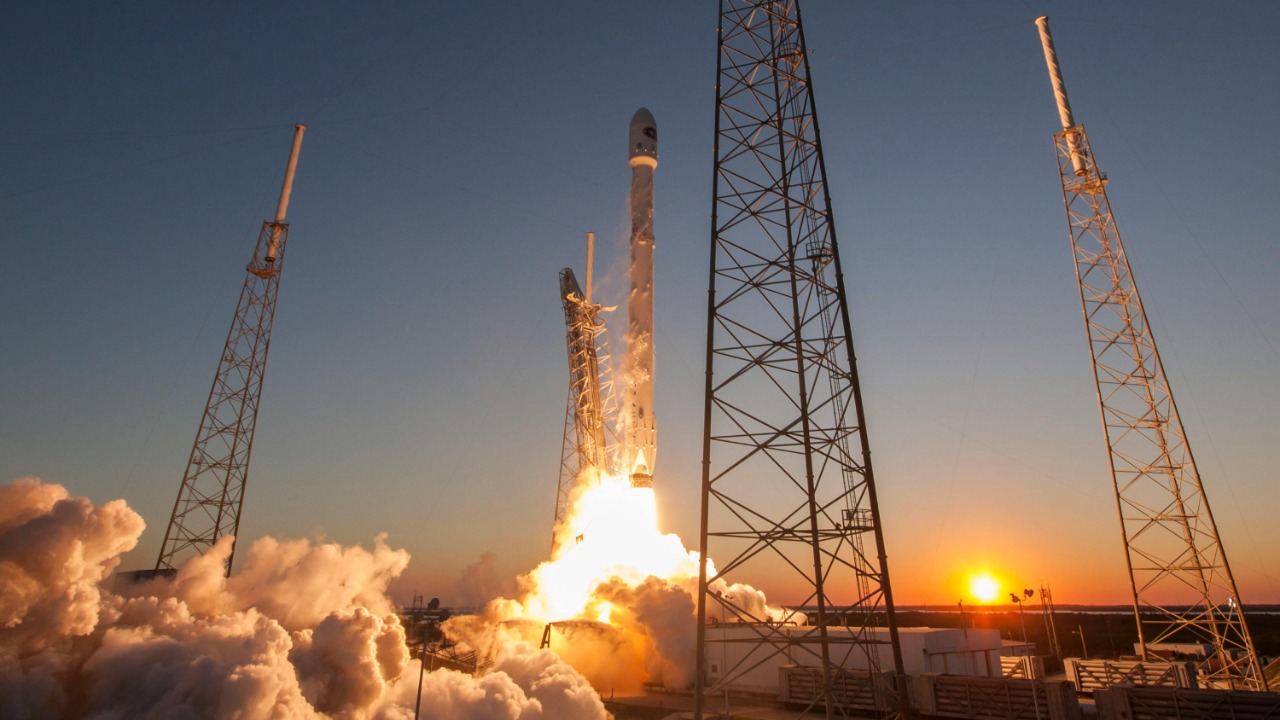

SpaceX has turned Florida’s Atlantic shoreline into the busiest spaceport on Earth, and its latest Starlink mission pushed that cadence into unprecedented territory with the 100th orbital launch from the state this year. The milestone caps a rapid climb in activity on the Space Coast, where reusable rockets and a maturing commercial market have transformed what used to be an occasional spectacle into a near-nightly routine.
That 100th liftoff is more than a round number. It signals how quickly launch operations, infrastructure and policy in Florida have adapted to a world in which rockets fly more like airliners, and it hints at how much more crowded the skies above Cape Canaveral and Kennedy Space Center could become in the next few years.
The night Florida hit triple digits
The mission that pushed Florida’s tally into triple digits lifted off from Kennedy Space Center after dark, sending another batch of Starlink internet satellites into orbit and etching a new record into the state’s launch history. Coverage of the event noted that the Launch took off around 10:40 p.m. at Kennedy Space Center, a late evening window that has become familiar to coastal residents who now plan dinner around the rumble of Merlin engines. For Florida, the flight was officially logged as the 100th rocket launch of 2025, a figure that would have sounded fanciful only a few years ago.
Local trackers had been eyeing this particular Starlink mission for weeks, knowing it would mark the moment Florida crossed the 100-launch threshold for the year. One live update feed framed it bluntly, noting that the SpaceX launch from Florida tonight was the one that would push the state into triple digits. That simple line captured the scale of the shift: “Tonight” on the Space Coast now often means a rocket, not a rare event but part of the rhythm of life.
Starlink 6-78 and the Falcon workhorse
The record-setting mission itself was a workhorse flight, not a one-off spectacle, which is precisely the point. The Falcon 9 that flew the Starlink 6-78 batch is part of a fleet that has turned orbital access into something approaching a scheduled service, and the mission’s designation underscores how deep into the series SpaceX already is. One preview noted that The 100th launch would send up the Starlink 6-78 mission from Kennedy, a reminder that dozens of similar flights have already preceded it.
On the pad, the rocket stood roughly 78 m tall, a figure that has become shorthand for the scale of Falcon 9’s presence on the Florida horizon. Reporting on the mission highlighted that the vehicle for Starlink 6-78 was a 78 m class booster, part of a design that has now flown hundreds of times. That a rocket of that size can launch, land and then do it again weeks later is the engineering foundation that makes a 100-launch year from one state even conceivable.
From prediction to reality on the Space Coast
Florida’s march to 100 launches in a single year did not come out of nowhere. Early in 2024, range officials and local reporters were already warning that the Space Coast was on track for another record, with projections that the previous year’s tally would be surpassed again. A detailed launch calendar noted that, In 2024, officials expected Florida’s launch record to fall and openly asked whether it would be broken again in 2025. The 100th liftoff has now answered that question decisively.
By the time the Starlink 6-78 mission flew, the Space Coast had already become the world’s busiest orbital gateway, with rockets lifting off from both Cape Canaveral and Kennedy Space Center at a pace that strained roadways and thrilled tourism officials. One recap of the milestone flight emphasized that Florida’s Space Coast had just hosted its 100th mission of the year, a phrase that would have sounded like science fiction when shuttle Atlantis flew its final flight. The prediction that the record would be broken in 2025 has now become a baseline, not a ceiling.
How Falcon 9 scaled to airline-like cadence
Behind Florida’s 100-launch year is a rocket that has quietly rewritten the economics of spaceflight. Falcon 9’s reusability and reliability have allowed SpaceX to stack missions on the calendar with a tempo that rivals commercial aviation, and the company has been steadily ratcheting up that cadence. A detailed breakdown of the program noted that, In 2023, the company upped the ante to 96 Falcon launches, and Then in 2024 it shattered even its own record.
That same analysis pointed out that the 96 figure was not a one-off spike but part of a deliberate climb, with the company targeting even more flights as ground systems and recovery operations matured. The ability to fly a booster, land it on a drone ship and then send it back to orbit after only minor refurbishment is what makes a 100-launch year from Florida possible, and the Number of launches: 148 that SpaceX was aiming for in 2024 shows how aggressively the company has been pushing that model. Florida’s skies are the proving ground for that experiment in scale.
Florida’s launch boom in context
To understand what 100 launches from Florida in a single year means, it helps to look at how quickly the state’s launch rate has climbed. The Eastern Range, which manages missions from Cape Canaveral and Kennedy, saw a surge in activity in 2024 that set the stage for this year’s milestone. A year-end assessment noted that Elon Musk‘s SpaceX accounted for 88 of the 93 launches from the Eastern Range in 2024, a dominance that effectively turned Florida into the company’s primary launchpad.
Those 88 flights in 2024, out of a total of 93, were already a record for the range and a clear signal that the old cadence of a few dozen launches a year was over. When officials talked about whether the record would be broken again in 2025, they were really asking how much more traffic the range could safely handle. The fact that Florida has now reached 100 launches in a year, with SpaceX again providing the bulk of them, shows that the infrastructure and airspace management around the Space Coast have kept pace with the rockets.
What the 100th launch looked like on the ground
For people on the ground, the 100th launch felt both historic and routine, a paradox that captures how normalized orbital flight has become in central Florida. Spectators lined the beaches and causeways as they have for decades, but many were also checking traffic apps and school schedules, treating the event as something to fit between errands. One local outlet framed the moment simply, noting that SpaceX’s Starlink launch will be 100th for Florida this year, a line that underscored how the state’s identity is now intertwined with a private company’s launch manifest.
The mission itself unfolded with the now-familiar choreography: liftoff, stage separation, a landing burn on a drone ship and the deployment of a stack of Starlink satellites that will eventually join a constellation providing broadband coverage around the world. A live video feed captured the moment SpaceX has launched the Starlink 6-78 mission aboard Falcon 9 B1080-23 from Launch Complex 39A (LC-39A) at the NASA site in Florida, a sentence that neatly ties together the commercial, military and civil heritage of the Cape. The 100th launch was not a fireworks show, it was a demonstration of a system that now works with clockwork regularity.
How Florida became the world’s busiest spaceport
Florida’s transformation into the world’s busiest launch site is the product of geography, policy and timing, but it is also the result of a deliberate strategy to court commercial space companies. The state’s leaders and federal partners invested heavily in pads, tracking systems and road improvements to make it easier for companies like SpaceX to fly often. A key part of that story is the way the Eastern Range has modernized its scheduling and safety systems to accommodate a surge of missions, a shift that helped enable the 93 launches in 2024 and cleared the path to 100 this year.
Local officials have been explicit about the stakes. One widely cited comment captured the mood, noting that “When you look at the total launch count across the world, we have launched more off the Space Coast than the entire w…,” a remark preserved in coverage that highlighted how When local leaders talk about launches now, they are comparing Florida not just to other states but to entire countries. The 100th launch is a milestone for SpaceX, but it is also a validation of Florida’s bet that embracing commercial spaceflight would pay off in jobs, tourism and global relevance.
What comes after 100 launches
Hitting 100 launches in a year raises an obvious question: how much higher can the curve go before it hits practical limits? SpaceX’s own ambitions suggest that the answer is “higher still.” A detailed tally of the company’s activity noted that, in 2024, SpaceX was aiming for 148 launches worldwide, a figure that would require even more frequent use of Florida’s pads if the company continues to concentrate its operations on the Space Coast. The 100th launch from Florida this year looks less like a peak and more like a waypoint.
Range officials and local planners are already thinking about what that means for airspace closures, shipping lanes and the communities that live under the flight paths. The fact that 88 of the 93 launches from the Eastern Range in 2024 were flown by a single company gives SpaceX enormous influence over how that future unfolds. If the company continues to ramp up Starlink deployments and begins flying larger vehicles, Florida’s 100-launch year may soon look like the quiet part of the curve.
Why this milestone matters beyond Florida
The 100th launch from Florida is not just a local story, it is a signal about where global spaceflight is headed. A state that once hosted a handful of high-profile missions each year is now supporting a tempo that rivals major commercial airports, and that shift has implications for everything from satellite broadband to national security. The official manifest on SpaceX launches shows a steady drumbeat of missions that mix Starlink deployments, crewed flights and national security payloads, all funneled through a handful of pads on the Space Coast.
For the broader industry, Florida’s 100-launch year is a proof of concept that high-cadence, reusable rocketry can be integrated into existing airspace and coastal communities without grinding them to a halt. It also raises competitive pressure on other launch providers and spaceports, which now have to match not just the cost but the reliability and frequency that SpaceX has demonstrated from Kennedy Space Center and Cape Canaveral. As the glow from the 100th liftoff fades over the Atlantic, the more consequential question is how quickly the rest of the world can catch up to what has become routine on Florida’s horizon.
More from MorningOverview