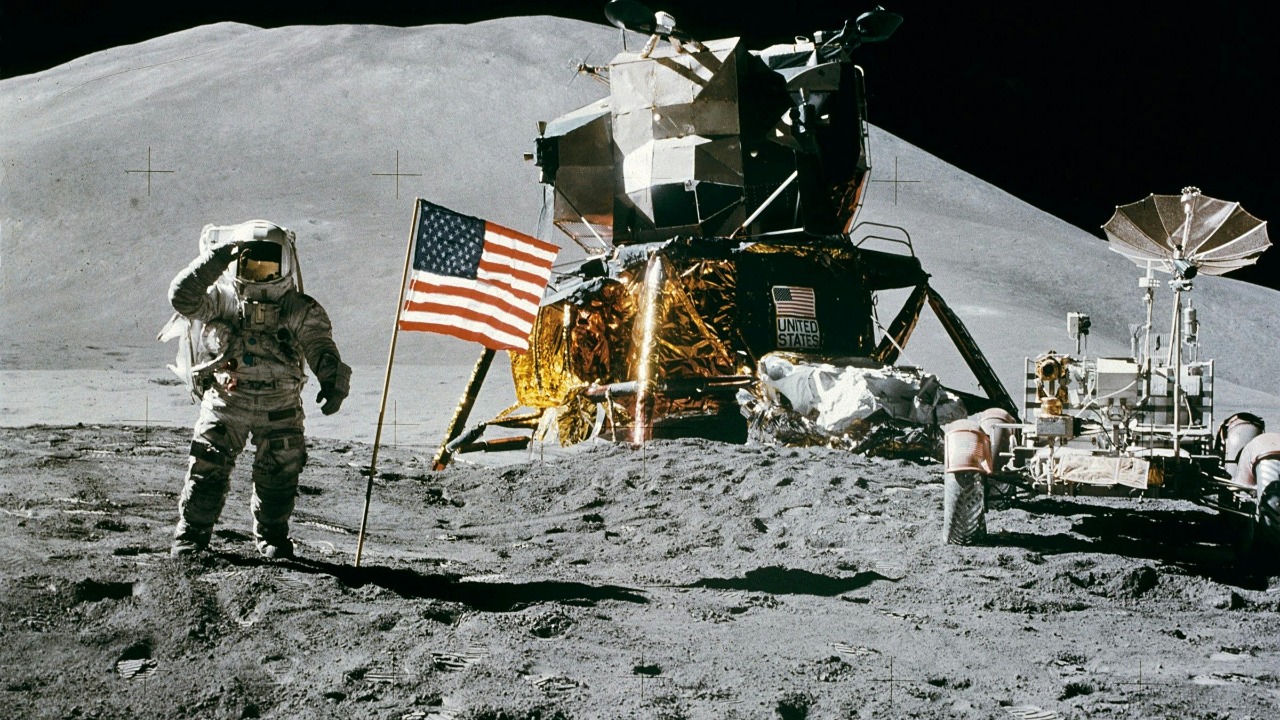

NASA is now targeting February 2026 for the first crewed journey back to the Moon in more than half a century, a mission that would send astronauts around our celestial neighbor rather than landing on its surface. If the schedule holds, it will mark the first human voyage to lunar distance since Apollo 17 left the Moon in 1972 and set the stage for a new era of landings later in the decade.
I see this moment as a hinge between two spaceflight eras: the tightly controlled Apollo program that ended with Eugene Cernan’s final steps on the lunar surface, and a more complex Artemis architecture that relies on commercial partners, new spacecraft and a long game aimed at sustained presence rather than a single flag-planting sprint.
From Apollo’s last footprints to a 53‑year wait
The last time humans walked on the Moon, Apollo 17 carried Ronald Evans as command module pilot and Eugene Cernan as Mission Commander, closing out a sequence of landings that had rapidly advanced science and geopolitics but proved difficult to sustain. That final mission in 1972 left Cernan as the last person to speak from the lunar surface, a moment that has come to symbolize how abruptly the Apollo era ended and how long the gap in human lunar exploration has stretched since those Apollo flights stopped.
Public fascination with the Moon never fully faded, but political priorities shifted, budgets tightened and attention moved to low Earth orbit, leaving the United States without a follow‑on program that could regularly visit our celestial neighbour. That long hiatus is precisely what makes a crewed return in the 2020s so charged: it is not just another mission on the manifest, it is a deliberate attempt to restart a journey that paused when Evans and Eugene Cernan came home and to answer decades of polling and debate about why humanity stepped back from the lunar frontier in the first place.
Artemis II: the February 2026 pathfinder
The mission now eyed for February 2026 is Artemis II, the first crewed flight in NASA’s new lunar campaign and the crucial bridge between uncrewed test flights and future landings. NASA has described Artemis II as a journey in which four astronauts will venture around the Moon, using the Orion spacecraft and its systems to validate life support, navigation and communications in deep space before any attempt to touch down on the surface, a role that places this flight at the heart of the broader Artemis II plan.
In official planning documents, Artemis II is depicted with The Orion spacecraft and the European Service Module for the Artemis II mission being prepared as an integrated stack, a configuration that will carry the crew on a free‑return trajectory around the Moon and back to Earth. That pairing of Orion and its European Service Module for the Artemis II flight, detailed in technical tables that link Artemis II directly to the follow‑on Artemis III mission, underscores how this February 2026 journey is designed as a systems shakedown that must succeed before NASA can credibly move on to Artemis II’s successor.
How the February 2026 target emerged
The February 2026 timeframe did not appear in a vacuum, it reflects a recalibration of NASA’s ambitions after technical findings and schedule pressure forced a rethink of earlier, more aggressive timelines. Reporting on the agency’s internal reviews has highlighted how findings from the uncrewed Artemis 1 test flight led NASA to push the first Moon landing since the Apollo era to 2027, a shift that effectively created room for a crewed lunar flyby in 2026 while acknowledging that a surface mission would require more time to address those Findings.
Public‑facing explanations of the new schedule have been blunt that NASA now wants to launch its Artemis 2 mission in February 2026, describing it as the first human mission to the Moon since 1972 and emphasizing that the flight will loop around the Moon rather than attempt a landing. One widely shared update on social media framed the shift by noting that NASA now wants to launch Artemis 2 in February, tying that date directly to the claim that it would be the first such journey since 1972 and reinforcing how the agency’s revised plan has filtered into broader awareness of the Artemis schedule.
What Artemis II will actually do around the Moon
For all the excitement around a crewed return to lunar distance, Artemis II is deliberately scoped as a mission that will not land on the Moon but will lay the groundwork for later surface expeditions. Coverage of NASA’s planning has been explicit that the crew of Artemis II will not land on the moon but will lay out a trajectory that tests Orion’s performance, deep‑space navigation and re‑entry under lunar‑return conditions, a profile that aligns with the agency’s description of a manned Moon mission by February 2026 that focuses on proving systems rather than planting boots on the Moon.
In that sense, Artemis II is both modest and ambitious: modest because it repeats the broad outline of Apollo 8’s historic loop around the Moon without attempting a landing, ambitious because it does so with a new spacecraft, new service module and a long‑term goal of enabling a 2030 astronaut moon landing that is already being discussed in the same planning documents. When I look at the mission profile, I see a calculated choice to accept a February target for a high‑stakes systems test, knowing that any issues uncovered on this flight will ripple directly into the schedule for the first surface return.
Artemis III and the race to put boots back on the surface
While Artemis II captures headlines as the first crewed return to lunar distance, Artemis III is the mission explicitly designed to put humans back on the Moon for the first time since Apollo 17 in 1972. Official descriptions state that Artemis III is NASA’s planned mission to return humans to the Moon for the first time since Apollo 17 in 1972, with a profile that sends the Orion spacecraft into lunar orbit before transferring crew to a landing system, a sequence that defines how Artemis III is meant to close the loop that Apollo left open.
Technical summaries go further, noting that Artemis III is planned to be the first crewed Moon landing mission of the Artemis program and the first crewed flight to the lunar surface since the Apollo era, with mission tables that describe how the spacecraft’s life support system will be stressed during the journey. Those same tables identify the mission under names such as Exploration Mission and include a Summary of the Artemis III mission plan, underscoring that Artemis III is not just a concept but a defined step in the broader Artemis III architecture.
Delays, Starship and the shifting landing timeline
The challenge for NASA is that the surface landing timeline tied to Artemis III has become increasingly fluid as key hardware, particularly the lunar lander, faces delays. One detailed analysis of the program has reported that Starship delays could push the Artemis 3 mission back to 2028, even as NASA is currently officially on track to launch Artemis missions while its commercial partner works through a test campaign that could involve up to 500 multiple rocket launches, a scale that illustrates why Starship has become a pacing item.
Internal planning has also evolved over time, with program leaders noting in June 2023 that Artemis III would need to adapt to findings from earlier flights and to the realities of the surface environment on space crops and other research goals. Tables summarizing the mission refer to a Summary of the Artemis III mission plan and list Names such as Exploration Mission alongside references to how the surface environment on space crops will be studied, a reminder that the mission is as much about science and technology as it is about symbolism, even as those evolving objectives are captured in the Summary of the Artemis III documentation.
Geopolitics, polls and who leads the new Moon race
The longer NASA’s schedule stretches, the more the Artemis timeline is judged against what other nations are doing, particularly China. A recent discussion of Artemis III framed the situation as China’s secret lunar landing program versus the US’s semi‑commercial Artemis lunar landing program, casting the question of who reaches the surface first as a proxy for broader technological and geopolitical competition and asking whether the United States is still leading the Moon race in the context of Artemis and its rivals.
Public opinion has become part of that calculus, with multiple reports referencing the use of a poll to gauge how citizens view the cost, risk and prestige associated with returning to the Moon for the first time since the Apollo era. When I weigh those signals against the technical realities, I see a program that is trying to balance domestic expectations, international competition and the hard constraints of hardware readiness, all while keeping to a February 2026 crewed flight that is ambitious but still more achievable than an earlier attempt to rush a landing before the supporting systems, from Orion to the lander, are fully proven.
More from MorningOverview