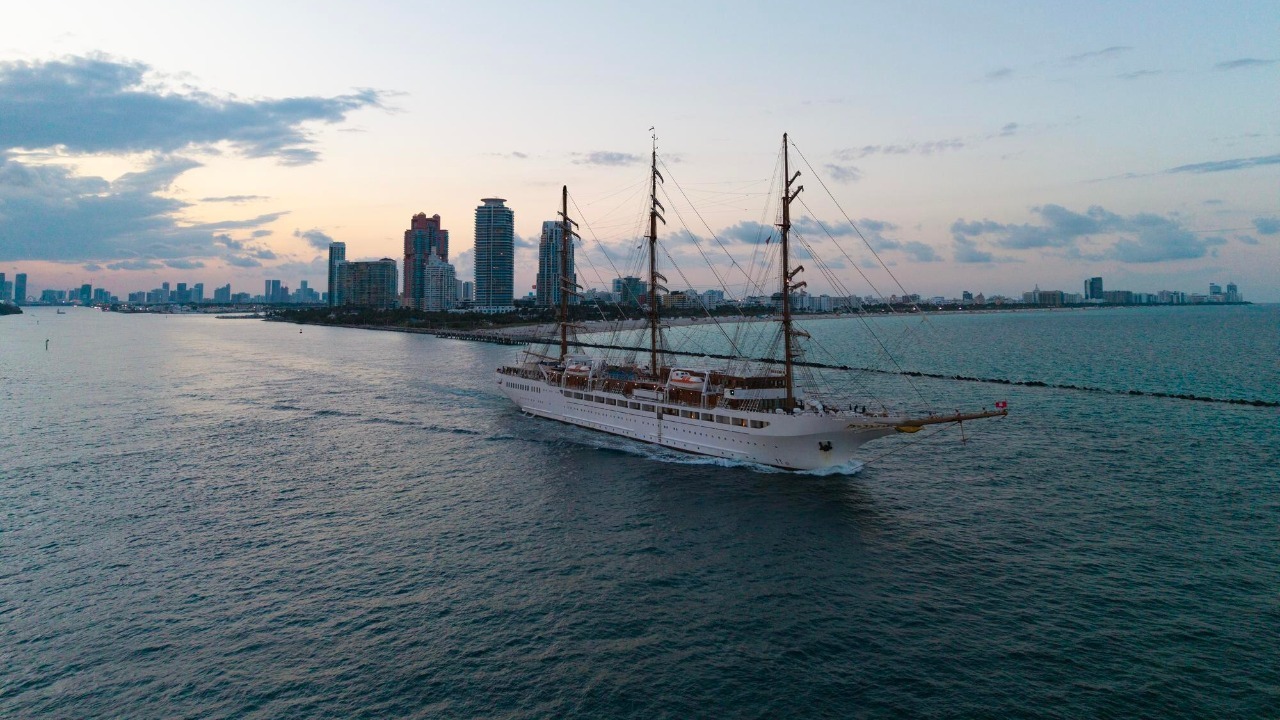

The world’s biggest modern cargo sailboat has just proven it can do what skeptics long said was impossible, hauling commercial freight across the Atlantic largely on the power of the wind. The Neoliner Origin, a purpose-built sailing vessel designed for industrial loads, has completed its first full crossing between Europe and the United States, turning a bold climate experiment into a working trade route.
Its arrival is more than a nautical curiosity. It signals that wind propulsion, once written off as a relic of the tall-ship era, is starting to reenter mainstream shipping at scale, with a vessel specifically engineered to carry thousands of tons of goods while cutting fuel use and emissions.
The Neoliner Origin’s record-setting voyage
The Neoliner Origin has been described across multiple reports as the world’s largest cargo sailboat, and its first Atlantic passage marks a turning point for wind-assisted trade. Earlier this year, the vessel completed a historic first crossing between Europe and North America, a milestone that confirmed that a large, commercially focused sailing ship can keep to a modern schedule while moving real freight. Coverage of the journey notes that the project was years in the making and that the ship’s operators framed the voyage as a proof of concept for a new generation of wind-powered logistics.
Reporting on the crossing highlights that the trip was not a ceremonial cruise but a working voyage that delivered cargo to the port of Baltimore in the United States, a detail underscored in accounts of the Largest Cargo Sailboat Completes Historic First Atlantic Crossing. Additional coverage describes how the Neoliner Origin’s operators treated the voyage as a template for regular service, not a one-off stunt, positioning the ship as a working asset in transatlantic trade rather than a floating demonstration project.
A 446-foot-long sailing freighter built for industry
What sets the Neoliner Origin apart is its scale and its unapologetically commercial design. The vessel is described as a 446-foot-long ship capable of carrying 5,200 tons of goods, figures that place it firmly in the realm of serious freight movers rather than boutique yachts. Designed by the French maritime company Neoline, the ship is explicitly engineered to integrate into existing logistics chains, with roll-on/roll-off capacity and space for containers and specialized cargo.
Reports emphasize that the Neoliner Origin was dubbed the world’s largest cargo sailboat and that its layout is meant to serve manufacturers that need predictable, repeatable service rather than experimental one-offs. The French roots of the project are central to its identity, with the ship described as being Designed by a French team at Neoline, which has pitched the vessel as a practical answer to tightening climate rules and customer pressure for lower-carbon shipping.
From bold experiment to working trade route
When the Neoliner Origin set out across the Atlantic, it did so under the banner of a bold experiment in how global trade might work in a carbon-constrained world. One detailed account describes the crossing as a Bold Experiment on the High Seas, stressing that the ship’s operators were not simply chasing a record but testing whether wind propulsion can meet the reliability demands of modern shippers. The Neoliner Origin, in that framing, is less a nostalgic throwback and more a prototype for a fleet of industrial sail cargo vessels that could follow.
Coverage of the voyage’s completion notes that the ship’s success has already drawn attention from logistics planners and climate-focused investors, who see the Neoliner Origin as a working example of how wind can be integrated into mainstream supply chains. One report characterizes the crossing as the moment when wind-in-your-sails technology moved from concept to commercial reality, with the vessel’s performance now being scrutinized for lessons on routing, scheduling, and cost.
Storms, setbacks, and proof of resilience
The Atlantic is rarely kind to experimental ships, and the Neoliner Origin’s first crossing was no exception. Reports on the voyage describe how the vessel encountered heavy weather that caused damage but did not prevent it from finishing its route, a key test of whether a large sailing freighter can withstand the same punishing conditions that conventional cargo ships face. One account notes that the ship managed to complete its first Atlantic crossing despite storm-related setbacks, underscoring that the project is not sheltered from the realities of ocean trade.
Details of the rough passage appear in coverage that frames the Neoliner Origin’s arrival as a success story precisely because it was not a smooth, choreographed demonstration. A report on how the world’s largest cargo sailboat finishes first Atlantic crossing despite storm damage stresses that the vessel still delivered its cargo, reinforcing the argument that wind-propelled ships can be robust enough for frontline commercial service rather than limited to fair-weather routes.
What the cargo reveals about commercial demand
The Neoliner Origin’s manifest on its maiden transatlantic run offers a glimpse of how brands are already using wind-powered shipping to burnish their climate credentials. One detailed report notes that, in a partnership with high-end alcohol producer Rémy Cointreau, the ship arrived in Baltimore carrying 11,088 bottles of premium spirits. That shipment is a clear signal that consumer-facing companies see marketing value in moving goods on a vessel that dramatically cuts fossil fuel use, especially for products where brand storytelling and sustainability claims carry real weight.
Other accounts emphasize that the Neoliner Origin is designed to carry a mix of cargo types, including vehicles, containers, and specialized goods, which positions it as a flexible platform for manufacturers that want to shift at least part of their logistics to lower-emission options. The ship’s operators have highlighted that the vessel can handle about 5,300 tons of goods on a voyage, a capacity that makes it relevant for industrial clients rather than just niche, high-margin cargo.
Why wind propulsion is back on the agenda
The Neoliner Origin’s crossing lands at a moment when shipping companies are under intense pressure to cut emissions, and wind is reemerging as one of the most practical tools available. Reports on the voyage repeatedly point out that wind propulsion systems can significantly reduce fuel consumption and greenhouse gas output, especially on long ocean legs where steady breezes are common. In that context, a large sailing cargo ship is not a romantic gesture but a pragmatic response to regulatory and market forces that are pushing the industry away from heavy fuel oil.
Coverage of the Neoliner Origin’s success also notes that the ship is part of a broader wave of experimentation, from retrofitted rotor sails on conventional freighters to newbuilds that combine large rigid wings with efficient auxiliary engines. One report on the World’s Largest Cargo Sailboat Completes Historic First Atlantic Crossing places the Neoliner Origin within that trend, arguing that the vessel shows how purpose-built sail cargo can complement, and in some cases outperform, retrofits on older hulls when it comes to cutting emissions per ton of freight.
From one ship to a potential fleet
For now, the Neoliner Origin is a singular presence on the Atlantic, but the ambition behind it is clearly to scale. Reports on the project describe plans for additional vessels if the first ship’s performance and customer demand justify the investment, with the goal of building a small fleet that can offer regular, scheduled service on key trade lanes. The early interest from brands like Rémy Cointreau, along with the attention from logistics planners, suggests that there is at least a niche market ready to pay for lower-carbon shipping, especially for high-value goods.
At the same time, coverage of the Neoliner Origin’s journey stresses that the economics of sail cargo will depend on how efficiently ships like this can be operated and how much value shippers place on emissions reductions. One report that frames the Neoliner Origin as a wind-meets-industry test case notes that the real measure of success will be whether the model can be replicated at scale, with multiple ships running frequent crossings and integrating smoothly into complex global supply chains.
More from MorningOverview