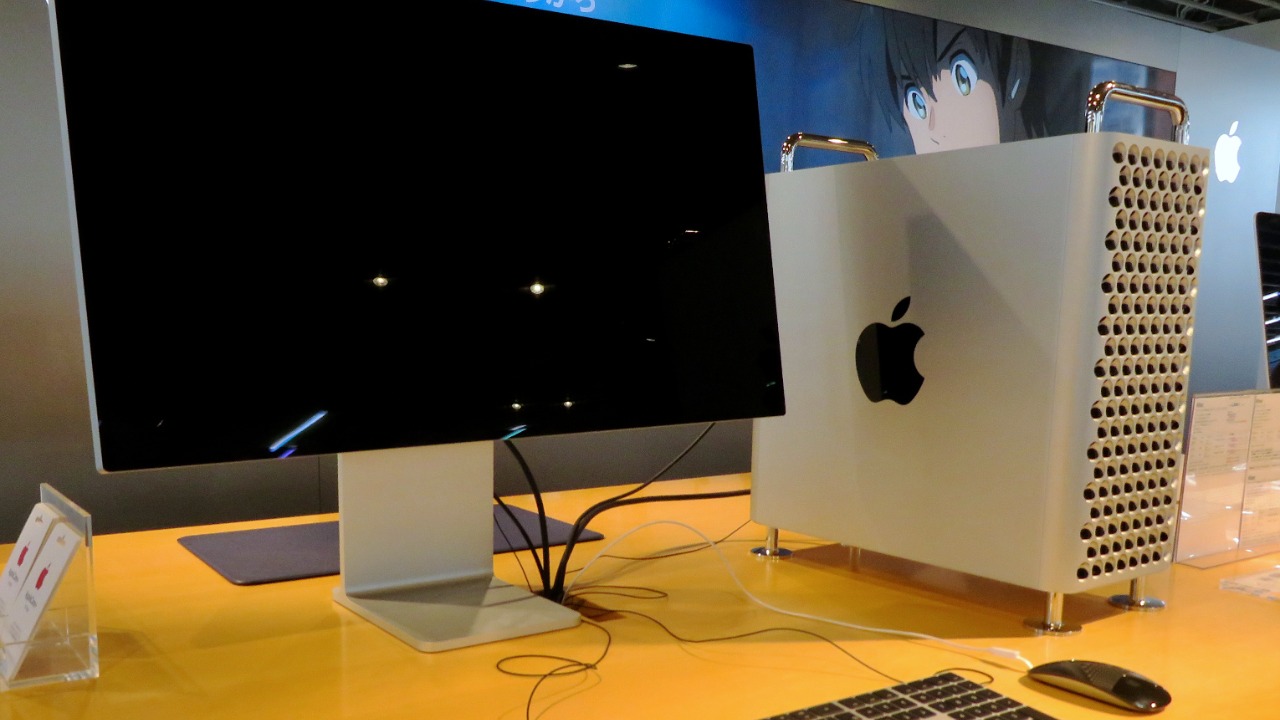

Apple’s most expensive desktop is slipping out of the spotlight as the company concentrates on a smaller, more flexible machine that better fits its silicon roadmap. The Mac Pro is reportedly being treated as a low priority while Apple channels its energy into making the Mac Studio faster and more affordable for the creative professionals who once defaulted to the tower.
The shift marks a quiet but consequential reset of Apple’s desktop strategy, signaling that modular expansion is giving way to tightly integrated performance and price-conscious configurations that still hit pro-level workloads.
The Mac Pro’s long road to the sidelines
The Mac Pro has always carried symbolic weight inside Apple’s lineup, a kind of halo product meant to prove that the company could still serve the most demanding editors, 3D artists, and developers. That is why the tower’s transition to Apple silicon, completed with the M2 Ultra configuration, looked like a turning point for long-time buyers who had waited through years of uncertainty. Yet reporting now indicates that those expectations were misplaced and that the Mac Pro is effectively on hold while Apple focuses elsewhere.
According to coverage of internal guidance, Apple has put the Mac Pro “on the back burner,” leaving the current model on older silicon while the rest of the Mac family moves ahead. One report notes that Buyers hoping the M2 Ultra milestone would restore a predictable schedule may instead see the tower sit unchanged until Apple decides it has a suitable new chip. That pattern echoes earlier gaps in the Mac Pro’s history and reinforces the sense that the machine is no longer central to Apple’s hardware story.
Bloomberg’s Mark Gurman and the new desktop pecking order
The clearest signal of this reprioritization comes from reporting tied to Bloomberg’s Mark Gurman, whose Apple coverage has repeatedly foreshadowed major product shifts. Gurman is cited as saying that the Mac Pro is no longer a priority and that Apple’s desktop focus has shifted to the Mac Studio, a smaller machine that still delivers high-end performance. In coverage dated Nov 16, 2025, this change is framed as a deliberate reordering of Apple’s desktop roadmap rather than a temporary pause.
One report summarizes the situation with the blunt assessment that Mac Pro Reportedly No Longer a Priority for Apple, Focus Switches to Mac Studio, and notes that the last refresh for the compact desktop was in March 2025. That timing matters because it shows Apple iterating more quickly on the Studio while leaving the Pro to age, a pattern that would be hard to justify if the tower still sat at the center of Apple’s pro strategy.
Why the Mac Studio fits Apple silicon better than the tower
Apple’s own chip design philosophy helps explain why the Mac Studio is winning attention. The company’s M-Series architecture is built around tightly integrated systems on a chip, where CPU, GPU, and memory live on a single package. That approach favors sealed, thermally optimized enclosures over the kind of open, modular chassis that defined earlier Mac Pro generations. The Studio’s compact design lets Apple push those chips hard without worrying about third-party expansion cards or user-swappable GPUs.
Reports describe Apple’s Mac Pro, which was the last Mac model to make the transition to the company’s M-Series chips, as now appealing to a very narrow slice of users. One analysis notes that Apple’s Mac Pro may well be headed toward serving only a very niche audience, precisely because Apple silicon does not reward the kind of modularity that once justified the tower’s existence. The Mac Studio, by contrast, lines up neatly with Apple’s preference for integrated performance, making it a more natural home for future chip generations.
Price, performance, and the shrinking Mac Pro audience
Even before this latest reporting, the economics of the Mac Pro were working against it. The tower’s starting price, once justified by unique expansion options and workstation-class CPUs, now has to compete with Apple’s own desktops that deliver similar or better performance at far lower cost. For many creative professionals, a Mac Studio paired with external storage and a high-end display already covers video editing, 3D rendering, and music production workloads that once demanded a full tower.
Coverage of Apple’s internal stance underscores how small the Mac Pro’s market has become. One report characterizes the current tower as catering to Long-suffering Mac Pro buyers who have stuck with the platform through repeated delays and redesigns, only to see Apple hesitate again as it waits for a suitable chip. When the audience is that small and the engineering costs that high, it becomes easier to see why Apple would rather pour silicon and software resources into a machine that sells in higher volumes.
What “on the back burner” means in practice
Putting the Mac Pro on the back burner does not mean Apple will immediately discontinue the product. Instead, it suggests a slow fade, where the current configuration remains on sale but sees fewer marketing pushes, fewer configuration updates, and longer gaps between chip upgrades. For buyers, that translates into a tower that looks increasingly static next to the Mac Studio, which is more likely to receive the latest M-Series silicon first.
One detailed report explains that Apple may leave the Mac Pro on older silicon until it releases a chip that justifies a new version, a stance that effectively freezes the product in place. Another analysis notes that Apple has largely written off the tower and is instead emphasizing the smaller desktop’s performance and options for future expansion, with one piece stating that Apple has largely written off the Mac Pro while highlighting the Mac Studio’s flexibility. In practice, that means pro buyers will see more frequent and more visible updates to the Studio, while the Pro quietly ages in the background.
How pro workflows are adapting to a Studio-first world
For working professionals, the question is less about Apple’s internal priorities and more about whether the Mac Studio can replace the Mac Pro in real projects. In many cases, the answer is already yes. Video editors cutting 8K footage in Final Cut Pro, 3D artists working in Blender, and audio engineers mixing in Logic Pro have shifted to Studio setups that combine high-end Apple silicon with fast external NVMe storage and Thunderbolt expansion. The performance gap that once separated the tower from smaller Macs has narrowed to the point where the Studio often matches or exceeds what the Pro can do in day-to-day work.
That shift is visible in how Apple and third-party retailers position their desktop offerings. Product listings now highlight compact, high-performance desktops with integrated GPUs and unified memory, while tower-style workstations are treated as specialized options. Even generic product listings for high-end desktops increasingly emphasize small-form-factor designs that mirror the Mac Studio’s approach, reinforcing the idea that the industry has moved toward dense, integrated power rather than sprawling towers.
The future of Apple’s pro desktop strategy
Looking ahead, the most likely scenario is that Apple continues to treat the Mac Studio as its flagship pro desktop while keeping the Mac Pro alive only as long as it remains profitable and technically feasible. The company’s chip roadmap favors machines that can be refreshed on a regular cadence, and the Studio’s design makes it easier to drop in new M-Series generations without rethinking the entire enclosure or expansion system. That rhythm aligns with how Apple now updates its laptops and all-in-one desktops, creating a more predictable ecosystem for developers and pro users.
At the same time, Apple still needs to reassure the small but vocal group of customers who built their workflows around the Mac Pro’s modularity. Some of that gap is being filled by external PCIe enclosures, Thunderbolt audio interfaces, and networked storage arrays that let a Mac Studio behave more like a traditional workstation. Retailers already showcase compact desktops paired with expansion hardware in their product configurations, a pattern that mirrors how Mac Studio buyers are extending their systems.
Why Apple is unlikely to reverse course soon
Given the reporting and the underlying economics, a sudden Mac Pro renaissance looks unlikely in the near term. The tower’s development costs are high, its audience is small, and its design philosophy clashes with Apple’s integrated silicon strategy. By contrast, the Mac Studio offers a cleaner path to iterate on performance, experiment with new chip bins, and hit price points that appeal to a broader slice of creative professionals and power users.
Multiple reports converge on the same conclusion: Apple has shifted its attention to a desktop that better matches its long-term plans. One analysis dated Nov 16, 2025, notes that Apple may have effectively lost interest in the Mac Pro as it leans into the Mac Studio’s role as the primary pro desktop, a sentiment echoed in coverage that describes how Apple puts Mac Pro on the back burner to focus on faster, more flexible desktops. Unless a future M-Series generation demands a radically different chassis, the Mac Studio is likely to remain Apple’s main stage for pro performance while the Mac Pro watches from the wings.
More from MorningOverview