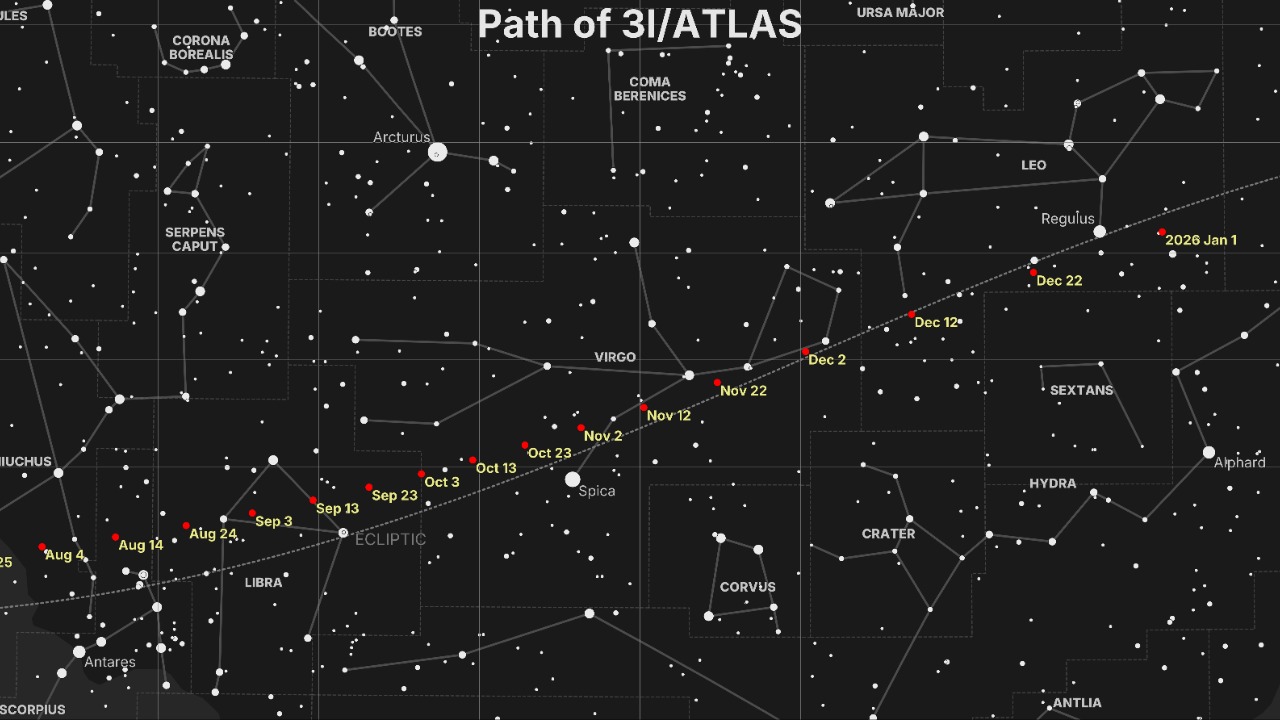

Comet 3I/ATLAS is only the third known object to barrel into our neighborhood from interstellar space, and it is already shredding old assumptions about how comets form, move, and even what they are made of. In the past few months, a cascade of observations has turned this icy visitor into a kind of forensic time capsule, hinting at conditions that may date back to the galaxy’s ancient past. As I sift through the data, nine findings in particular stand out for how sharply they are forcing scientists to rethink the basic playbook of space science.
1. A third interstellar visitor that refuses to behave
The first shock is simply that Comet 3I/ATLAS exists at all, and that it looks nothing like a routine comet. According to Quick Facts from NASA Science, Comet 3I/ATLAS is only the third known object to pass through our Solar System from outside it, following 1I/ʻOumuamua and 2I/Borisov. That alone would make it a once‑in‑a‑generation laboratory. Yet early tracking showed an orbit and activity pattern that did not fit neatly into either of those earlier examples, suggesting that the diversity of interstellar debris is far greater than astronomers had modeled.
Detailed profiles from planetary scientists underline how odd this object is even by interstellar standards. A technical overview titled What is comet 3I/ATLAS describes Hubble Comet 3I/ATLAS as a target of the NASA/ESA Hubble Space Telescope, with imaging that reveals a coma and tail structure more reminiscent of a long‑period comet than a compact asteroid. That mix of traits, part familiar and part alien, is already forcing dynamicists to revisit how they classify small bodies that arrive from beyond the Sun’s gravitational reach.
2. Gemini North’s portrait and a path that will never repeat
The second surprise comes from the sheer clarity with which astronomers have been able to watch this object glide past. High‑resolution images from the Gemini North telescope on the Pacific island of Hawaii captured Comet 3I/ATLAS in late November, resolving fine jets and dust structures that usually blur together in more distant comets. Those Gemini North images give researchers a rare chance to compare an interstellar object’s surface activity with the behavior of comets that have spent their lives orbiting the Sun.
At the same time, radio and optical tracking have confirmed that 3I/ATLAS is on a one‑way trajectory that will never bring it back. Observations from the Atacama Large Millimeter Array, or ALMA, showed that the comet veered slightly, about four arcseconds, off its predicted path as it interacted with solar radiation and outgassing forces. That tiny but measurable deflection, reported in Observations from the Atacama Large Millimeter Array, confirms that once it swings past the planets it will leave our Solar System for good, turning every current dataset into a non‑repeatable experiment.
3. Razor‑sharp radio signals from interstellar darkness
Perhaps the most headline‑grabbing twist so far is not visual at all but radio. When astronomers pointed sensitive receivers at 3I/ATLAS, they expected a noisy spectrum shaped by natural processes like outgassing and solar wind interactions. Instead, as one analysis of the campaign describes it, what they caught from the interstellar darkness were two razor‑sharp radio frequency peaks that stood out starkly from the background. The report on this Nov observing run does not claim an artificial origin, but the precision of the frequencies has forced teams to consider exotic natural mechanisms that had not been part of standard comet models.
For me, the real shock is how quickly this single result has widened the search space for what comets can do. If a natural body can generate such narrowband radio features, then long‑standing assumptions about what counts as a “technological” signal need to be revisited. It also raises practical questions for future surveys that rely on radio quietness to flag anomalies, since 3I/ATLAS shows that interstellar debris itself may be capable of mimicking some of the signatures that were once reserved for hypothetical civilizations.
4. A near‑miss with Jupiter’s Hill sphere
Another of the nine standout findings is orbital rather than spectral. As Comet 3I/ATLAS passes near Jupiter in March 2026, it will come remarkably close to Jupiter’s Hill radius, the region where the giant planet’s gravity dominates over the Sun’s. One detailed dynamical analysis notes that as Comet 3I/ATLAS threads this needle, it will move too fast to be captured as a permanent satellite, but the geometry is close enough that modelers have had to consider whether it could, in principle, add a new moon to Jupiter. That scenario is laid out in a discussion of how As Comet 3I/ATLAS interacts with Jupiter’s Hill sphere.
Even if capture remains unlikely, the close approach is a gift to gravitational theorists. It turns 3I/ATLAS into a live test particle for how a massive planet sculpts the paths of interstellar objects, a process that may be common in other planetary systems but is almost impossible to watch directly. By tracking tiny changes in the comet’s velocity and direction as it skims Jupiter’s Hill region, researchers can refine models of how often rogue comets are deflected, trapped, or ejected, which in turn feeds into broader estimates of impact risk and the long‑term evolution of planetary systems.
5. An object that may be older than any known comet
Age is another domain where 3I/ATLAS is forcing a rethink. Scientists now suggest that this ancient traveler may be the oldest comet ever spotted, with its composition and trajectory hinting at an origin in the early epochs of the Milky Way. One synthesis of recent imaging notes that astronomers reveal that the new object could be a relic from the galaxy’s ancient past, a conclusion drawn from its unusual color and the stability of its coma at large distances from the Sun. That perspective is captured in a report explaining how Astronomers reveal the comet’s likely origin in the galaxy’s ancient past.
The discovery story adds another layer of intrigue. The object was Discovered on July 1 by Chile’s ATLAS survey, a ground‑based system that scans the sky for moving points of light. That detail, highlighted in the same account that credits Chile with the initial detection, underscores how much of modern interstellar science depends on wide‑field, automated surveys rather than single flagship observatories. For me, the idea that a system built to guard Earth from near‑term impacts may have stumbled onto a fossil from the dawn of the galaxy is one of the most quietly revolutionary aspects of the 3I/ATLAS story.
6. A comet that may not be a comet at all
Not everyone is convinced that 3I/ATLAS should even be called a comet, and that debate is reshaping how astronomers draw the line between categories. One widely shared discussion framed the object as a Mysterious Interstellar Object Defies Comet Classification Astronomers, arguing that its activity level, rotation, and outgassing pattern do not match standard comet behavior. That argument, circulated in an analysis of how Mysterious Interstellar Object, raises the possibility that 3I/ATLAS could represent a new class of interstellar body, or at least a hybrid that blurs the line between comet and asteroid.
The pushback has been sharp. A Harvard scientist publicly criticized what he described as superficial new research that too quickly labels 3I/ATLAS a conventional comet, arguing that what they need is a more detailed analysis of its rotation and an extremely specific orientation before drawing firm conclusions. That critique is summarized in a report that quotes his warning and notes that he urged colleagues to revisit the object’s light curve and spin state, as described in Your browser‑based summary of the debate. For classification systems that have long treated “comet” as a settled label, this argument is a reminder that nature does not always respect human taxonomies.
7. Chemical clues from a classified network and a global watch
Beyond dynamics and labels, 3I/ATLAS is also rewriting expectations about what interstellar ice is made of. One detailed account notes that a classified network of SpaceX satellites was used to monitor the object’s spectrum, with early interpretations suggesting that the comet could be billions of years old. That same report, which explores Why an interstellar comet has scientists excited, hints at unusual ratios of volatiles that do not match typical Solar System comets, implying that 3I/ATLAS condensed in a very different chemical environment.
The geopolitical response has been just as striking as the scientific one. A mysterious interstellar object, 3I/ATLAS, has entered our Solar System, sparking global scientific interest and prompting The International community to activate a dedicated monitoring team under the United Nations. According to one detailed briefing, that UN team was set up to watch a possible alien object as the interstellar visitor 3I/ATLAS passes near Earth, in part because it could even hold clues to alien chemistry or biology. Those stakes are laid out in a report on how mysterious interstellar object triggered a UN alert, a rare example of planetary science and international security policy intersecting in real time.
8. Evidence that the Solar System is not an island
For decades, textbooks treated the Solar System as a mostly closed box, with comets and asteroids forming from local material and staying gravitationally bound. 3I/ATLAS is helping to overturn that picture. A recent synthesis argues that 3I/ATLAS is not just a passing curiosity, but evidence that the Solar System is part of a dynamic, interconnected galactic environment where material is routinely exchanged between stars. That argument, which emphasizes how the object is unlike anything seen before, is laid out in a detailed explainer on why ATLAS is reshaping our understanding of the universe.
NASA’s own framing reinforces that shift in perspective. In its official overview, the agency notes that Comet 3I/ATLAS is only the third known object to arrive from interstellar space, and that tracking such visitors helps refine models of how often foreign debris crosses Earth’s orbit and how best to scan the skies to keep us safe. Those Stats are not just trivia. They feed directly into risk assessments, mission planning, and even the design of future telescopes that will need to catch the next 3I‑class object before it slips back into the dark.
9. A catalyst for a new era of comet science
All of these shocks, from razor‑sharp radio lines to a near‑miss with Jupiter’s Hill sphere, add up to more than a quirky one‑off. They mark a pivot point in how scientists think about comets as tools for probing the deep history of the galaxy. One synthesis of the current research notes that 3I/ATLAS is not just a passing curiosity, but a probe that can reshape our understanding of the universe by tying together dynamics, chemistry, and planetary defense. That sentiment echoes through the detailed overview of what ATLAS is and how Hubble Comet 3I/ATLAS has become a flagship target for NASA and ESA instruments.
Even the public‑facing explainers have had to stretch to keep up. One widely shared piece framed the story under the banner of Oct, asking what is 3I/ATLAS and why it is unlike anything seen before, while another social‑media analysis from Oct highlighted how Scientists used dramatic new images to argue that the object may be the oldest comet ever spotted. Those narratives, captured in discussions of Scientists and in the broader question of What is comet 3I/ATLAS, show how quickly a single icy fragment can force both experts and the public to redraw their mental maps of the cosmos. As I see it, that is the most shocking finding of all: not just that 3I/ATLAS is strange, but that our frameworks were so unprepared for it.
More from Morning Overview