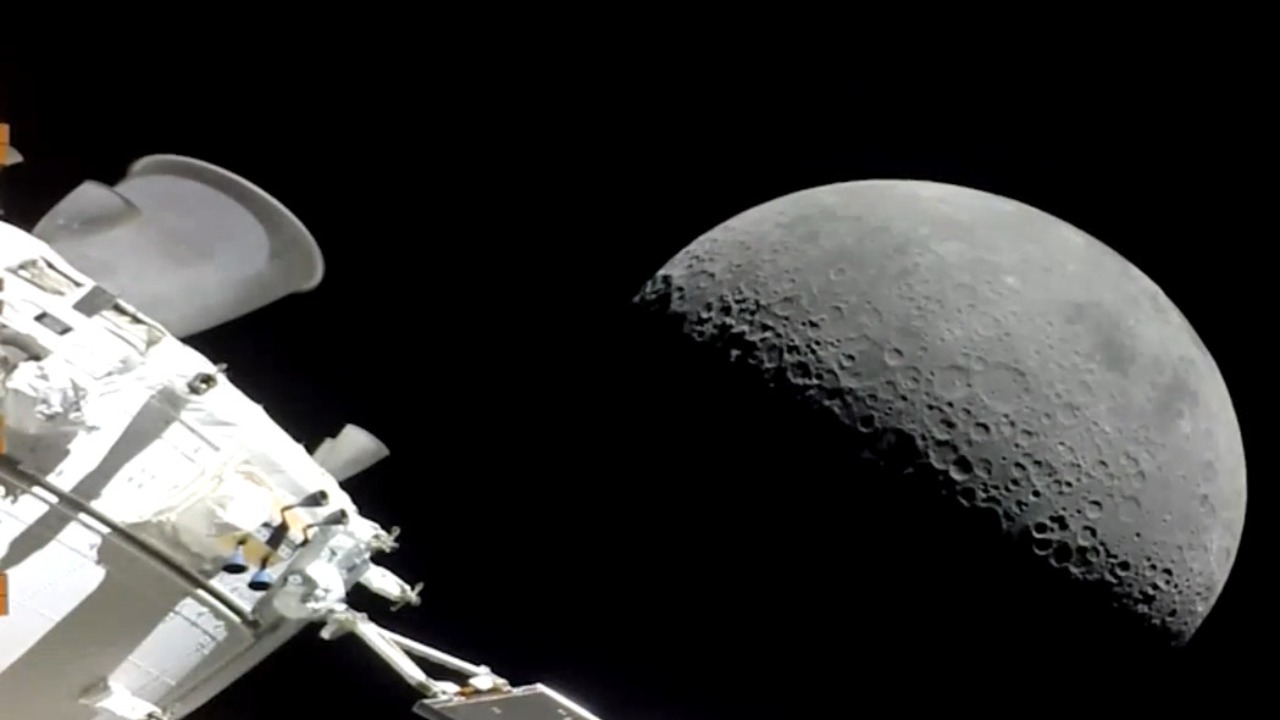

Spaceflight planners are treating 2026 as a pivot year, with six headline missions that range from NASA’s push back to the moon to the first heavy-lift launches of a new generation of commercial rockets. Together, these flights are meant to prove that lunar landings, asteroid exploration and fully reusable super-heavy launchers are no longer distant ambitions but near-term milestones. I will walk through the six missions that, taken together, show how quickly the landscape is shifting from government-led exploration to a mixed ecosystem of national agencies and powerful private launch providers.
1. NASA’s Artemis Moon Mission
NASA’s Artemis Moon Mission is framed as the agency’s first human moon mission in more than 50 years, a return to crewed lunar exploration that several previews of six major 2026 launches describe as a defining event for the year. The mission is designed to move beyond a simple repeat of Apollo, using the Space Launch System and Orion spacecraft to test long-duration operations in lunar orbit and, if schedules hold, support a landing architecture that can be reused for later flights. Reporting on the broader 2026 lineup stresses that this is not an isolated stunt but part of a sustained program that aims to establish a presence on and around the moon, with Artemis flights feeding into future lunar infrastructure and, eventually, Mars planning. By explicitly calling it the first human moon mission in more than 50 years, planners are signaling both the historical break since Apollo 17 and the political stakes of proving that the United States can still mount complex deep-space expeditions.
In practical terms, the 2026 Artemis mission is expected to validate life-support systems, navigation techniques and mission control procedures that will be reused across multiple flights, which is why it appears at the top of lists of 6 spaceflights ahead in 2026. The mission also sits at the center of a web of commercial contracts, from lunar lander providers to spacesuit manufacturers, so its success or delay will ripple through the entire industrial base. I see this as a test not only of NASA’s technical readiness but of its ability to coordinate a complex public-private ecosystem, where schedule slips or cost overruns can quickly become political flashpoints. If Artemis flies close to plan, it will strengthen the case for continued investment in deep-space exploration; if it stumbles, critics will question whether a program of this scale can stay on track in an era of tight budgets and fast-moving commercial competitors.
2. Commercial Moon Landings
Commercial Moon Landings in 2026 are positioned as a parallel track to NASA’s crewed efforts, with uncrewed lunar touch-downs by private companies aiming to demonstrate that the moon can be a regular destination for robotic payloads. Overviews of upcoming lunar activity describe multiple missions that are expected to deliver instruments, technology demonstrations and possibly resource-prospecting hardware to the surface, treating these flights as part of a broader wave of moon landings and new telescopes that will define the year. The commercial landers are typically smaller than NASA’s human-rated systems, but they are built to fly more often, with standardized interfaces that allow universities, space agencies and companies to buy lunar access as a service. That shift, from bespoke national missions to recurring commercial flights, is one reason these landings are treated as a major storyline rather than a side note.
From a policy and business perspective, the 2026 commercial landings are a test of whether lunar operations can support a sustainable market instead of relying entirely on government grants. Companies planning these missions are betting that science payloads, technology tests and early resource surveys will generate enough demand to keep their landers flying, especially if they can coordinate with larger programs like Artemis. I view the 2026 flights as a proof-of-concept for that model: if landers touch down successfully, deliver their cargo and return usable data, they will strengthen the argument that the moon can support recurring commercial services. If they fail in large numbers, investors and policymakers may decide that lunar operations are still too risky for private capital, slowing the transition toward a more diversified lunar economy.
3. Asteroid Sample Return Mission
The Asteroid Sample Return Mission slated for 2026 is highlighted alongside lunar projects as one of the most scientifically ambitious flights of the year, with planners emphasizing that it will collect and return material from a small body to laboratories on Earth. Coverage of upcoming exploration efforts groups this mission with other asteroid missions and deep-space flights, underscoring how it fits into a broader push to understand the building blocks of the solar system. By bringing pristine samples back, rather than relying only on remote sensing, scientists can measure isotopic ratios, organic compounds and mineral structures with far greater precision than any spacecraft instrument can achieve in situ. That level of detail is crucial for testing theories about how water and complex molecules reached Earth, and for comparing different asteroid families to see how they evolved.
Operationally, a 2026 sample return requires a tightly choreographed sequence of maneuvers, from rendezvous and surface interaction to departure, cruise and reentry, which is why it is treated as a flagship robotic mission rather than a routine flyby. The spacecraft must survive low-gravity operations around an irregularly shaped body, secure material without contaminating it, and then deliver a capsule safely through Earth’s atmosphere to a recovery team. I see this as a high-stakes rehearsal for future resource utilization, because the same navigation and sampling techniques could eventually be adapted for mining water or metals from near-Earth objects. Success would not only expand our scientific understanding but also strengthen the case that asteroids can be practical targets for exploration and, eventually, commercial activity; failure would remind planners how technically unforgiving small-body operations can be, potentially slowing follow-on missions.
4. SpaceX Starship Orbital Test
The SpaceX Starship Orbital Test planned for 2026 is framed as a key step toward fully reusable super-heavy launch capability, with reporting on upcoming missions noting that Elon Musk’s company intends to launch new Starship flights in the 2026 lineup. Starship is designed as a two-stage system that can lift large payloads to orbit and beyond, then return both stages for refurbishment, a model that, if it works at scale, could dramatically lower the cost per kilogram to space. The 2026 orbital test is expected to focus on reaching a stable orbit, demonstrating controlled reentry profiles and gathering data on thermal protection and structural loads. Because Starship is also integrated into NASA’s lunar plans as a potential lander, its progress is closely watched by government program managers as well as commercial customers.
From my perspective, the stakes of the 2026 orbital test go beyond a single company’s ambitions. If Starship can reliably reach orbit and begin partial reuse, it will pressure competitors to accelerate their own heavy-lift and reusability roadmaps, reshaping the economics of satellite deployment, deep-space missions and even point-to-point transport concepts. The test also carries regulatory and environmental implications, since repeated launches of a very large vehicle from coastal sites require careful coordination with aviation, maritime traffic and local communities. A successful flight would validate years of incremental testing and support arguments that aggressive iteration can deliver breakthroughs in launch capability; a major failure, by contrast, could trigger tighter oversight and raise questions about whether such a large fully reusable system can be operated safely at the cadence its designers envision.
5. Starship Flight 10 from Starbase
Starship Flight 10 from Starbase, Texas, is singled out in launch previews as a pivotal test that sets the stage for more ambitious 2026 operations, with coverage noting that SpaceX is trying for a third time to launch this specific flight from its Gulf Coast site. The live updates on Starship Flight 10 preparations describe how teams at Starbase, Texas, have had to work through technical issues and regulatory checks before attempting another liftoff. Flight 10 is not just another test in a long series; it is treated as a benchmark for whether the company can translate early experimental flights into more repeatable operations. The vehicle’s performance, from ascent through stage separation and any attempted recovery maneuvers, will feed directly into decisions about how aggressively to scale up launch cadence and how quickly to transition from prototypes to more production-like hardware.
In the broader context of 2026 spaceflight, I see Flight 10 as a bridge between the early, high-risk phase of Starship development and the more operational role the vehicle is expected to play in lunar and commercial missions. The fact that it has required multiple launch attempts underscores how challenging it is to field a rocket of this size, but it also shows the company’s willingness to iterate rapidly in the face of setbacks. For stakeholders such as NASA, which is counting on Starship for elements of its lunar architecture, and for satellite operators considering very large payloads, the outcome of Flight 10 will be a concrete data point on reliability and turnaround time. A clean flight profile would support plans to integrate Starship into the 2026 manifest more deeply; a problematic one could force schedule adjustments and prompt a reassessment of how quickly the vehicle can move from experimental to operational status.
6. Blue Origin New Glenn Debut
The Blue Origin New Glenn Debut is another headline event in 2026, with overviews of the year’s six big missions highlighting that Blue Origin will join NASA and SpaceX in fielding a heavy-lift rocket. One detailed preview of six spaceflights ahead in 2026 notes that the lineup includes launches involving organizations like Blue Origin, underscoring how New Glenn is expected to share the stage with NASA’s lunar missions and new Starship flights. Technical descriptions of New Glenn explain that it is scheduled to launch Blue Origin’s Blue Moon Mark 1 lunar lander on robotic missions planned for early 2026 and late 2027, positioning the rocket as both a commercial launcher and a key part of the company’s own lunar strategy. By pairing a reusable first stage with a large payload fairing, New Glenn is designed to compete directly in the heavy-lift market that has so far been dominated by a small number of vehicles.
Strategically, I view the New Glenn debut as a turning point in the competition among large launch providers. With New Glenn entering service alongside vehicles like Vulcan and Starship, the market for high-mass payloads will have more redundancy and pricing pressure, which could benefit satellite operators, government agencies and international partners looking for reliable access to orbit and beyond. Discussions of upcoming variants, including references to New Glenn and Vulcan in the context of Starship’s twelfth flight test targeted for the first quarter of 2026, suggest that Blue Origin is already thinking about how to evolve the design once the initial configuration proves itself. If the debut flight performs well, it will validate years of investment and give Blue Origin a credible platform for both commercial contracts and its own Blue Moon Mark missions; if it encounters serious issues, the delay could open more room for rivals to consolidate their positions in the heavy-lift segment just as demand for large constellations and deep-space probes is accelerating.
More from MorningOverview