
The third known visitor from another star system, 3I/ATLAS, has already delivered on one of the biggest promises in modern astronomy: a chance to treat an interstellar object as a potential alien probe and check, carefully, if anyone out there is trying to talk. As it swept past the inner solar system, radio telescopes on Earth locked on and combed its surroundings for artificial signals. The scans are now complete, and while they did not reveal extraterrestrial technology, they have quietly reset expectations for how we search the next interstellar wanderer.
I see the 3I/ATLAS campaign as a turning point, less for what it failed to find than for how systematically it looked. The observing teams treated the object as both a natural comet and a hypothetical spacecraft, building a template for future technosignature hunts that will be ready the next time a strange object appears on our sky surveys.
What exactly is 3I/ATLAS?
3I/ATLAS is the official designation for the third interstellar object ever discovered passing through our solar system, following 1I/ʻOumuamua and 2I/Borisov. Astronomers first picked it up on July 1, 2025, and quickly realized that its trajectory could not be explained by a bound orbit around the Sun, which marked it as a visitor from beyond our local planetary family. The “3I” tag flags it as the third such interstellar body, while “ATLAS” refers to the survey system that spotted it, a wide-field sky scanner that has become one of the workhorses of near-Earth object discovery.
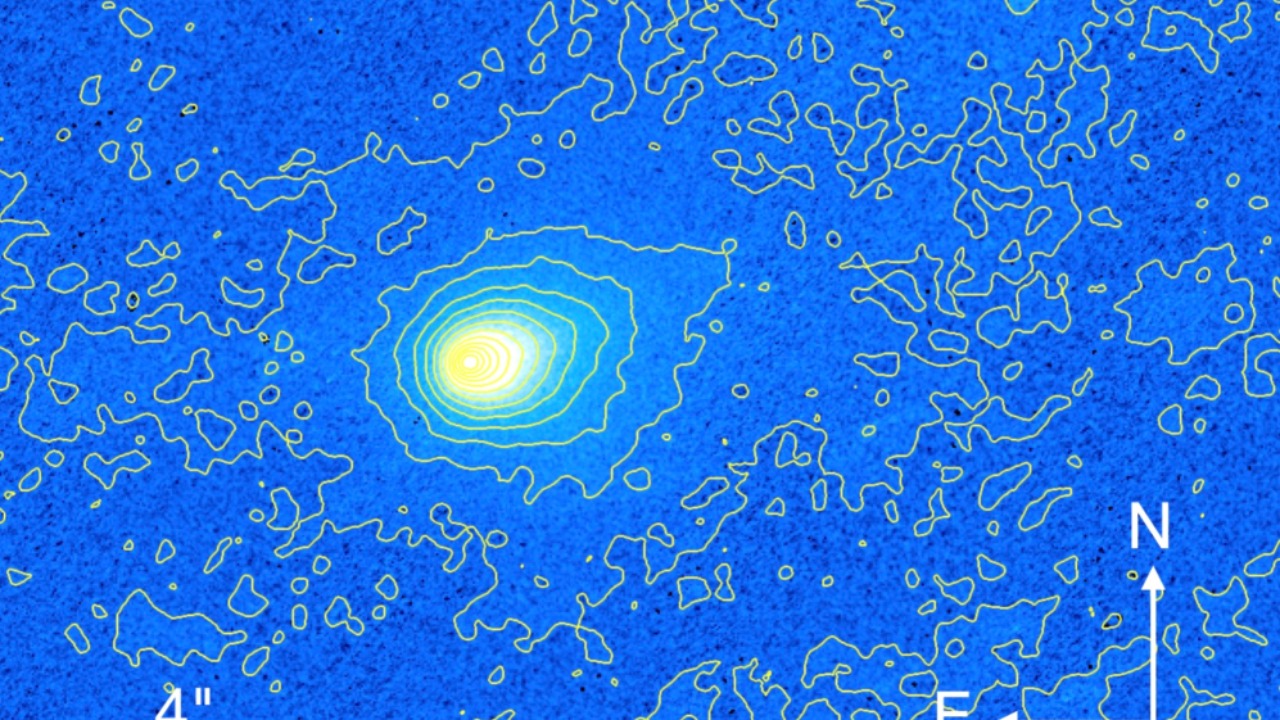
From the start, 3I/ATLAS looked more like a comet than a bare rock, with a diffuse appearance and behavior consistent with ices warming and venting gas as it approached the Sun. In technical writeups, researchers describe it as an interstellar comet, a label that reflects both its origin and its physical character. One detailed overview of the object notes that the interstellar object 3I/ATLAS was discovered on July 1, 2025, and that there is currently no evidence to suggest that it is anything other than a natural body.
Why astronomers rushed to scan it for aliens
Once astronomers confirmed that 3I/ATLAS came from another star system, the object instantly became a prime target for technosignature searches. The logic is straightforward: if any civilization in the galaxy is sending out probes or beacons, interstellar comets and asteroids passing through planetary systems are natural checkpoints where we might detect their presence. The earlier cases of 1I/ʻOumuamua and 2I/Borisov had already sparked debates about alien technology, so by the time this third visitor arrived, the scientific community was determined to gather more systematic data.
The urgency only increased as 3I/ATLAS approached its closest point to Earth. During that window, the object came within about 167 million miles of our planet, a distance that made it bright enough and close enough for sensitive radio telescopes to study in detail. One account of the observing campaign notes that, as the visitor made its closest approach to Earth, coming within just 167 m, an international team coordinated a search for artificial signals. I see that coordination as a sign of how quickly technosignature science has matured since the first interstellar object was spotted less than a decade ago.
Breakthrough Listen and the “big dish” strategy
To turn 3I/ATLAS into a real test of the alien-probe idea, astronomers leaned on one of the most ambitious SETI efforts currently running: Breakthrough Listen. The project specializes in using large radio telescopes to scan nearby stars and unusual objects for narrowband signals that nature is unlikely to produce. For 3I/ATLAS, the team brought in what one report aptly described as “Breakthrough Listen Brings In the Big Dish,” a reference to the use of a 100 meter class instrument that could collect faint radio whispers from deep space.
That “big dish” was the Green Bank Telescope, often shortened to GBT, which is the world’s largest fully steerable radio telescope. As part of the Breakthrough Listen program, astronomers used the 100-m instrument to scan 3I/ATLAS across a wide range of frequencies, looking for any sign of an artificial transmission. The decision to commit such a powerful facility to a single comet underscores how seriously the community now takes the possibility that interstellar objects might carry or conceal technology.
How close the Green Bank Telescope got to the visitor
Even the best telescope is only as useful as the geometry of the encounter allows, and in this case the geometry was unusually favorable. The Green Bank Telescope tracked 3I/ATLAS when it was roughly 167 million miles from Earth, a distance that, in cosmic terms, is close enough to treat the object almost like a nearby asteroid. That proximity meant that any moderately strong transmitter on or near the comet would have been detectable, at least in principle, by the sensitive receivers at Green Bank.
Reports on the campaign emphasize that GBT scanned 3I/ATLAS from a distance of about 167 m, or 269 million kilometers, and that the observations spanned a broad swath of the radio spectrum. In practical terms, that meant the team could probe for everything from narrowband “hello world” style beacons to more complex, broadband emissions that might leak from a spacecraft’s onboard systems. I read that choice of frequencies as a deliberate attempt to avoid tunnel vision about what alien technology might look like.
What the Breakthrough Listen data actually show
Once the observing runs wrapped up, the harder work began: combing through terabytes of data for any sign that 3I/ATLAS was more than a lump of ice and rock. The Breakthrough Listen team applied their standard technosignature pipeline, which is designed to flag narrowband spikes, drifting tones, or repeating patterns that could indicate an artificial origin. They also cross checked candidate signals against known sources of interference, from satellites to terrestrial transmitters, to avoid mistaking human noise for alien engineering.The result, after all that filtering, was stark in its simplicity. The analysis reports that there is currently no evidence to suggest that 3I/ATLAS is an artificial object, and that no credible technosignatures were found in any of the searches. One summary of the work notes that 3I/ATLAS was also observed with radio telescopes as part of Breakthrough Listen, and that the team did not detect any artificial radio signals at the distance to 3I/ATLAS. From a scientific standpoint, that null result is still a result, because it lets researchers place quantitative limits on the kinds of transmitters that could be hiding there undetected.
Independent checks and the “no technosignatures” verdict
Breakthrough Listen was not the only group watching. Other teams carried out their own analyses of the radio data and the comet’s physical behavior, looking for any anomalies that might hint at technology. These efforts converged on the same basic conclusion: 3I/ATLAS behaves like a natural interstellar comet, with no obvious signs of artificial modification or control. That consensus matters, because it reduces the chance that a single pipeline or instrument bias is hiding something important.
One detailed discussion of the observing campaign describes the Results of the technosignature search and notes that the study reported “no credible detections” of artificial radio signals. Another account, summarizing the broader effort, quotes scientists stating plainly that “no techno signatures were detected” while testing 3I/ATLAS for signs of alien technology. In that piece, the authors stress that Scientists see the work as a template for future searches for extraterrestrial signals, not as the end of the story.
What the comet itself reveals about alien engineering
Radio silence is one thing, but if 3I/ATLAS were a disguised probe, we might also expect to see physical oddities: sharp edges, metallic glints, or unnatural jets of material. Observers therefore paid close attention to the comet’s brightness, shape, and outgassing behavior as it moved through the inner solar system. The data so far show a diffuse, dusty coma and tail consistent with volatile ices sublimating in sunlight, with no obvious geometric structures or repeating patterns in the light curve that would suggest rotating machinery.
A detailed overview of the object’s physical properties concludes that the interstellar comet shows no signs of extraterrestrial technology. That assessment notes that Interstellar comet 3I/ATLAS has been monitored for unusual emissions or structures, and that no artificial features, such as reflective panels or engineered vents on its surface, have been detected. Taken together with the radio results, that picture strongly favors a natural origin, even if it cannot absolutely rule out more subtle forms of engineering.
How 3I/ATLAS fits into the growing catalog of interstellar visitors
With three interstellar objects now on the books, patterns are starting to emerge. 1I/ʻOumuamua was famously odd, with its elongated shape and non gravitational acceleration, which led some to speculate about alien sails or probes. 2I/Borisov, by contrast, looked like a fairly ordinary comet that just happened to come from another star. 3I/ATLAS seems to fall closer to the Borisov side of that spectrum, a dusty, outgassing body whose behavior can be explained without invoking technology.
That does not make 3I/ATLAS boring. Instead, it gives astronomers a baseline for what a “typical” interstellar comet might look like, and it helps calibrate expectations for future technosignature searches. One summary of the observing campaign notes that the interstellar comet 3I/ATLAS has been studied across multiple wavelengths and that no artificial radio signals or engineered structures have been found on its surface. In parallel, the Breakthrough Listen team’s own project page on ATLAS lays out how they integrated these observations into a broader strategy for scanning interstellar objects, treating each new visitor as both a scientific target and a potential messenger from another civilization.
Why a “no aliens” result still matters for the search
It is tempting to treat the absence of technosignatures from 3I/ATLAS as a disappointment, but I think that misses the deeper value of the campaign. Every carefully executed null result tightens the constraints on what kinds of alien technology could be present, and it forces researchers to refine their tools and assumptions. In this case, the teams involved have shown that they can mobilize large facilities quickly, coordinate across institutions, and process complex data streams in near real time as an interstellar object races past.
Those capabilities will be crucial when the next, perhaps stranger, visitor arrives. The methods honed on 3I/ATLAS, from the use of the 100 meter class Green Bank Telescope to the multi wavelength checks for physical anomalies, are now part of a playbook that can be applied to future objects. As one technical summary of the work puts it, there is currently no evidence to suggest that 3I/ATLAS is artificial, and no credible technosignatures were detected in any of these searches. That conclusion, grounded in coordinated observations and careful analysis, is less a closed door than a rehearsal for the day when the data finally point in a different direction.
More from MorningOverview