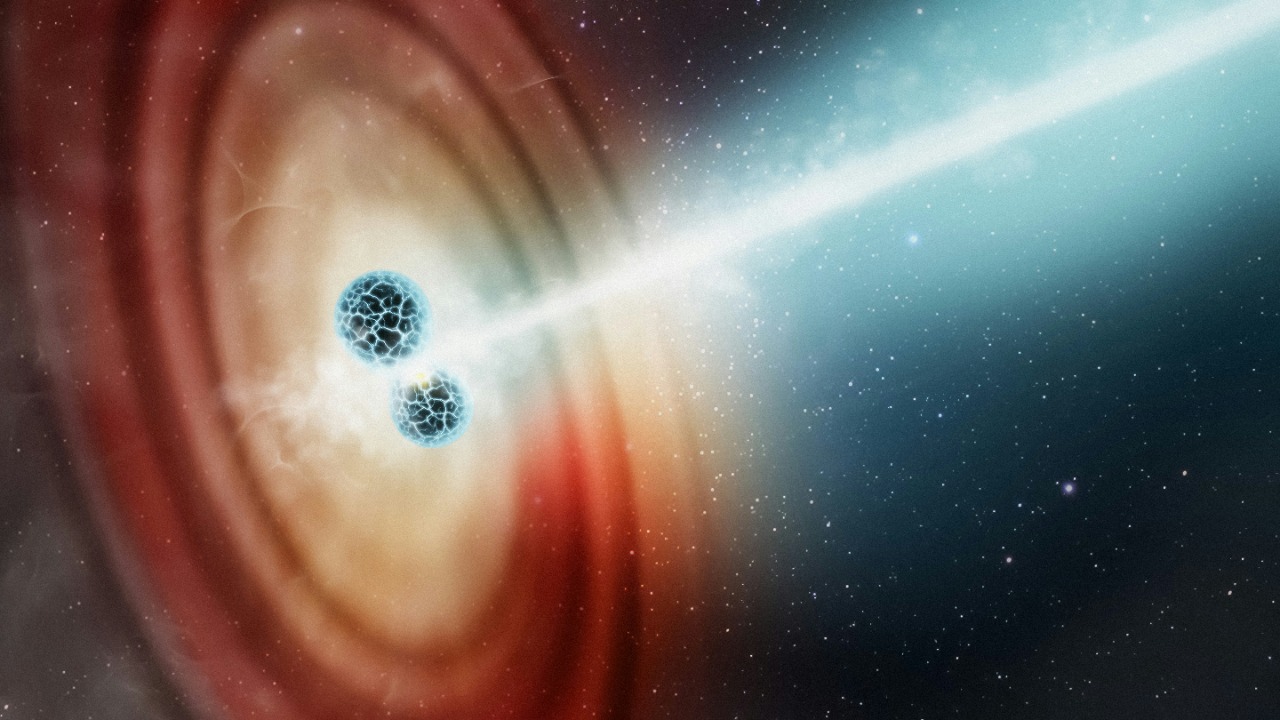

Three supermassive black holes igniting at once in a single system is one of the most extreme feeding frenzies the universe can stage, and recent observations show that this is happening during a rare triple-galaxy smash. Astronomers see all three black holes gorging on infalling gas at the same time, turning the collision of galaxies into a laboratory for watching gravity, radiation, and galaxy evolution intersect in real time.
The Simultaneous Feasting of Three Black Holes
The simultaneous feasting of three black holes is the central drama in this rare triple-galaxy smash, and the defining feature is that all three supermassive black holes are actively gorging at once rather than taking turns. In the system described as three black holes gorging simultaneously in colliding galaxies, each black hole sits in the core of its own galaxy, yet the ongoing merger has funneled so much gas and dust toward the centers that all three have lit up together as powerful accretion engines. Instead of a quiet gravitational dance, the scene is dominated by blazing active galactic nuclei, where matter spirals inward, heats to extreme temperatures, and releases torrents of radiation before crossing the event horizon. The fact that all three are in this active state at the same time shows that the environment is saturated with fuel, and that the dynamics of the merger are efficiently driving material into the deepest parts of the shared gravitational well. For observers, this triple ignition turns what might have been a faint, distant system into a beacon that can be dissected across multiple wavelengths, from X-rays to radio, revealing how each black hole is carving out its own feeding channel inside the larger collision.
What makes this triple feast so striking is how it pushes beyond the already rare cases where two supermassive black holes are seen feeding together. Astronomers have previously identified a rare pair of actively feeding supermassive black holes, or quasars, that are on the verge of colliding, a discovery described as a black hole brawl because both quasars are simultaneously devouring gas as their host galaxies close in. That binary system is already unusual, since it requires two massive galaxies, each with a central black hole, to be caught in the brief window when both are lit up as quasars before they merge. A triple system raises the stakes further, because three separate galactic cores must all retain enough gas, and be driven inward at the right pace, for their black holes to ignite together. The result is a gravitationally bound trio of engines that can stir the surrounding gas, launch powerful jets, and potentially seed future gravitational wave events when their orbits decay. For cosmologists and galaxy-evolution modelers, the stakes are high: a triple feast offers a stress test for theories about how often such systems form, how efficiently mergers trigger accretion, and how feedback from multiple active black holes at once can regulate or even quench star formation in the tangled remnant that will eventually emerge from the smash.
The Role of Colliding Galaxies in Triggering the Phenomenon
The role of colliding galaxies in triggering the phenomenon of three black holes igniting at once is fundamental, because without the violent interaction between galaxies, the central black holes would likely remain far quieter. When galaxies pass close enough to feel each other’s gravity, tidal forces distort their disks, stir up their gas, and drive vast streams of material inward toward their centers, a process that can ignite the universe’s most powerful black holes. Observations of colliding galaxies that ignite the universe’s most powerful black holes show that these interactions are especially effective at creating bright, rapidly growing active galactic nuclei, because the disturbed gas loses angular momentum and plunges toward the central regions. In the triple-galaxy smash where three black holes gorge simultaneously, the same physics is at work, but multiplied: each galaxy brings its own reservoir of gas, and the combined gravitational chaos channels material into all three cores. Instead of a single inflow funneling gas to one black hole, the merger geometry can create multiple inflow streams, each feeding a different nucleus, which explains why all three can be active at the same time. This makes the collision not just a backdrop but the engine that powers the entire event, turning a quiet group of galaxies into a single, blazing multi-core system.
Evidence that colliding galaxies create especially bright and fast-growing black holes comes from detailed studies of systems where the merger is already under way and the central engines are flaring. In such systems, researchers find that colliding galaxies create the brightest, fastest growing black holes at their centers, with the active galactic nuclei outshining the combined starlight of their hosts and growing at rates that are difficult to sustain in isolated galaxies. The key detail is that these entities are explicitly identified as “Colliding,” underscoring that the interaction itself is the trigger for the extreme accretion. In the context of the triple-galaxy smash, this pattern suggests that each of the three galaxies is contributing to a shared reservoir of disturbed gas, and that the overlapping tidal forces are repeatedly shocking and compressing that gas as the galaxies interpenetrate. For stakeholders who build models of galaxy evolution, this means that mergers cannot be treated as simple pairwise events, because multi-galaxy collisions can produce compounded feeding episodes where several black holes grow rapidly at once. For observers planning future surveys, it also implies that targeting regions where multiple galaxies are clearly interacting may be the most efficient way to uncover additional triple or even higher-order systems, which would refine estimates of how often such extreme feeding frenzies shape the growth of the most massive black holes.
Implications of This Rare Triple Black Hole Ignition
The implications of this rare triple black hole ignition reach far beyond the spectacle of three luminous cores blazing inside colliding galaxies, because the event provides a unique test case for how black holes and galaxies coevolve. In the system where three black holes gorge simultaneously in colliding galaxies, each black hole is not only growing by swallowing gas but also flooding its surroundings with energy in the form of radiation, winds, and possibly jets. When three such engines operate at once, their combined feedback can heat and expel gas from the central regions, potentially shutting down future star formation or redistributing material into extended halos. This makes the triple ignition a natural laboratory for studying how feedback scales when multiple active galactic nuclei share the same environment, and whether their overlapping outflows reinforce or interfere with each other. For theorists, the configuration offers a stringent benchmark for simulations that attempt to track the growth of supermassive black holes during complex mergers, because any successful model must reproduce not just one active nucleus but three, all triggered within the same dynamical event. For observers, the system hints that some of the brightest, most chaotic regions in deep surveys may hide multiple black holes rather than a single dominant quasar, which has direct consequences for how accretion histories are reconstructed from integrated light.
There are also long-term stakes tied to the eventual fate of the three black holes once the galactic smash settles into a single remnant. As the galaxies merge more completely, dynamical friction and gravitational interactions with surrounding stars and gas will cause the black holes to sink toward a common center, where they can form bound pairs and, ultimately, coalesce. Earlier discoveries of a rare quasar pair on the verge of colliding, described as a black hole brawl, already highlight how such mergers can become powerful sources of gravitational waves when the black holes spiral together. A triple system raises the possibility of sequential or even hierarchical mergers, where two black holes combine first and the remnant later merges with the third, producing a series of gravitational wave events that future space-based detectors could, in principle, detect. For the broader field of galaxy evolution, this means that rare triple ignitions are not just curiosities but potential signposts of the most massive black holes in the universe assembling through repeated mergers. For stakeholders designing next-generation observatories, from X-ray telescopes to gravitational wave missions, systems like this triple-galaxy smash help define the most extreme targets they must be able to study, because understanding how three black holes ignite and eventually merge in a single collision is central to explaining how the universe built its largest gravitational anchors.
More from MorningOverview