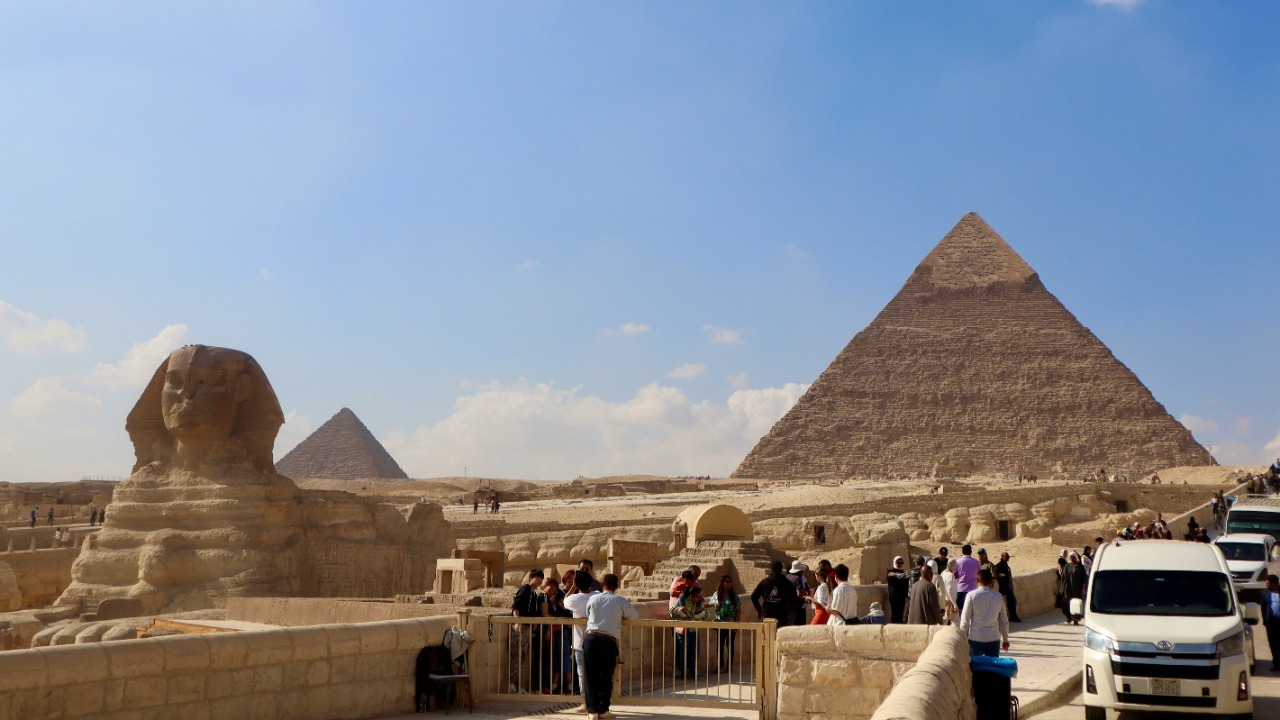

The Great Pyramid of Giza is often treated as a monument of stone, but it also functions as a monument of numbers. I see at least fifteen tightly documented geometric and astronomical puzzles embedded in its dimensions, alignments, and internal spaces, each grounded in careful measurement rather than legend. Taken together, these features show how Khufu’s builders turned a royal tomb into a vast, silent workbook of ancient mathematics.
1. The Pi-Proportion Perimeter
The Pi-Proportion Perimeter begins with two hard numbers: a base perimeter of 921.6 meters and an original height of 146.6 meters. When I divide the perimeter by the height, I get a ratio of about 6.285, which is strikingly close to 2π, or 6.2832, as documented in Egyptian pyramid measurements. This means that if the height is treated as the radius of a circle, the perimeter approximates that circle’s circumference.
For historians of science, this raises the question of whether Old Kingdom architects intentionally encoded a circle-square relationship in the pyramid’s outline or whether the match is a coincidence of practical design. Either way, the ratio forces modern researchers to confront the level of geometric insight available to Khufu’s surveyors and stonecutters, and it keeps the Great Pyramid central to debates about early approximations of π.
2. Golden Ratio in the Slant
The Golden Ratio in the Slant appears when I look at a cross-section from the pyramid’s center. Half the base length is 115.16 meters, and the apothem, or slant height from the base midpoint to the apex, is about 186.43 meters. Dividing apothem by half-base gives roughly 1.618, the golden ratio φ, as set out in detailed dimensional studies. In geometric terms, the triangle formed by half-base and apothem behaves like a golden triangle.
This proportion has long fascinated architects and artists because φ appears in growth patterns and later classical design. If the ratio in the Great Pyramid is deliberate, it suggests that Khufu’s builders were manipulating harmonious rectangles and triangles centuries before Greek mathematical texts. Even if it emerged from structural or aesthetic rules of thumb, the near-perfect match keeps the monument at the center of discussions about how ancient designers perceived “ideal” proportions.
3. Near-Perfect Cardinal Alignment
The Near-Perfect Cardinal Alignment puzzle starts with the fact that the Great Pyramid’s sides deviate from true north by only about 3 arcminutes, or 0.05 degrees. Precise surveys summarized in orientation analyses show that no other known ancient structure matches this level of cardinal accuracy. Each side tracks the compass directions so closely that the errors are barely measurable without modern instruments.
To achieve this, the builders had to solve practical problems in observational astronomy and long-distance surveying, likely using stellar references and repeated sighting baselines. For modern engineers and archaeologists, the alignment is a benchmark for pre-instrument precision, forcing any theory of pyramid construction to account for how teams working with simple tools could consistently transfer angular measurements across a 230-meter base.
4. Matching Passage Angles
The Matching Passage Angles inside the pyramid create a subtle internal symmetry. Both the descending passage and the ascending passage share the same measured inclination of 26 degrees 31 minutes 23 seconds, a match recorded in detailed architectural surveys. This is not a rough similarity but an exact duplication of angle, carried through many meters of narrow corridor.
Maintaining that angle in two different directions required careful control of slope during excavation and construction, especially given the confined working space. For researchers, the twin inclinations suggest that the passages were conceived as a single geometric system rather than ad hoc tunnels, which has implications for how we interpret their ritual or symbolic roles and for how we model the sequencing of the pyramid’s internal engineering.
5. Steep Grand Gallery Rise
The Steep Grand Gallery Rise adds another layer to the pyramid’s internal geometry. The Grand Gallery climbs at 26 degrees 18 minutes 9 seconds over a length of 46.68 meters, according to precise measurements of the interior. This long, narrow space is roofed with a corbelled vault, where each course of stone projects slightly inward, creating a stepped ceiling that follows the same overall incline.
From a mathematical standpoint, the gallery’s angle sits close to that of the main passages but is not identical, hinting at a deliberate differentiation in function or load distribution. For structural engineers, the combination of a consistent slope and carefully spaced corbels shows that the builders were managing both geometry and stress paths, turning the gallery into a case study in how ancient designers balanced ritual procession routes with the need to channel the weight of millions of tons of masonry.
6. Cubit-Based Chamber Ratios
The Cubit-Based Chamber Ratios in the King’s Chamber reveal how the royal cubit governed interior design. The room measures 10.47 meters east-west, 5.23 meters north-south, and 5.81 meters high, which correspond to 20 by 10 by 11 royal cubits when I apply the standard 0.524-meter cubit, as detailed in construction analyses. These are not arbitrary numbers but a tight integer set that defines the chamber as a near-double cube.
Such whole-number ratios simplify layout and stone cutting, but they also invite interpretations about harmonic or symbolic proportions in royal spaces. For historians of architecture, the 20:10:11 scheme shows that the same unit that set the pyramid’s overall scale also structured its most important internal room, reinforcing the idea that Khufu’s builders treated the monument as a coherent mathematical object from base to burial chamber.
7. Cubic Coffin Volume
The Cubic Coffin Volume puzzle focuses on the granite coffer inside the King’s Chamber. Its internal dimensions are about 0.978 meters by 0.529 meters by 1.05 meters, which yield a volume close to 1.0 cubic meter, effectively one royal cubit cubed when converted using the 0.524-meter standard, as noted in detailed studies of the chamber furnishings. In other words, the coffer’s interior approximates a unit volume in the same system that defines the chamber.
For modern analysts, this suggests that the coffer was not only a sarcophagus but also a calibrated container tied to the same measuring logic as the room around it. The near-unit volume strengthens arguments that Egyptian builders were comfortable working with three-dimensional measures, and it gives researchers a rare, well-preserved reference point for testing reconstructions of the royal cubit’s exact length.
8. Massive Block Count and Volume
The Massive Block Count and Volume turn the entire pyramid into a logistical equation. Estimates compiled in engineering reconstructions put the total at about 2.3 million limestone blocks, each averaging 2.5 tons, for a combined volume of roughly 2.6 million cubic meters. These figures imply a total stone mass in the range of millions of tons that had to be quarried, transported, and set with consistent accuracy.
From a mathematical perspective, organizing that many blocks requires planning in terms of daily delivery rates, ramp capacities, and workforce allocation. For modern project managers and civil engineers, the numbers highlight that Khufu’s monument was as much a feat of large-scale resource scheduling as of geometry, forcing any credible construction theory to address not just how stones were lifted but how the entire supply chain was calculated and controlled.
9. Latitude-Speed of Light Echo
The Latitude-Speed of Light Echo is a numerical curiosity that has fueled modern speculation. The Great Pyramid stands at a latitude of 29 degrees 58 minutes 45 seconds north, a value that, when written as 29.9845 and scaled, resembles the digits 299792458, the speed of light in meters per second. This correlation is noted explicitly in discussions of pyramid alignments, which stress that it is a coincidence rather than evidence of advanced physics.
For historians of ideas, the coincidence illustrates how modern observers can project contemporary constants onto ancient works, sometimes obscuring what the builders actually knew. The echo is still useful, however, because it forces a clear distinction between documented ancient capabilities, such as precise surveying, and unverified claims about hidden scientific codes, reminding researchers to separate measurable facts from numerological pattern-hunting.
10. Geodetic Earth Scale Model
The Geodetic Earth Scale Model idea arises from comparing the pyramid’s base to Earth’s size. Each side measures about 230.33 meters, giving a perimeter that, when scaled by a factor of 1:43,200, aligns with twice the equatorial radius of Earth, approximately 20,000 kilometers, as argued in interpretations of geodetic encoding. The factor 43,200 also equals the number of arcminutes in a full circle of 360 degrees.
Supporters of this view see the pyramid as a model of Earth’s meridian, while critics caution that the match could result from retrofitting modern values to ancient dimensions. For geodesists and archaeologists, the claim underscores how closely the pyramid’s scale tracks planetary measures, but it also highlights the need for rigorous evidence before concluding that Khufu’s architects possessed a quantified model of Earth’s circumference.
11. √5 Triangle in Niche
The √5 Triangle in the Queen’s Chamber niche shows how subtle geometry appears even in secondary spaces. The chamber itself has sides of about 5.75 meters and a height of 6.23 meters, while the niche forms a right triangle with an angle of 53 degrees 8 minutes, according to careful interior surveys. That angle is characteristic of triangles related to √5 and, by extension, to golden ratio constructions.
For architectural historians, the niche’s geometry suggests that proportional thinking extended beyond the main chambers into smaller architectural details. The presence of a √5-related angle in a ritual or symbolic recess supports the idea that the same mathematical toolkit used for the pyramid’s outer form also shaped its interior articulation, giving researchers another data point when mapping how Egyptian designers combined practical layout with numerically meaningful forms.
12. Stellar Shaft Alignments
The Stellar Shaft Alignments turn narrow stone ducts into astronomical instruments. One of the air shafts from the King’s Chamber is inclined at about 45 degrees and, around 2500 BC, pointed toward α Draconis (Thuban), the then pole star, according to detailed shaft studies. This suggests that the shaft was oriented with reference to the sky rather than simply for ventilation.
For archaeoastronomers, such alignments imply that the pyramid’s internal geometry was coordinated with stellar positions and the slow precession of Earth’s axis. This has significant implications for how we date construction phases and understand royal afterlife beliefs, since a shaft aimed at a circumpolar star could symbolize an eternal celestial destination, embedding cosmological concepts directly into the building’s angular layout.
13. Subterranean Binary Steps
The Subterranean Binary Steps puzzle lies beneath the pyramid’s base. The subterranean chamber sits about 30 meters below ground level, and the passages leading to it extend roughly 100 meters in total, changing angles in a series of distinct segments that some analysts interpret as binary-like steps, as described in recent geometric interpretations. Each shift in slope creates a clear break in the passage profile.
While the idea of “binary” encoding remains interpretive, the stepped sequence itself is a measurable feature that distinguishes the lower system from the smoother main passages above. For researchers, these abrupt angular transitions raise questions about whether the subterranean works represent an earlier design phase, an abandoned plan, or a deliberate symbolic pattern, making the lower levels a key testing ground for theories that link pyramid geometry to abstract counting systems.
14. Slope’s Circle-Square Link
The Slope’s Circle-Square Link is one of the most discussed numerical features of the Great Pyramid. The outer faces rise at an angle of 51 degrees 50 minutes 40 seconds, and the tangent of this angle is close to 4 divided by π, as highlighted in analyses of sacred geometry. This means that the ratio of vertical height to half-base length approximates 4/π, again tying a square footprint to a circular constant.
For geometers, this relationship suggests that the pyramid’s profile can be read as a bridge between a square base and an implied circle, echoing the pi-like perimeter-height ratio. Whether intentional or emergent from practical slope choices, the match keeps the Great Pyramid central to debates about early attempts to “square the circle,” and it provides a precise angle that modern architects can compare with later canonical slopes in Egyptian and classical architecture.
15. Equinox Shadow Precision
The Equinox Shadow Precision connects the pyramid’s mass to the motion of the Sun. Built during the reign of Khufu, dated to about 2589 to 2566 BC, the structure incorporates roughly 5.5 million tons of stone, according to comprehensive construction estimates. Its alignment is so exact that at the equinox, the shadow of the pyramid tracks the cardinal directions with notable precision, reinforcing the link between its geometry and solar cycles.
For Egyptologists, this solar alignment supports interpretations of the pyramid as part of a broader ritual landscape tied to the Sun’s daily and yearly paths. The equinox behavior also shows that the same surveying that fixed the sides to true north was calibrated to seasonal solar positions, giving modern researchers a rare convergence of architectural, astronomical, and religious evidence in a single, measurable phenomenon.
More from Morning Overview